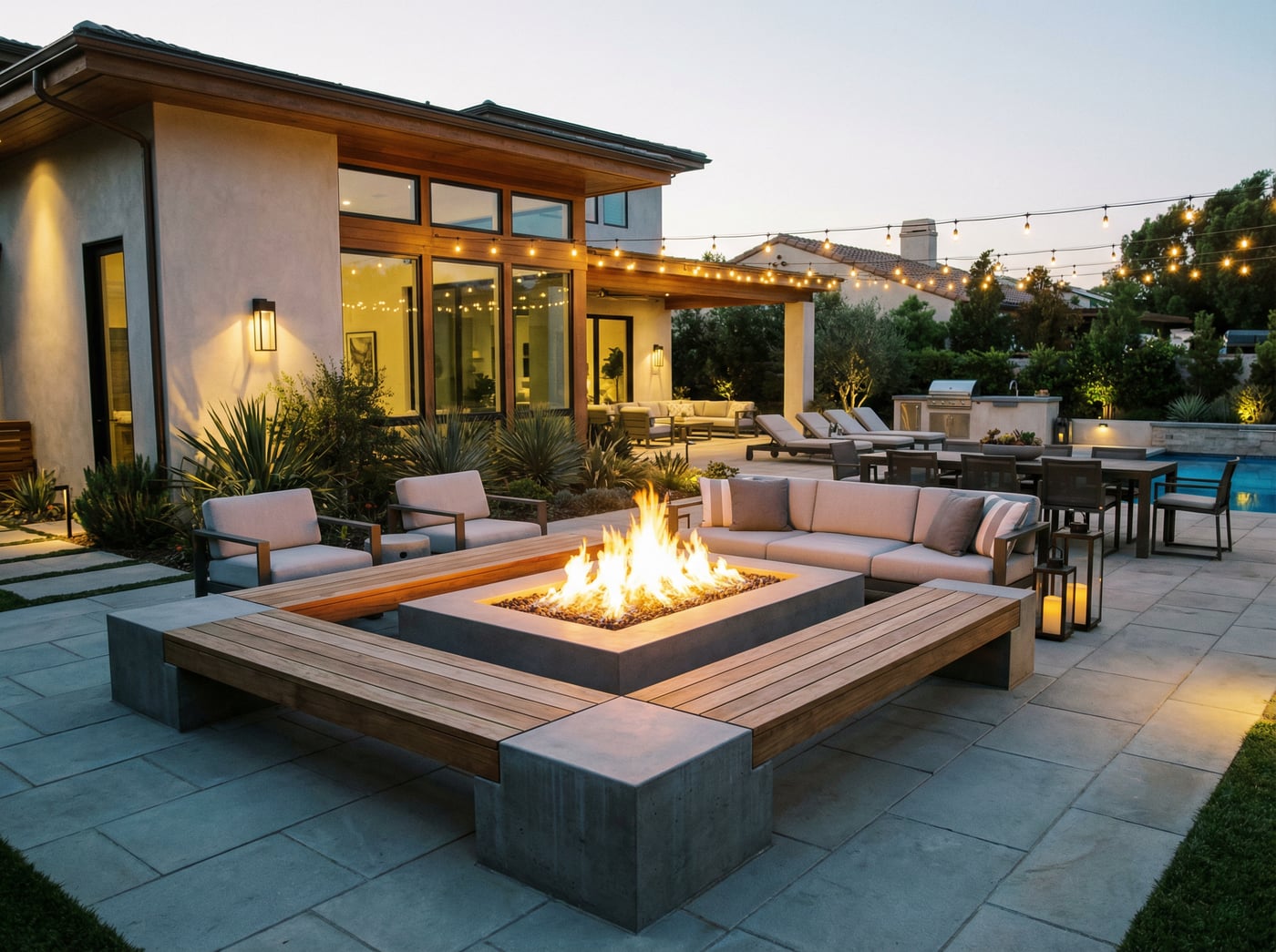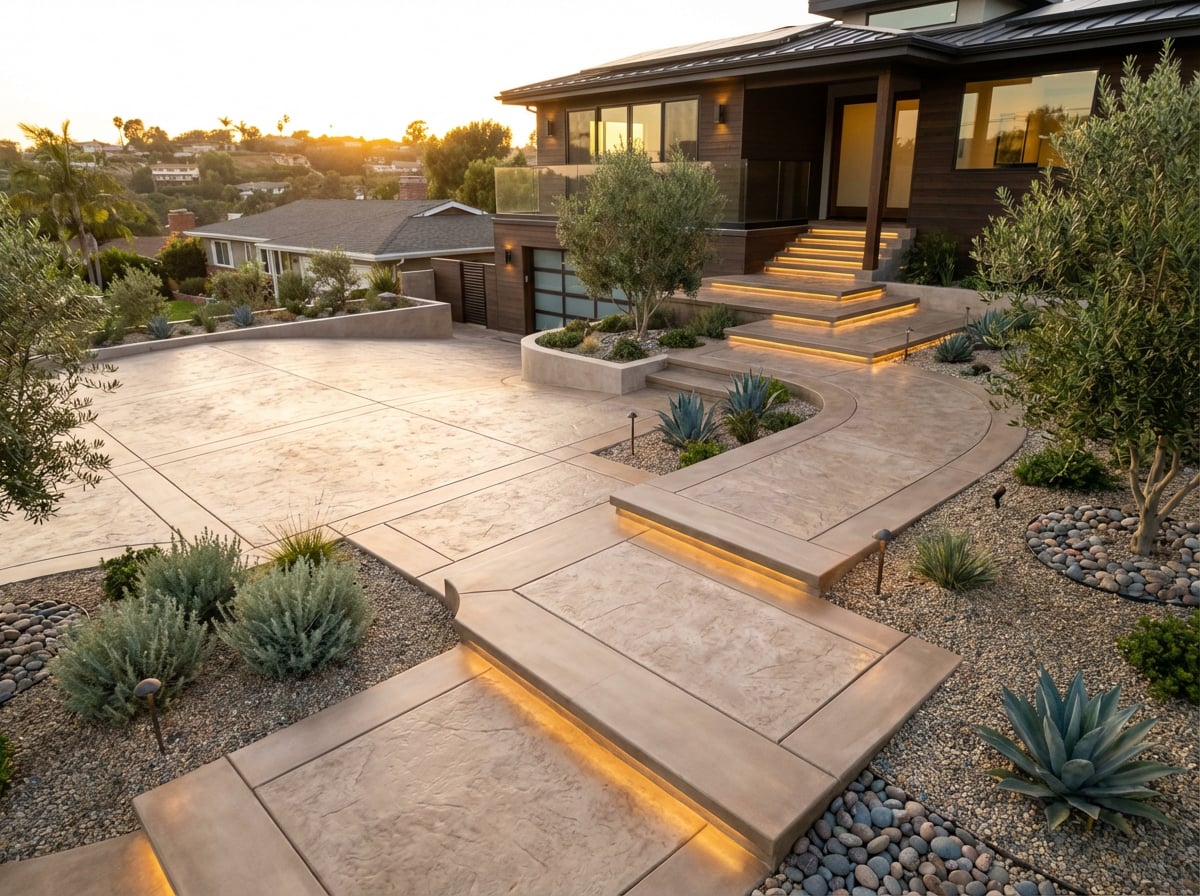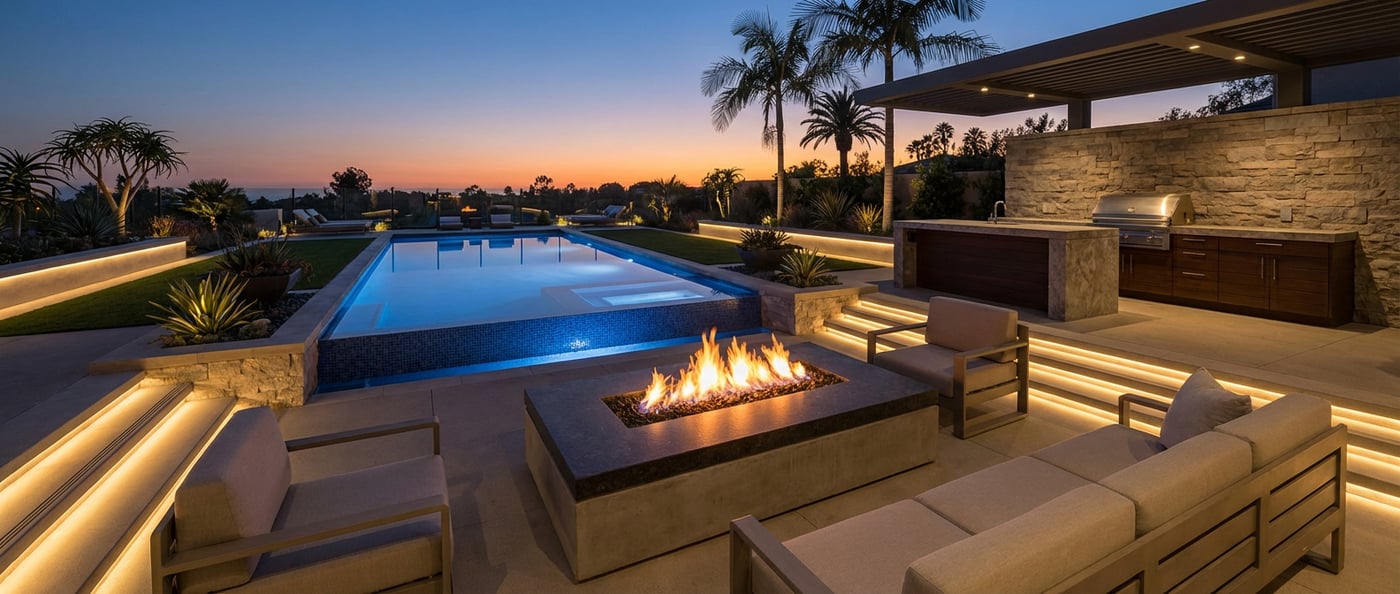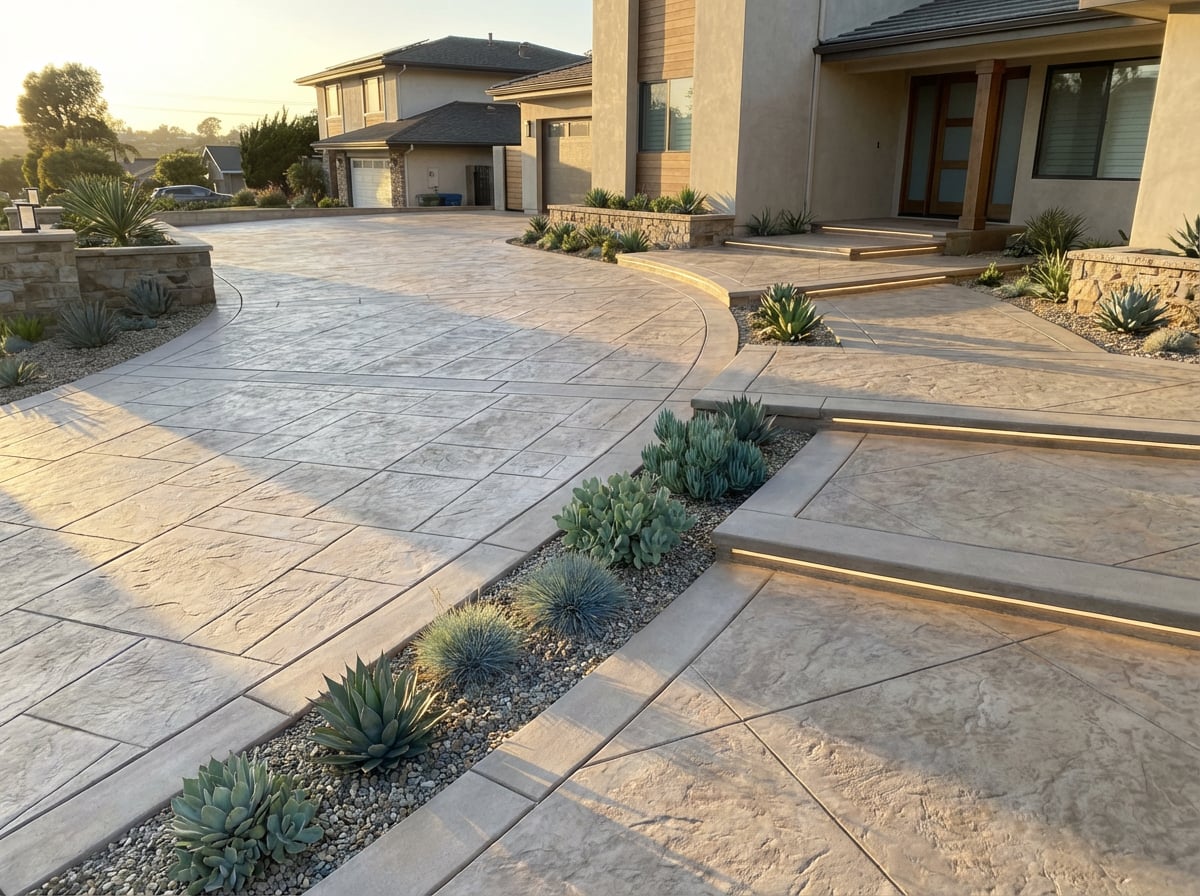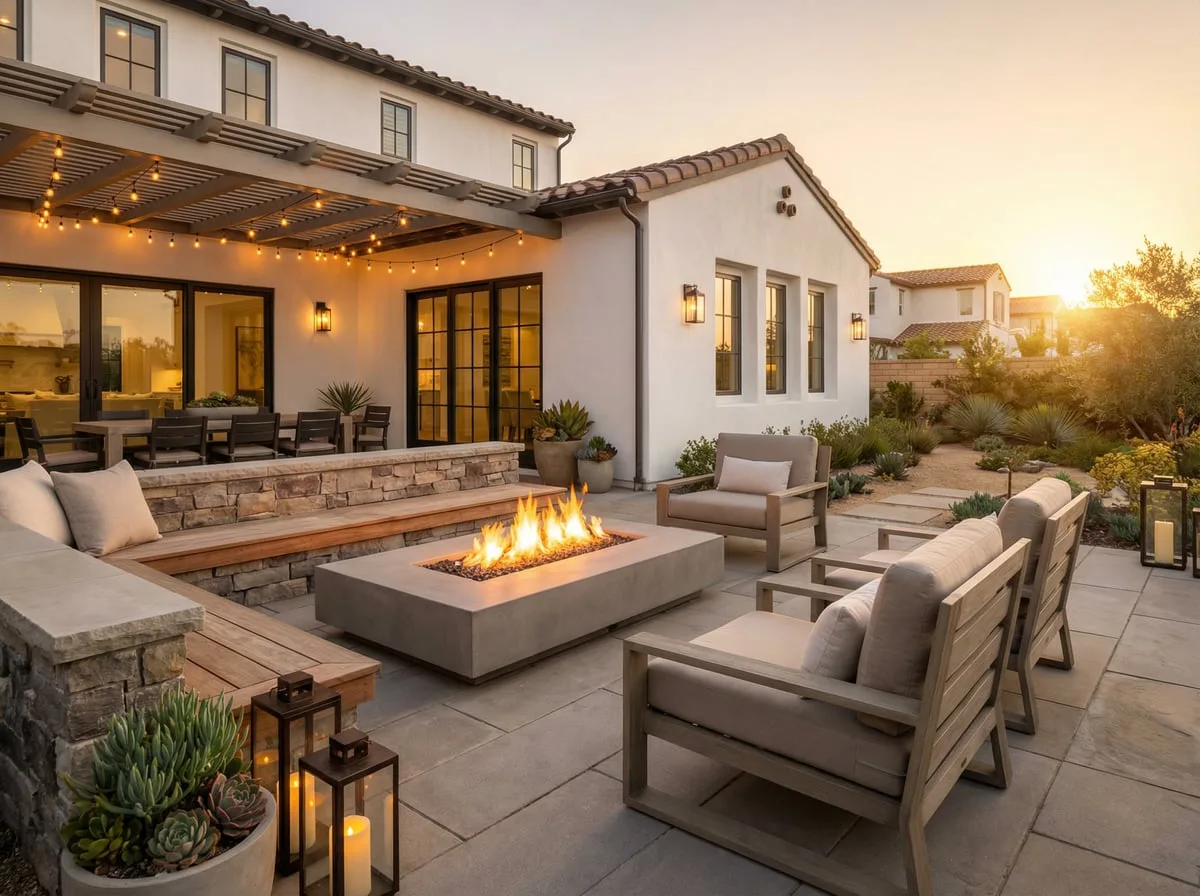
A room with no walls
A good patio reads before you think about it. The stone is level under a bare foot. The joint lines carry the eye toward the house or away from it, on purpose. The edges hold their geometry where they meet a lawn, a step, a pool coping. Water moves off the surface in a direction you never have to notice. You set a glass down on the table and it does not rock. Five years in, the color is quieter, the joints are still closed, and nothing has shifted out from under the furniture.
That is what a patio is supposed to feel like. Most of them do not.
Drive any San Diego neighborhood and the failures are the same hand. A paver field that heaves in two places where the base was short. Weeds stitched through the joints because polymeric sand was skipped or washed out in the first real rain. White haze of efflorescence blooming where the concrete was sealed too early, or sealed with the wrong product, or never drained properly in the first place. Edges sinking a quarter inch below the field because the restraint was the last thing installed and the first thing to give. A slab with a crack that was always going to happen because nobody cut a control joint where the geometry demanded one.
A patio is a room with no walls. And because there are no walls, every decision is visible. Edge restraint, base depth, joint stabilization, slope, drainage — these are the parts of the build that nobody photographs and nobody mentions in the proposal. They are also the parts that decide whether you still love the space in year three, or whether you have learned to stop looking at the corner by the downspout.
We build patios for the second decade, not the second month. The surface is what you see. The rest is why it lasts.
What our patio and hardscape work includes
Hardscape is the bones of an outdoor room. Under our scope we design and install:
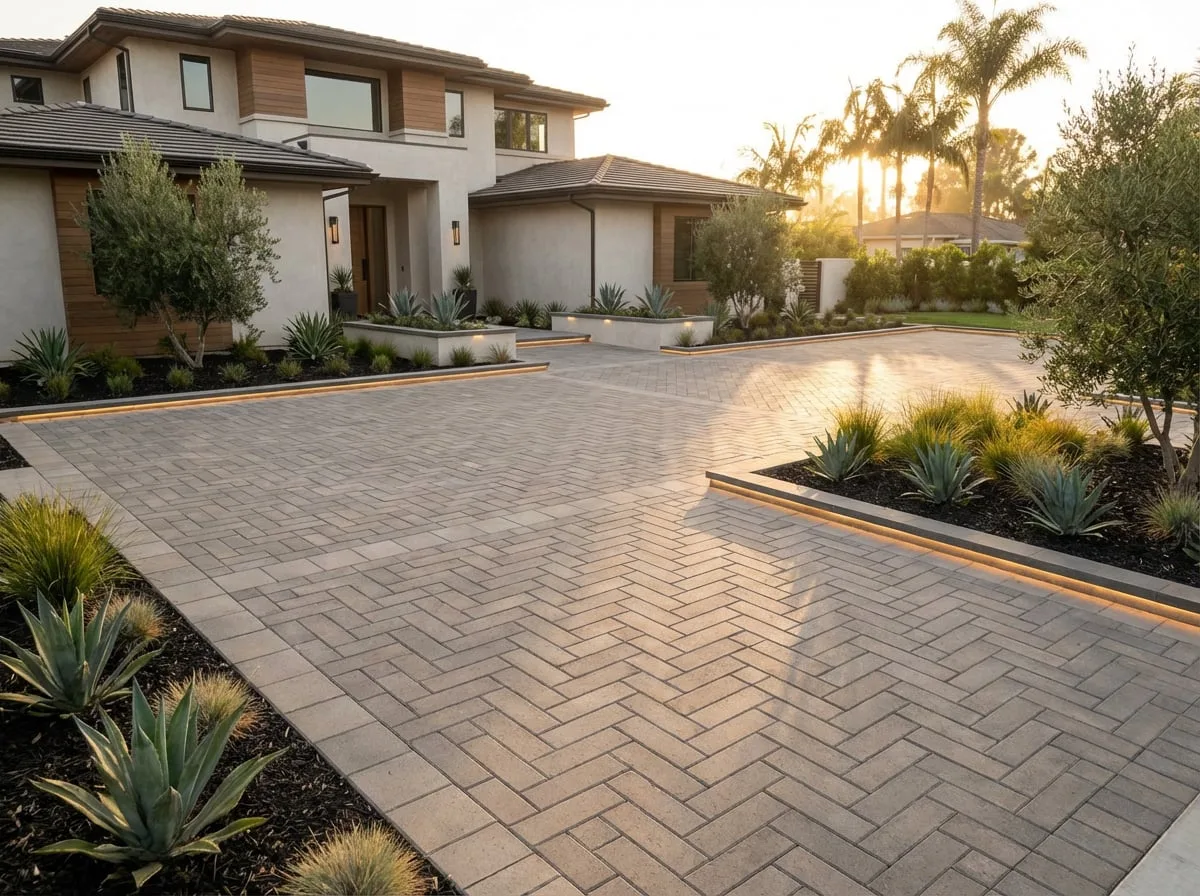
- Paver patios. Belgard, Techo-Bloc, and Unilock — large-format, tumbled, wet-cast, and permeable systems selected to the architecture of the house.
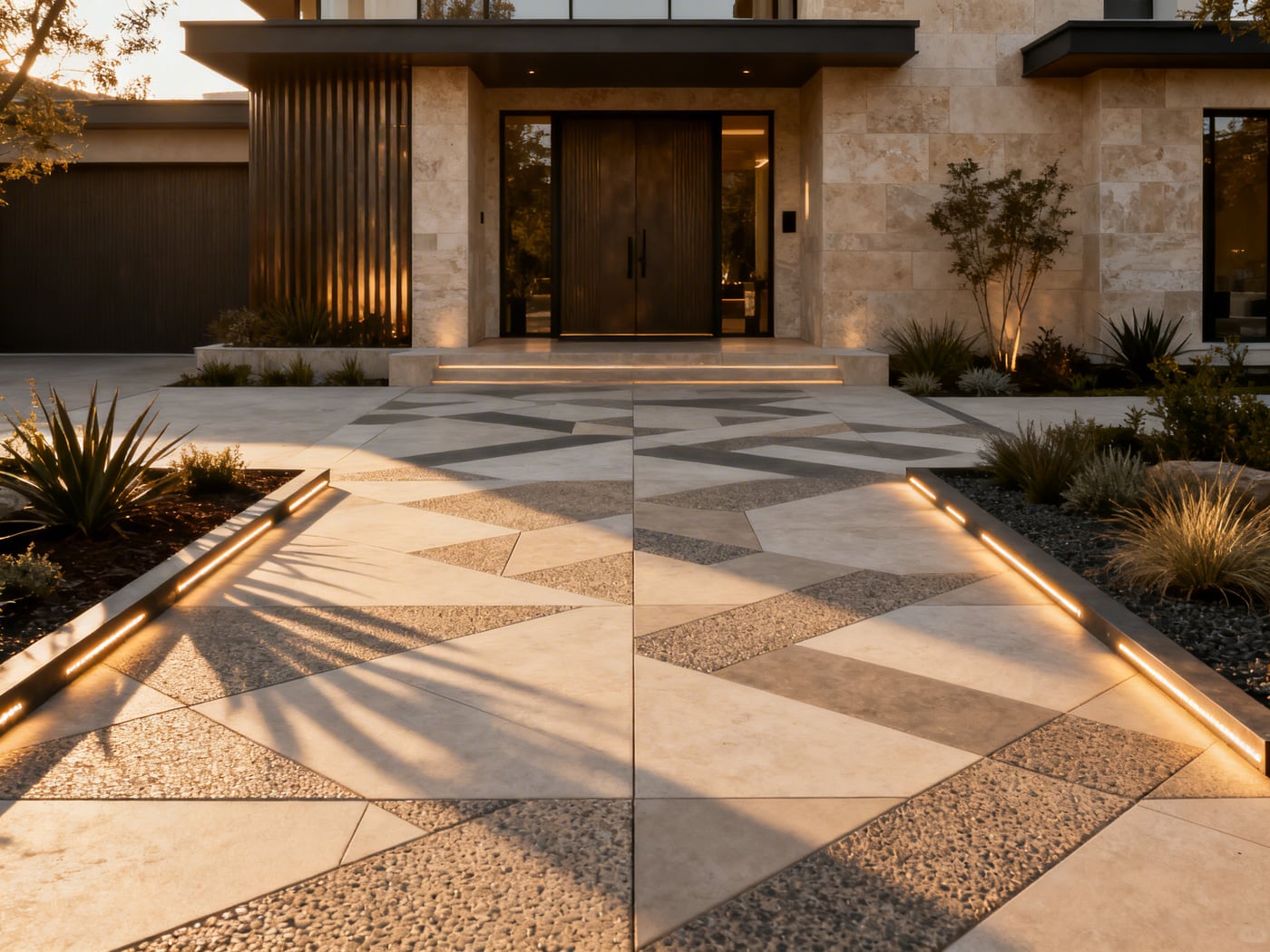
- Natural stone. Travertine, bluestone, flagstone, and large-format porcelain pavers where the patio lives next to a pool or a finished interior floor we want to echo.
- Poured concrete. Integral color, hand-cut sawcut joint layouts, and stamped patterns where they belong — sand-finish, salt-finish, or broom, chosen for foot feel and glare rather than fashion.
- Walkways, steps, landings, and integrated seating. The connective pieces that decide whether a yard feels like one room or a series of mismatched corners.
The invisible half is the one that decides the lifespan:
- Compacted engineered base to the depth the soil actually requires — not the depth the quickest install allows.
- Geotextile separator between native soil and aggregate, so the base does not pump fines over time.
- Polymeric sand and proper joint stabilization, the step that keeps weeds, ants, and wash-out off the field.
- Positive slope away from structures, tied into a considered drainage plan.
- Edge restraint installed under the field, not against it — the single detail most responsible for patios that stay true at the perimeter.
Patios sit inside a larger plan. If your grade is wrong, the patio will tell on it — begin with drainage and grading. If your site drops, patios and retaining walls are the same conversation. If the patio meets a pool, it belongs inside our pool deck and poolside hardscape detail. And if the patio is the floor of an outdoor room that will also cook and entertain, plan it alongside the outdoor kitchen from the first drawing, not after the slab is down.
Our process
We run every patio and hardscape project through the same seven-chapter sequence. It is the same shape as our full remodel work, scaled to the scope.
The first conversation. Thirty minutes by phone or on your property. We ask what the patio needs to do — morning coffee, Sunday dinners for twelve, a quiet reading corner, a bridge between the house and a pool that is coming later. We tell you honestly whether we are the right firm for the scope and the timeline.
Site visit and program brief. Both founders walk the property. We read the grade, the existing drainage, the soil, the access, the transitions between hardscape, planting, and structure. We photograph the constraints and take the measurements a real design requires.
Design-to-reality visualization. Before a saw touches a paver, we render the patio in 2D and 3D on your actual property — not a stock image, not someone else’s yard. Joint layout, color drift, edge detail, step geometry, transitions to lawn or pool. You see the finished space and we revise on paper, which is where revisions belong.
Proposal and contract. Line-item. Scope, schedule, material selections, allowances, payment milestones. No fine print doing work the front of the proposal should have done.
Permitting and material procurement. Some patios need permits; most do not. We handle whatever your jurisdiction and HOA require through the San Diego County Planning & Development Services portal or the relevant municipal office, and we order material to the project rather than pulling from whatever the yard has on hand.
Build, by a single crew. One crew, first cut to final wash-down. The order of operations is the game, and it is where most installs fail:
- Demo and haul-off.
- Grading to the design slope.
- Base prep — excavation to the depth the soil demands, not the minimum.
- Geotextile separator laid before aggregate.
- Base compaction in lifts, not a single dump.
- Edge restraint set under the finished field line, not after.
- Setting — pavers or stone placed off a string line, cuts planned, not improvised.
- Cuts — wet-saw, clean, dry-fit before final setting.
- Joint stabilization — polymeric sand (Techniseal or SEK) activated on a dry field in the right temperature window.
- Wash-down, seal if specified, walk-through.
Our Field Lead runs the day-to-day. Either Gio or Mike is personally on every project. You have both cell phones from the first call.
The 10-Month Walk-Through. Ten months after completion, through a wet winter and a hot September, we come back. We walk every square foot. Joints, edges, slope, finish. Anything that needs attention gets it. No invoice.
Materials and the brands we install
Material choice matters. Material choice without installation discipline is expensive wallpaper.
We install the full Belgard and Techo-Bloc paver lines — Mirage, Borealis, Blu 60, Industria, Villagio, and the larger-format wet-cast systems the catalogs keep adding. We install Unilock where the project calls for it. On the natural-stone side, travertine for warmth underfoot and color that ages quietly, bluestone for a crisper, architectural read, flagstone for the projects that want hand-set irregularity, and large-format porcelain pavers where a patio needs to live next to a pool without etching or staining.
For poured concrete we work in integral color, planned sawcut joint layouts drawn to the geometry of the patio rather than the convenience of the crew, and stamped patterns only where they belong. Sand-finish and salt-finish both have a place. Broom finish has a narrower one than most installers admit. Glare, foot feel, and how the finish ages through five summers are the questions we actually answer.
Joints are stabilized with Techniseal or SEK polymeric sand — the single cheapest detail on a paver patio, and the one most responsible for how the field looks in year two. Mike’s specialty materials background on the stone and tile side gives us direct supplier access, honest pass-through pricing, and installation detail most outdoor-remodel firms simply do not see.
Premium material installed cheaply fails. Modest material installed right ages well. We have watched both outcomes enough times to have an opinion.
Investment and cost drivers
Patio and hardscape projects with San Diego Landscape Remodeling run between $25,000 and $120,000 for most of what we build.
A $25,000 patio is a modest footprint — roughly 300 to 500 square feet — a mid-tier paver or standard poured concrete, a straightforward grade, and a clean tie-in to existing drainage. It is a real, well-built outdoor room, not a trial scope.
Between $50,000 and $80,000 is where the middle of our patio work lives: a larger footprint, a higher-tier paver or natural stone, integrated steps or a seating wall, proper drainage tied into the rest of the yard, and transitions to lawn, planting, or structure that have been designed rather than improvised.
North of $100,000 is natural stone at scale, large-format porcelain, complex geometry — curves, radii, multi-level landings — integration with pool coping, and the kind of site prep that gets written into the proposal because the soil or the access demand it.
What actually moves the number:
- Material choice. Paver, poured concrete, natural stone, and porcelain are four different labor profiles. Stone and porcelain carry more cutting, more hand-setting, and more setting-bed work than standard pavers.
- Square footage. Not linearly — the first 300 feet carry the mobilization cost; the next 300 are more efficient.
- Base depth required by soil. Expansive clay soils in parts of East County and the inland valleys require a deeper base than sandy coastal soil. The base is where the budget gets honest.
- Slope and drainage complexity. Flat lots get priced differently than sloped lots; sloped lots with an existing drainage problem get priced differently again.
- Edge length. A square patio has less edge per square foot than a curved one. Edges are where the labor lives.
- Cuts per square foot. Curves, radii, and complex patterns mean more cuts, more waste, and more hand-setting. Straight runs are cheaper for a reason.
- Steps and landings. Every step is its own small project — footing, riser, tread, and the geometry that ties it into the field.
- Coping and border detail. A border course, a contrasting edge, or a coped transition to a pool or planter adds material and hand-setting hours.
- Permit jurisdiction. Coastal zone, hillside overlay, and certain HOAs add process time and review fees.
- Site access. A yard we can reach with a skid-steer is a different proposition than one where every wheelbarrow rolls down a side yard.
Premium fair value, delivered with full founder access. No budget tier, no price matching, no corner-cutting on the parts of the build you cannot see.
Where we work
We build patios and hardscape across San Diego County — by design, not by dispatch. Each city carries its own soil, permit posture, and HOA reality, and we write to that on every location page rather than templating. Representative examples: a bluestone terrace in Del Mar will answer to the coastal zone and the marine air; a large-format porcelain field in Rancho Santa Fe will answer to the Covenant and the expansive-soil profile; a hand-set paver patio in Mount Helix will answer to the slope, the decomposed-granite subgrade, and the view corridor. The details are local. The standard is not.
Frequently asked
What is the best paver material for San Diego patios?
Concrete pavers, natural stone, and porcelain tile all perform well in San Diego’s climate. Material selection depends on the design, the budget, and how the space will be used. We help you choose based on your specific property and how you plan to use the patio.
How much does a patio cost in San Diego?
A well-installed paver patio in San Diego ranges from $20,000 to $60,000+ depending on square footage, material grade, base preparation, and edge details. Budget bids that skip proper base work result in patios that shift and drain poorly within a few years.
How long does a patio installation take?
A standalone patio project typically takes 1–3 weeks of active construction depending on size and material. Permitting, material lead times, and scheduling add time before work begins on site.
Paver or poured concrete — which lasts longer?
Both last a long time when installed correctly. Pavers have the advantage that a single unit can be lifted and reset if the base moves or a utility has to be accessed, and the field never cracks across the middle because the joints absorb movement. Poured concrete is a single monolithic slab — beautiful when the sawcut joints are drawn to the geometry, and prone to a hairline crack somewhere if they are not. Neither material fails on its own. Bad base work fails both.
How deep does the base actually need to be?
It depends on the soil and the load. For a standard paver patio in stable coastal soil, four to six inches of compacted base over a geotextile separator is typical. In the expansive clay soils you find in parts of East County and the inland valleys, six to eight inches is more honest, and sometimes more than that. For driveways or anywhere a vehicle rolls, eight to twelve inches. If a proposal specifies a base depth without first seeing the soil, ask why.
What causes patios to heave or sink?
Three things, almost always. An under-built base that could not carry the load once the soil got wet. Missing or failed edge restraint letting the perimeter pavers migrate outward, which drops the field behind them. Drainage directed toward the patio rather than away from it, saturating the sub-base and letting it pump fines through the aggregate. All three are install decisions, not material decisions. A cheap paver over a correct base outlasts a premium paver over a shortcut one.
How do you handle drainage on a flat lot?
Nothing is truly flat. A flat-reading lot still needs one to two percent slope across the patio, tied into a surface or subsurface drainage path that carries water to a legal discharge point. On genuinely flat properties we often add channel drains at the field’s low edge, French drains along adjacent planting, or a graded swale outside the patio line. The detail is in our drainage and grading scope, and it belongs in the first design conversation, not the last.
What about salt and efflorescence?
Efflorescence is the white haze you see on new concrete and some pavers as soluble salts migrate to the surface during curing. It is cosmetic and usually resolves over the first six to twelve months as the material dries and traffic takes it off. Sealers applied too early trap it and make it permanent. We specify a cure window before sealing, use efflorescence-appropriate cleaners when the field calls for intervention, and select materials and sealers together rather than as an afterthought.
Do we need a permit for a patio?
Often no for an on-grade patio that does not impact drainage, setbacks, or egress. Often yes for elevated decks, patios that structurally connect to the house, projects inside the coastal zone or a hillside overlay, and almost anything behind an HOA with architectural review. We verify with the jurisdiction before the proposal is signed. You can check your parcel’s requirements through San Diego County Planning & Development Services or your city’s equivalent portal.
How long does a patio install take start to finish?
A small paver patio runs about one to two weeks on site. Mid-size hardscape projects — larger footprint, integrated steps, a seating wall, drainage work — typically run three to five weeks. Natural stone and large-format porcelain add setting time. The lead time between a first conversation and the day the crew breaks ground varies with scope, permitting jurisdiction, material lead times, and where your project sits in our calendar — we would rather walk you through that honestly than publish a window we cannot keep.
What does the workmanship warranty cover?
We warranty our workmanship for a minimum of one year, with manufacturer warranties on the materials extending longer. More importantly, every project carries our 10-Month Walk-Through: ten months after completion, we return to your property, walk every square foot of our work with you, and handle anything the seasons have exposed — joints, edges, slope, finishes. On our dime. You can verify Mike’s active Class B general contractor standing any time through the CSLB license lookup.
Who do we actually talk to during the build?
Gio or Mike. Direct-Founder Access is part of the product, not a phrase. Every project is personally run by one of the founders — no account manager, no handoff, no “I’ll check with the team.” Our Field Lead runs the day-to-day on the ground. You have both founders’ cell phones from the first call. If you prefer a single point of contact, you choose which one, and that is the cell you text.
Can we walk a completed patio before we commit?
Yes. References available on request. During discovery, we are glad to take you past completed projects in person so you can see the work as it lives — underfoot, at dusk, in the rain if the weather cooperates — rather than as it photographs. It is the old-fashioned way to vet a builder, and on this kind of work it is still the best one.
References available on request
We do not publish testimonials. When a project is complete, we invite future clients to speak directly with the homeowners who have lived in the finished work and to walk past the patios in the neighborhoods where they sit. It is a deliberate editorial posture, and it is the one we believe the work deserves.
When you are ready
If the scope is serious and the timeline is flexible, we would like to see the property. A first conversation is thirty minutes — by phone, or on your yard — and there is no cost to begin. We will read the grade, listen to what the space is meant to do, and tell you honestly whether we are the right firm for the work. If we are not, we will say so and point you to who is.
Licensed and insured general contractor, operating under Mike’s Class B license — CSLB #1139785.