
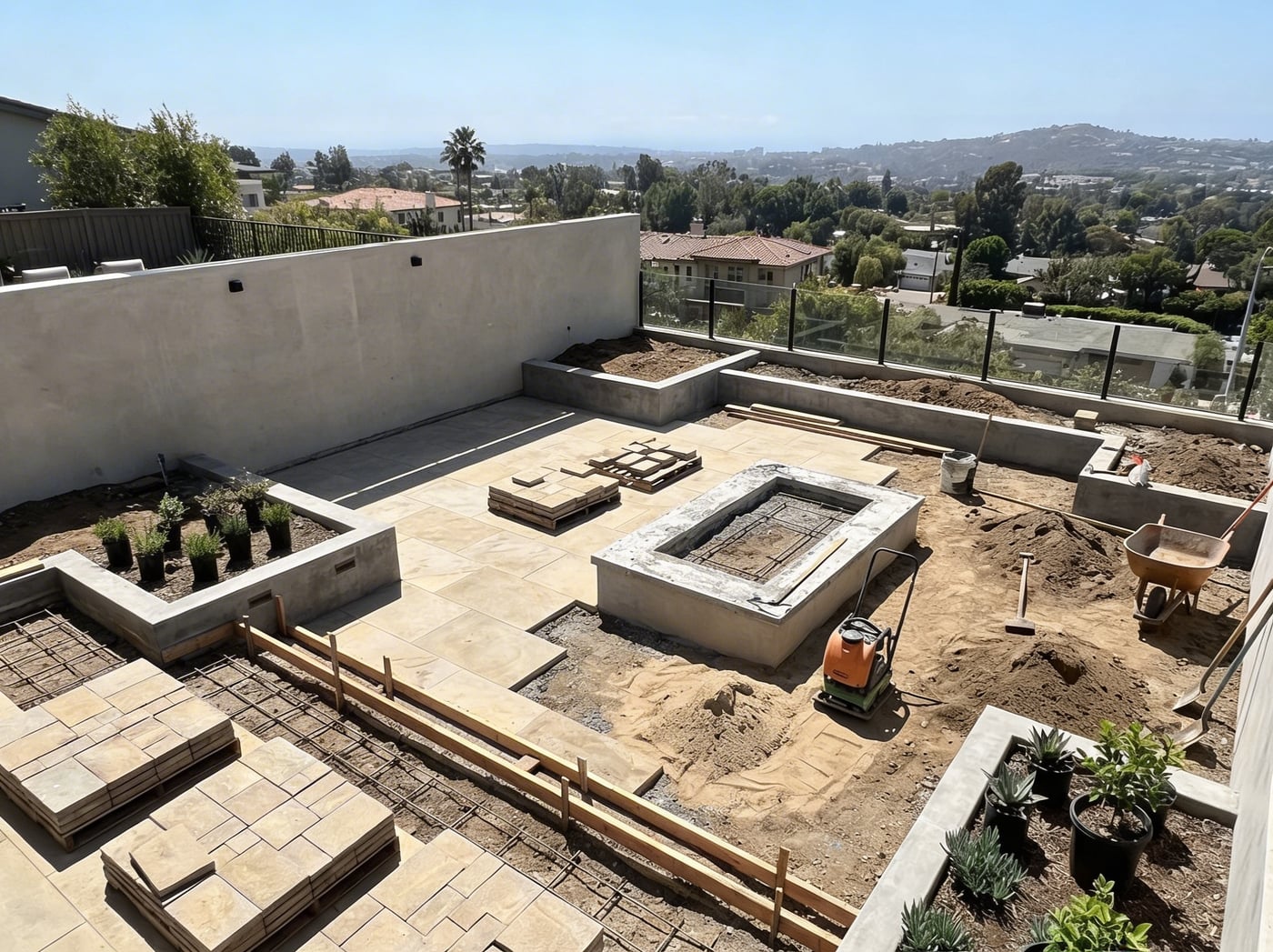
Outdoor remodeling for Mount Helix hillside estates
Mount Helix is a mountain with a cross on top and a long memory. Drive the switchbacks any evening near sunset and you will find the same scene that has drawn people to this hill for a century — the white cross above Mount Helix Park catching the last of the light, and below it, a ring of homes looking west across the county toward downtown, the Coronado Bridge, Point Loma, and the ocean behind it. From a west-facing yard here, on a clean evening, you can watch the Pacific turn from blue to copper to ink while the lights of the city come up one grid at a time. It is not a view you buy at one of the coastal neighborhoods. It is a view you buy only here.
The homes that sit on the hill are custom. Most were designed one at a time, many carved directly into the slope, and the best of them treat the view as a piece of the architecture rather than a backdrop to it. Which is another way of saying the outdoor rooms on this hill are not a landscaping problem. They are a hillside engineering problem with a design brief on top. The patio that floats out toward the view is only there because the grading holds. The terrace garden below it only reads as a garden because somebody routed the winter water somewhere it will not undermine the wall. The homeowner who understands that — who knows the view is the point, and knows the engineering is what earns the view — is the homeowner this page is written for.
The property profile
Mount Helix sits in unincorporated San Diego County, tucked against La Mesa and within an easy drive of Rancho San Diego and El Cajon. It is a county-jurisdiction hill surrounded by city-jurisdiction neighbors, which matters when permits come up. The homes here tend toward custom builds in the $3M-plus bracket, and parcels typically run from a third of an acre up past two acres, with the larger lots stepping down the slope in a series of terraces and pads rather than sitting on a single buildable plane.
Ownership on Mount Helix skews long-tenured. A meaningful percentage of the homes on this hill have not changed hands in twenty years, which is part of why the streetscape reads as settled rather than developed. The other movement you see is tear-down-and-build — a mid-century hillside home on a trophy lot, acquired, taken to the studs or to the dirt, and replaced with a new custom home designed to open every west-facing wall to the view. Both sets of owners call us for the same reason. The outdoors is the reason the house exists, and the outdoors has to be built by a firm that understands what the hillside demands before the design ever gets drawn. See the neighboring markets in La Mesa, Rancho San Diego, and El Cajon.
Soil, slope, and the water
The soils on Mount Helix are predominantly decomposed granite — the crumbly, gold-brown, granular material you will recognize from the cut banks along the driveways up the hill. Decomposed granite drains well when it is graded well and behaves poorly when it is not. Beneath it, and often only a few feet down, are shallow bedrock ledges that will stop a footing excavation cold and dictate where a pool, a caisson, or a retaining wall can actually be placed. Threaded through both are pockets of expansive clay that swell in winter and shrink in summer, and any structure that bridges a clay pocket without recognizing it will tell you about it inside two seasons.
Drainage is the engineering problem that defines every Mount Helix parcel. Where the winter water goes in February decides whether the patio is still there in April. A hillside remodel that does not begin with a drainage plan — surface flow, subsurface, roof leaders, neighboring upslope runoff, all of it — is a hillside remodel that will cost twice to build once. Our drainage and grading scope is the first line on the proposal, not the last.
Permits and the hillside overlay
Mount Helix falls under San Diego County Planning & Development Services, and most of the hill sits inside the county’s hillside overlay. The overlay exists because building on slope is a different discipline than building on flat ground, and the review process reflects it. Grading-permit thresholds trigger quickly when the lot is cut and filled at any meaningful scale. Retaining walls above three to four feet of exposed height require engineered drawings stamped by a licensed civil or structural engineer, and a long retaining run that reads as a single element to the eye is often, on paper, a tiered series of walls engineered individually to keep each one under a threshold. See our dedicated retaining walls work for how we handle those details.
Plan-check timelines on a graded hillside lot are longer than they are on a flat infill, and the right answer is to build that window into the schedule rather than to cut corners hoping review will go faster than it will. We submit clean drawings, respond to comments in days rather than weeks, and keep the critical path moving.
Design character on the hill
The architectural vocabulary on Mount Helix reads Mediterranean, Spanish Colonial, and contemporary hillside — tile roofs and stucco on the older estates, board-formed concrete and steel on the newer custom builds, and a handful of modernist homes that predate either conversation. What ties the palette together, when it is done well, is a quiet respect for the view. The best outdoor rooms on this hill do not compete with the horizon. They frame it.
Material choice follows. Quiet stone rather than loud stone. Low-glare surfaces on the pool deck so the sun does not bounce into the room behind. Cedar and steel shade structures that read as linework against the sky rather than as a roof that closes the view down. Lighting zoned so the foreground layers pick up at dusk and the eye is drawn out toward the ridge, not held at the edge of the patio. Planting that settles the grade into the architecture rather than decorating around it. A terrace on Mount Helix should feel like it has been there as long as the hill has. Our patios and hardscape and landscape lighting scopes are designed around that restraint.
Where SDLR fits
A Mount Helix remodel is five jobs that have to behave as one. Drainage decides where the retaining can go. Retaining decides where the hardscape can sit. Hardscape decides how the structure lands. Structure decides how the lighting is zoned. Every one of those decisions sits on top of the one before it, and the firm that hands the property from a grading sub to a masonry sub to a carpenter to an electrician — each one showing up weeks apart, each one solving for their own scope — will build you a yard you learn to live around.
San Diego Landscape Remodeling works every piece of the hillside puzzle as a single coordinated scope. One crew, one Field Lead, one schedule, and direct founder access from the first conversation through the last walk. Both Gio and Mike personally run every project on this hill — there is no account manager between you and the people who are actually making decisions on your property. That matters anywhere. On a hillside custom home where a misread detail becomes a retaining-wall conversation two winters from now, it matters more.
The 10-Month Walk-Through is written into every project we build, and on Mount Helix it earns its keep. Ten months after completion — through a wet winter, a dry summer, and the first real movement the hill will show — we return to the property and walk every square foot of our work with you. Grading, drainage outlets, wall drainage, joints, finishes, structures, lighting. Anything the seasons have exposed gets handled on our dime. Almost nobody in this industry comes back. That is exactly why we do.
Services on Mount Helix
Every Mount Helix project draws on the same ten-service menu, coordinated under one scope:
Full backyard remodels · outdoor kitchens and BBQ islands · patios and hardscape design · fire pits and fireplaces · pergolas and shade structures · retaining walls and seating walls · artificial turf installation · landscape lighting · pool decks and poolside hardscape · drainage and grading.
On this hill, drainage and grading and retaining walls are rarely optional line items. They are the scope the rest of the yard rests on.
Frequently asked
How do you handle hillside drainage on a Mount Helix lot?
We start with the water, not the hardscape. Before a paver is selected we map surface flow across the lot, trace roof leaders to daylight or to subsurface, account for upslope runoff from neighboring parcels, and design a conveyance system that routes February’s water somewhere it will not undermine a wall, a footing, or a patio. Swales, French drains, area drains, and pop-up emitters are specified to volume, not to habit.
When do retaining walls on Mount Helix require engineered drawings?
San Diego County typically requires engineered, stamped drawings for retaining walls that exceed three to four feet of exposed height, and for any wall carrying a surcharge — a driveway, a pool, a structure — regardless of height. A long retaining run is often designed as tiered walls, each kept below the threshold, to preserve the sightline while staying inside a cleaner permitting path. We coordinate the civil or structural engineer directly as part of the scope.
How do you design without blocking the view?
With restraint. Shade structures on a view lot are specified as linework rather than roof — slender cedar or steel members, open louvers or sail cloth, sized so the horizon still reads through. Pool-deck material is chosen for low glare. Lighting is zoned to pick up foreground layers at dusk and draw the eye outward. The best compliment a Mount Helix yard receives is that guests forget the design and remember the view.
What is the permit timeline on a graded hillside lot here?
Longer than on a flat infill in an incorporated city, and that is the honest answer. San Diego County PDS review on a hillside-overlay lot with grading, retaining, and structure in the scope typically runs measured in months rather than weeks. We build that window into the project calendar deliberately, submit clean drawings the first time, and respond to plan-check comments in days to keep the critical path moving.
What does working under the hillside overlay actually mean?
It means the county reviews the project against a set of slope-specific standards in addition to the standard building code — height, grading quantities, slope density, view corridors, and landscaping on manufactured slopes. For the homeowner it mostly shows up as longer plan-check, additional drawings, and tighter limits on what you can cut, fill, or cover. It is a discipline, not an obstacle, and a firm that knows the overlay writes drawings that pass review.
How do you handle defensible space on a Mount Helix parcel?
Defensible space is part of the design brief, not a finish-line checklist. We follow Cal Fire guidance on the zone-zero, zone-one, and zone-two separations around the home, select planting palettes that reduce fuel loading without sacrificing the garden, and detail hardscape transitions at the building envelope so the yard works with the home’s fire posture rather than against it.
How does the pool deck integrate on a sloped lot?
Carefully. A pool on a Mount Helix lot is almost always a cut-and-fill decision, and the deck around it is both a finish surface and a structural platform. We coordinate the pool shell, the deck structure, the retaining behind and below, and the drainage at the deck perimeter as one detail. Pool decks on this hill are designed with the grading and retaining, not on top of them. The joint between deck and wall, and the joint between deck and house, are specified in drawings long before they are poured.
References available on request
We do not publish testimonials. When a project is complete, we invite future clients to speak directly with the homeowners who live in the finished work, and we walk prospective Mount Helix clients past completed projects in the neighborhoods where they sit. You can verify Mike’s Class B general contractor standing any time through the CSLB license lookup.
When you are ready
If you own a west-facing lot on Mount Helix and the outdoor rooms are not yet doing justice to the view, we would like to hear about the property. A first conversation is thirty minutes — by phone or on your yard — and there is no cost to begin. We will listen, we will tell you what we see on the hillside, and we will tell you honestly whether we are the right firm for the work.
Licensed and insured general contractor, operating under Mike’s Class B license — CSLB #1139785.