
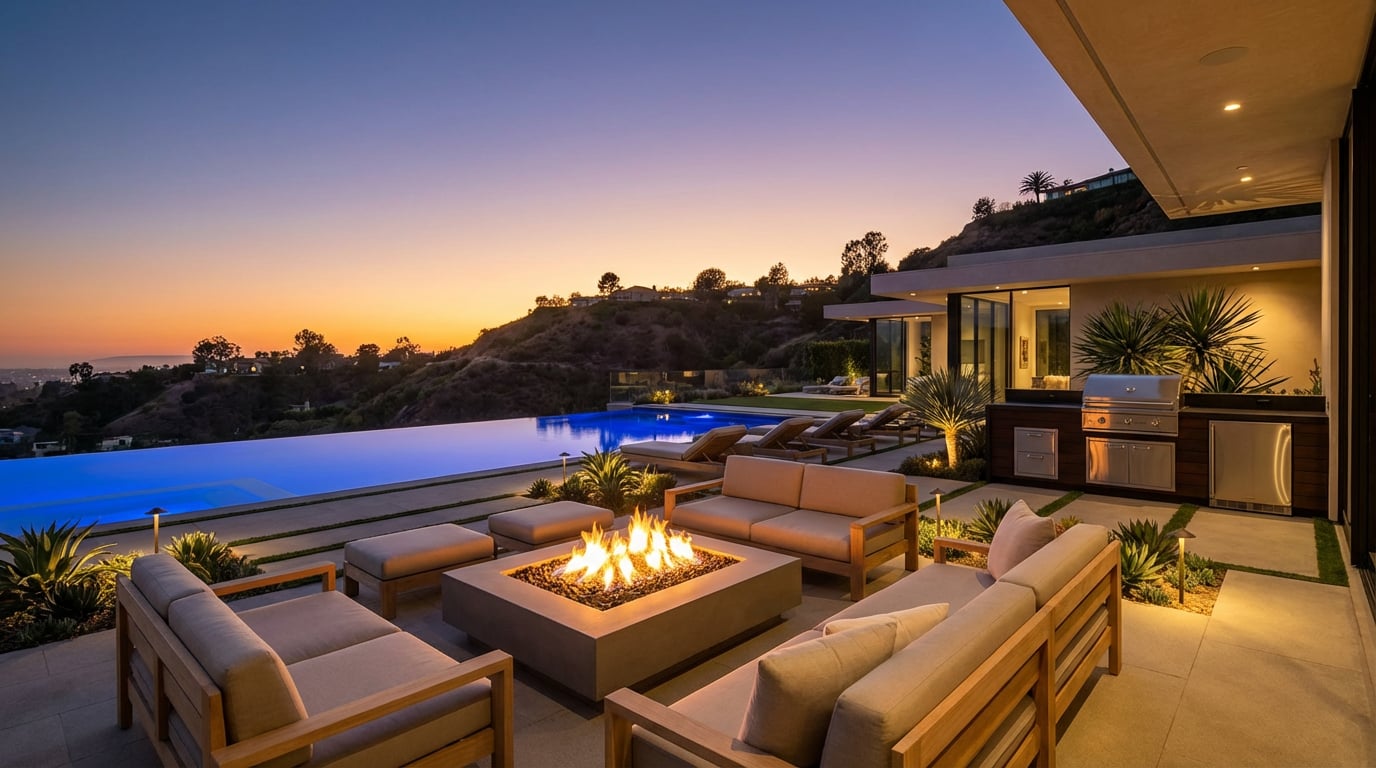
A property that already knows what it is
The bridle path still runs along the road, the horse still has right of way, and the oaks over your driveway were old when the house was drawn. That is the first thing a Covenant property tells you — it has been here longer than you, and it will be here longer than you. The Lilian Rice-era Spanish Colonial bones that set the aesthetic of the village in the 1920s still govern the whole town, and the afternoon light through a mature canopy is the same light your neighbors sat in a generation ago.
You did not buy into Rancho Santa Fe to make it look like somewhere else. You bought in because the place is quiet in a way most of California is not, because the lots have room, because the architecture has memory. What you want outside the house is the same quality of inevitability the house itself already has — a yard that reads as though it were always there, built so the bones will still be correct when the next family lives in it.
That is the only kind of outdoor work this address rewards. Everything else looks borrowed.
The Covenant, the neighbors, and the homes
The Rancho Santa Fe Covenant is a 6,200-acre master-planned community with a two-acre minimum in most of its residential zoning — one of the first master-planned communities in the country, drawn in the 1920s around Lilian Rice’s Spanish Colonial village and still held to its original design intent today. Around it sit the adjacent enclaves: The Crosby to the east, Del Mar Country Club (Fairbanks) to the south, and Cielo a short drive north. Custom estates across these neighborhoods trade between roughly $5M and $50M and above, and the ceiling has moved only one direction in the last decade.
The ownership mix is specific. A meaningful share of Covenant homes are held by multi-generational families — grandparents who raised children on the property and now host grandchildren on it — alongside a steady stream of more recent buyers who have just taken possession of a home they intend to personalize over years, not weekends. Both sets of clients share one trait: they are not in a hurry, and they will not be pushed. Work gets commissioned when the program is right, and the program is judged on whether it will still look correct in twenty years.
Soil, canopy, and the inland climate
Covenant soils are predominantly decomposed granite with clay loam in the low pockets and the drainages — drains fast on the ridges, holds water uncomfortably at the toes of the slopes, and changes character several times across a two-acre lot. The real constraint on most properties is not the soil itself but the mature coast live oak canopy above it. Oak root zones extend well past the drip line, they are allergic to grade change, trenching, and compaction, and the trees do not forgive what you do around them for five to ten years after you do it. Every plan begins with the canopy mapped and the critical root zones fenced.
Rancho Santa Fe sits inland enough to run hotter than the coast in summer — mid-90s is a normal August afternoon — and cool enough to frost a low spot in January. Hardscape specification, shade planning, and planting palette all account for that swing.
Permits and the Covenant Design Review Committee
Permits for Rancho Santa Fe projects go through San Diego County — the Planning & Development Services department handles grading, structural, and most of what outdoor work touches — and the County’s process is the ordinary half of the equation.
The extraordinary half is the Rancho Santa Fe Association’s Covenant Design Review Committee (CDRC). Every exterior change on every Covenant property — materials, colors, plant palette, grading, wall height, tree removal, lighting — is reviewed. A concept submission comes first; a final submission with full drawings and a material board comes second; conditions of approval are normal; and a genuine review cycle is not something to be negotiated out of the schedule. Work started without CDRC sign-off is work that gets stopped. The adjacent enclaves have their own architectural review bodies — The Crosby and Fairbanks each run their own process — and the expectation is the same: real drawings, real materials, real deference to the place.
We plan our schedule around that reality. The design phase is longer here than it is elsewhere in the county, and it should be.
Design character
The vernacular the Covenant was drawn in is Lilian Rice-era Spanish Colonial Revival — low-slung massing, white and cream stuccos, clay tile roofs, wrought iron, shaded arcades, and courtyards that do most of the entertaining. Mediterranean and contemporary Mediterranean have joined it as accepted languages over the last two decades, and a handful of well-sited contemporary homes have earned their place by being exceptionally disciplined about material and grade. The palette the town reads as correct is narrow and honest: hand-finished stucco, clay and terracotta tile, cut and dry-stacked stone, cedar, and wrought iron — with plaster, plaster-finished concrete, and COR-TEN used sparingly where the architecture has already earned the move.
What reads wrong is a contemporary glass-box patio grafted onto a Spanish house, a fire feature whose stone does not belong to any geology within a thousand miles, and a lawn-and-pool combination that ignores the oaks it sits under. The Covenant does not punish ambition; it punishes ambition without discipline. The most memorable outdoor work in this zip code is the work that you walk through twice before realizing how much was actually built.
Where we fit in a Rancho Santa Fe project
The CDRC process is inside our scope. We draw to CDRC standards, we prepare concept and final submittals, we assemble the material board, we map the oak canopy and critical root zones on the site plan, and we carry the application through conditions and sign-off before the crew mobilizes. Where the project benefits from an architect or landscape architect you have already engaged, we collaborate with them directly — one set of drawings, one schedule, one build discipline — rather than forcing you to coordinate between parties. Where you do not have a designer, our in-house design process takes the program from first sketch to photorealistic 2D and 3D rendering of your actual property so you see the finished space before a single paver is cut.
Both founders, Gio and Mike, are on every Covenant project personally — no account managers, no hand-offs — and our lead craftsman, with 25-plus years of high-end outdoor build experience, runs the day-to-day on the ground. Ten months after completion, we come back for The 10-Month Walk-Through — we walk the property with you after a wet winter and a hot September have tested everything, and we handle what the seasons have exposed on our dime. Founder access, one crew from first cut to final clean, and a back-end return visit are not upsells. They are how we work everywhere, and they are the minimum this address expects.
Services available in Rancho Santa Fe
Every service we offer is available to Covenant and adjacent-enclave properties. Most of our Rancho Santa Fe work is commissioned as a full backyard remodel — one coordinated plan across the entire outdoor footprint — because that is how these properties deserve to be approached. Within that scope or as standalone work, we build:
- Outdoor kitchens and BBQ islands
- Patios and hardscape
- Fire pits and fireplaces
- Pergolas and shade structures
- Retaining walls and seating walls
- Artificial turf installation
- Landscape lighting
- Pool decks and poolside hardscape
- Drainage and grading
Frequently asked
How long does CDRC review actually take?
Plan on a real design and review window. Concept review and final review are separate submittals, conditions of approval are normal, and revisions between concept and final are the rule rather than the exception. Every Covenant project we run is scheduled with the review cycle built into the front of the calendar, not bolted onto the end — because the alternative is a permit hold after mobilization, which is not a position we put a client in. We give you the honest timeline in writing at proposal.
How do you protect the oaks?
Every plan begins with the canopy mapped and the critical root zones identified. Fencing goes up before demolition, no trenching or grade change inside the protected zone, and no material staging under the drip line. Where the program needs to cross a root zone, we either redesign around it or use a method the arborist has reviewed in writing — and we keep a consulting arborist on call for the properties where it matters. Oak root damage is cumulative and often invisible for years. We plan as though the tree will outlive the project, because on a correctly run Covenant property it will.
What does a typical Covenant project cost?
Full backyard remodels inside the Covenant generally land between $150,000 and $500,000-plus, depending on scope, site access, grading complexity, and finish level. A coordinated remodel of a half-acre footprint with kitchen, structure, pool-deck integration, and a mature planting program typically falls in the $250,000-to-$500,000 range. We build to the $500,000-plus tier where the property and program support it. We do not run “budget” tiers — there is one quality of work.
Do you work alongside our architect or landscape designer?
Often, yes. A meaningful share of our Rancho Santa Fe work is commissioned after an architect or landscape architect has already begun the program. We coordinate directly with them on drawings, materials, and schedule — one build discipline, one set of documents, one review package to CDRC. Where you do not have a designer, our in-house process handles the program end-to-end.
How do you handle drainage on a two-acre lot?
Two-acre properties usually have more than one drainage problem, and the drainages often don’t talk to each other. We survey the whole site, identify the low points, model where the water actually goes in a February storm, and build the hardscape and grading plan around the answer rather than around the aesthetic. The clay loam pockets get different treatment than the decomposed granite ridges. It is inside our drainage and grading scope on every remodel and it is almost always the quiet reason the finished yard behaves.
What about defensible space around the oaks?
Covenant parcels fall inside a wildfire-aware jurisdiction, and defensible-space obligations are real — but they have to be reconciled with oak preservation, which pulls in the other direction. The move is not to clear the canopy; it is to plan the understory, the plant palette, and the structure placement so that the property meets Cal Fire defensible-space guidance without damaging the trees the site is valued for. That is a design problem before it is a maintenance problem, and we plan it at design.
How does a Rancho Santa Fe project compare to Fairbanks Ranch or Santaluz?
Same level of client, different governance and different topography. Fairbanks Ranch has its own architectural review and a more open, manicured property character — less oak canopy, more turf and garden. Santaluz runs a modern-coastal vernacular with its own HOA design guidelines, tighter lots, and a cleaner material palette. The Covenant is older, larger, more forested, and more deferential to the original Lilian Rice design language — which means more review process, more preservation, and more weight on materials that read as native to the place. Our approach adjusts accordingly.
Can we see completed work in the area?
References available on request. During discovery, we are glad to take you past completed projects so you can see finished work as it lives, not as it photographs. On this kind of commission, in this kind of neighborhood, that is still the right way to vet a builder.
References available on request
We do not publish testimonials. When a Rancho Santa Fe project is complete, we invite prospective clients to speak directly with the homeowners who live in the finished work — a real conversation, not a cropped quote. It is the old-fashioned way to vet a builder, and on Covenant-level work, it is the one that matters.
When you are ready
If the property is in the Covenant, The Crosby, Fairbanks, or Cielo, and the program is serious, we would like to hear about it. A first conversation is thirty minutes — by phone, or walking the property with both founders — and there is no cost to begin. We will listen, we will tell you honestly what we see, and we will tell you whether we are the right firm for the work.
Licensed and insured general contractor, operating under Mike’s Class B license — CSLB #1139785. Verify active standing any time through the CSLB license lookup.