
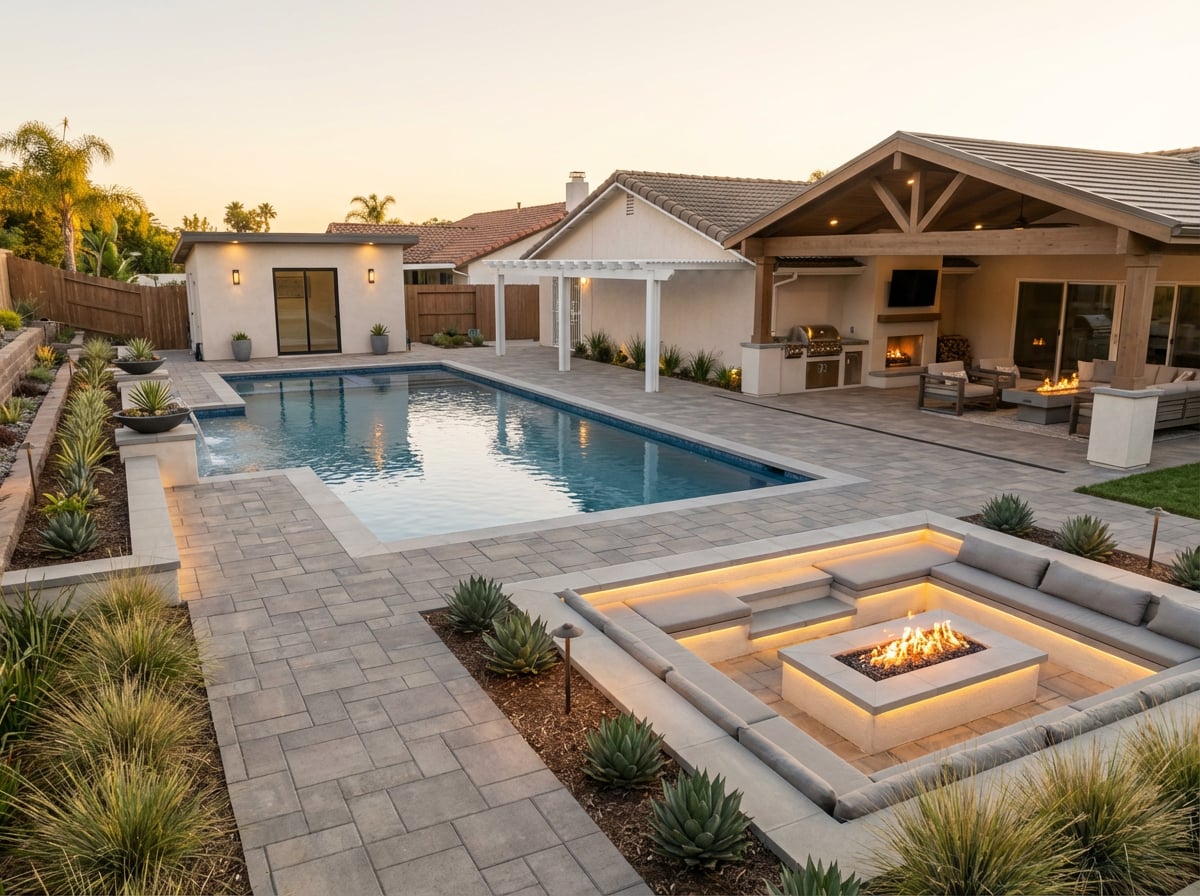
A yard that is already a room
La Mesa is one of the few San Diego cities that still reads like a small town from inside the car. The jacarandas come in late spring and drop a purple floor over Date Avenue. The trolley bell carries from Spring Street to the first terrace of backyards above it. On Memorial Day the village fills up for the parade, and by dusk the yards along La Mesa Boulevard are every bit as used as the curb out front — folding chairs pulled back through the side gate, kids on lawns that have hosted forty summers of kids. The yards here are not design objects. They are furniture.
That is the first thing we look for when we walk a La Mesa property. The furniture is already there — the mature coral tree, the low clinker-brick wall that came with the house in 1958, the slope that drops to the avocado at the back fence — and a good remodel does not erase any of it. It restates it. A mid-century ranch on Alta La Mesa wants a garden that remembers 1962. A craftsman bungalow in the village wants a porch edge, a cutting garden, and a back patio that reads as if it was always there. The Mount Helix-adjacent hillside customs want a different register entirely — cleaner lines, longer sightlines down the city bowl, a terrace built to hold a dinner that runs past sunset.
What the better La Mesa yards have in common is that they feel lived in on a Tuesday, not just on a photograph.
Who actually lives here
La Mesa is a layered market, and the layers matter. East of Grossmont Hospital, the lots tend to run 0.15 to 0.25 of an acre — tight, flat, often on the original 1950s plan, with side yards a person can cross in four strides. Move west through the village and toward Mount Helix and the lots loosen to 0.3 of an acre and up, with frontages that carry mature canopy and back fences that drop onto a view.
The ownership follows the geography. On the flats, long-tenured is the norm — families who bought the ranch in the seventies, raised two generations under the avocados, and are now deciding what to do with the yard now that the grandkids are the ones visiting. Toward the top — Fuerte, the Mount Helix saddle, the hillside customs built and rebuilt over the last fifteen years — the buyers are newer, often relocating, often bringing a design sensibility that expects the garden to match the house.
HOA coverage is thinner here than in many East County markets. The Windsor Hills pocket carries its own HOA for architectural review; most of the rest of La Mesa is unincorporated of that kind of oversight. Where an HOA does apply, we pull the CC&Rs before we design, not after.
Soil, slope, and what your patio is sitting on
La Mesa is two soils pretending to be one. In the flats — the neighborhoods east of 70th, the village core, the grid south of the 8 — the native soil is a clay loam that swells when it rains and shrinks in August. An unengineered patio base on that soil cracks on a predictable schedule. The fix is not thicker concrete; it is a properly compacted aggregate base, the right geotextile separation, and detailed joints that allow the slab to move without advertising the movement. Done right, the patio reads as one piece for decades. Done fast, it reads as three.
Climb toward Mount Helix and the soil changes under your feet. Decomposed granite takes over, and not far below it you hit weathered bedrock — sometimes at three feet, sometimes at eighteen inches. A hillside slab here is a different engineering conversation: rock-ledge assessment before the footings are drawn, drainage designed for a surface that will not accept water the way the flats do, and retention detailed for a slope that moves in winter whether you want it to or not.
Permits, and which desk your plan lands on
Jurisdiction is the first question we answer on a La Mesa property, because the answer changes the schedule. Incorporated La Mesa addresses go through the City of La Mesa Community Development Department for building, grading, and any structure that exceeds code minimums. The department runs its own plan check, its own inspection calendar, and its own historic-resource review for the older craftsman stock in and around the village. It is a manageable department when you know how to speak its language. We do.
Mount Helix-adjacent parcels are frequently not inside the city. A La Mesa mailing address does not guarantee a La Mesa permit — plenty of lots on the Helix side answer to the County, and those projects route through San Diego County Planning & Development Services instead. The scope of review is different, the setbacks are different, the hillside overlay may apply, and defensible-space requirements enter the drawing.
For the older homes — the 1915-to-1935 craftsman stock in the village, the early Spanish bungalows — we treat the garden as part of the historic envelope. Front-yard hardscape that disrupts the original frontage reads wrong and often triggers review. We design to the house, not around it.
Designing to the period of the house
La Mesa rewards design restraint. The village is a catalogue of American residential periods in a three-mile radius — craftsman bungalows with deep porches, early Spanish with tile roofs and arched openings, mid-century ranches with their long horizontal rooflines, and on the hillside, the contemporary customs that came after 2005. Each one wants a different garden.
The mid-century ranch wants a refresh, not a reinvention. Low, horizontal planting beds. Board-formed concrete instead of stamped. A patio that extends the rooflines into the yard. The Spanish bungalow wants a courtyard feel — a tiled fountain, bougainvillea on a low wall, a citrus tree that earns its place with fruit and shade. The craftsman wants a cutting garden and a back patio detailed in brick or clinker that echoes the original chimney.
The hillside contemporary customs play in a different key. Here we work in clean board-formed walls, COR-TEN edges, large-format pavers, and a planting palette that carries the architecture out to the property line rather than dressing it up.
The fastest way to tell a yard that was designed from a yard that was ordered is to stand in the street and see whether the garden belongs to the house. In La Mesa, too many remodels get that backwards. We do not.
Why San Diego Landscape Remodeling fits this city
Our business address is in La Mesa. Which means the city’s soil, the city’s permit counter, and the city’s pattern of old houses and new hillside builds are not abstractions to us — they are Tuesday. We know which lots run clay and which start hitting rock on the second foot of excavation. We have sat in the Community Development lobby. The geography is our daily reality.
That matters more on a La Mesa project than in most cities, because La Mesa rewards the operator who already knows the block. It does not forgive a contractor who learns the soil on your lot.
One crew runs every project from first cut to final clean. Gio or Mike is personally on every project. Our Field Lead runs the day-to-day. There is no account manager, no handoff, no phone tree. Ten months after your project completes — through a wet winter, a hot September, and the first real wear the yard will see — we return for The 10-Month Walk-Through. We inspect the joints, the grading, the finishes, the structures, and handle anything the seasons have exposed. No invoice. That is part of the product, not an upsell.
By design, not by dispatch. Every project on our schedule was planned months ahead and built once.
What we bring to La Mesa
A La Mesa project typically pulls from the full service line. Which services apply depends on the lot, the house, and the program:
- Full backyard remodels — one coordinated plan for the entire outdoor footprint.
- Outdoor kitchens and BBQ islands — built-in grills through full appliance programs with counter runs, storage, gas and water lines.
- Patios and hardscape design — paver, poured concrete, stone, and tile, detailed to the period of the house.
- Fire pits and fireplaces — freestanding pits through masonry fireplaces with engineered flues.
- Pergolas and shade structures — cedar, Accoya, and louvered aluminum, engineered and permitted.
- Retaining walls and seating walls — segmental and poured wall systems for the hillside lots.
- Artificial turf installation — specified, sub-based, and seamed to the spec of the lot.
- Landscape lighting — path, step, wash, and canopy, zoned and wired into the build.
- Pool decks and poolside hardscape — deck integrations and coping detail for existing and new pools.
- Drainage and grading — the work under everything else, detailed first on La Mesa clay and hillside lots.
Neighbors we work in daily: Mount Helix, El Cajon, and Rancho San Diego.
Frequently asked
How do I know if my address is inside the City of La Mesa or unincorporated County?
Every La Mesa property carries a specific jurisdiction, and a La Mesa mailing address does not guarantee city jurisdiction. The first thing we do on a new project is confirm the answer by pulling the parcel record. Incorporated addresses permit through the City of La Mesa Community Development Department; unincorporated Mount Helix-adjacent parcels route to San Diego County PDS. The schedule, fees, and review process differ between the two.
What is realistic for a Mount Helix-adjacent hillside lot?
Hillside lots are engineering before they are design. The grade, the bedrock depth, and the drainage pattern drive every other decision on the property. We walk the lot with grading in mind first and finish in mind second. Where bedrock sits shallow, the structural strategy is different than on soil; where the slope sheds water toward the house, the drainage plan has to earn its place before a single paver is laid. Expect a real engineering conversation.
We have a 1920s craftsman in the village. How do you handle historic-home garden treatment?
We design to the period of the house rather than across it. On a craftsman bungalow that means clinker brick or low stone walls that echo the original chimney, a front frontage that preserves the porch relationship to the street, a back patio detailed to the era, and a planting palette that belongs to the house. Where front-yard changes touch the historic envelope, we route the review through the city properly rather than hope it goes unnoticed.
Our lot is small — what is actually possible on 0.18 of an acre?
Smaller La Mesa lots respond well to discipline. The trick is to stop treating the yard as a single room and start treating it as two or three linked ones — a cooking zone, a seating zone, a lawn or planted buffer between them — each sized to its real use. One large patio is usually the wrong move on a tight lot. One well-placed overhead structure, a defined dining terrace, and a secondary seating area read far bigger than a single paved plane.
What does a serious La Mesa remodel actually cost?
Most of our La Mesa work lands between $50,000 and $300,000 depending on lot size, slope, scope, and finish level. A refreshed patio, a new overhead, lighting, and planting on a village lot is the lower end of that range. A hillside property with grading, retention, pool-deck integration, and a kitchen is comfortably in the middle to upper. We do not take on small-scope work, and we do not price-match.
We are on the Mount Helix side and worried about defensible space. Do you design for it?
Yes. Hillside properties in this part of East County carry real fire exposure, and defensible space is not a checkbox — it is a design input. Planting palettes, mulch choice, structure setbacks, and overhead geometry all respond to Cal Fire guidance for the zones around the house. Where the County overlay applies, the plan set reflects it. A beautiful hillside garden that ignores fire is not a garden we will design.
Do you only work in the village, or only on the hillside?
Both. Our La Mesa projects range from 1915 craftsman bungalows inside the village to contemporary customs on the Mount Helix saddle, and the work looks different at each end of that range by design. The craftsman deserves a garden that belongs to a ninety-year-old house. The hillside custom deserves a terrace that carries the architecture to the view. One firm, one crew, two very different registers.
How far ahead should we be talking to you?
Months, not weeks. Our calendar holds a short list of projects each year, and the design, revisions, proposal, permitting, and procurement window runs before the crew ever breaks ground. Clients who call us a year out get the calendar slot they want. Clients who call needing a yard by Labor Day are better served by a different kind of contractor, and we will say so honestly.
References available on request
We do not publish client testimonials. When a La Mesa project is complete, we invite future clients to speak directly with the homeowner who lives in it, and during discovery we will walk you past completed work in the neighborhoods where it sits. It is the old-fashioned way to vet a builder, and on this kind of work, it is still the best.
When you are ready
If your La Mesa property is on the table — the 1925 craftsman, the mid-century ranch, the Mount Helix hillside custom — we would like to hear about it. A first conversation is thirty minutes, by phone or on the yard, and there is no cost to begin.
Licensed and insured general contractor, operating under Mike’s Class B license — CSLB #1139785.