
Process
The seven stages of a project.
From the first conversation to the tenth month after handover. Written out in full, because most firms will not.
Most outdoor remodeling in San Diego is sold the way a used car is sold. A representative comes out, measures in an afternoon, writes a proposal over the weekend, and presses for a signature before a competing bid arrives. The build that follows is a chain of subcontractors the homeowner has never met, managed by a project coordinator the homeowner has never met, paid for by a deposit that funds the previous client's job.
We are not that firm, and the way we run a project is the reason. What follows is the actual arc of a project at our firm — the seven stages, in the order they happen, written out honestly. Read it before you call. If the pace is wrong for you, or the way we work is wrong for you, we would rather you find that out here than in a meeting.
A note on timing before we begin. You will notice we do not publish a window between your first call and the day a crew breaks ground. That is deliberate. Design, revisions, proposal, permitting, and procurement all happen in sequence, and the length of each varies with scope, jurisdiction, material lead times, and where the project falls in our calendar. We will give you an honest timeline once we understand your project. We will not give you a marketing timeline to earn the meeting.
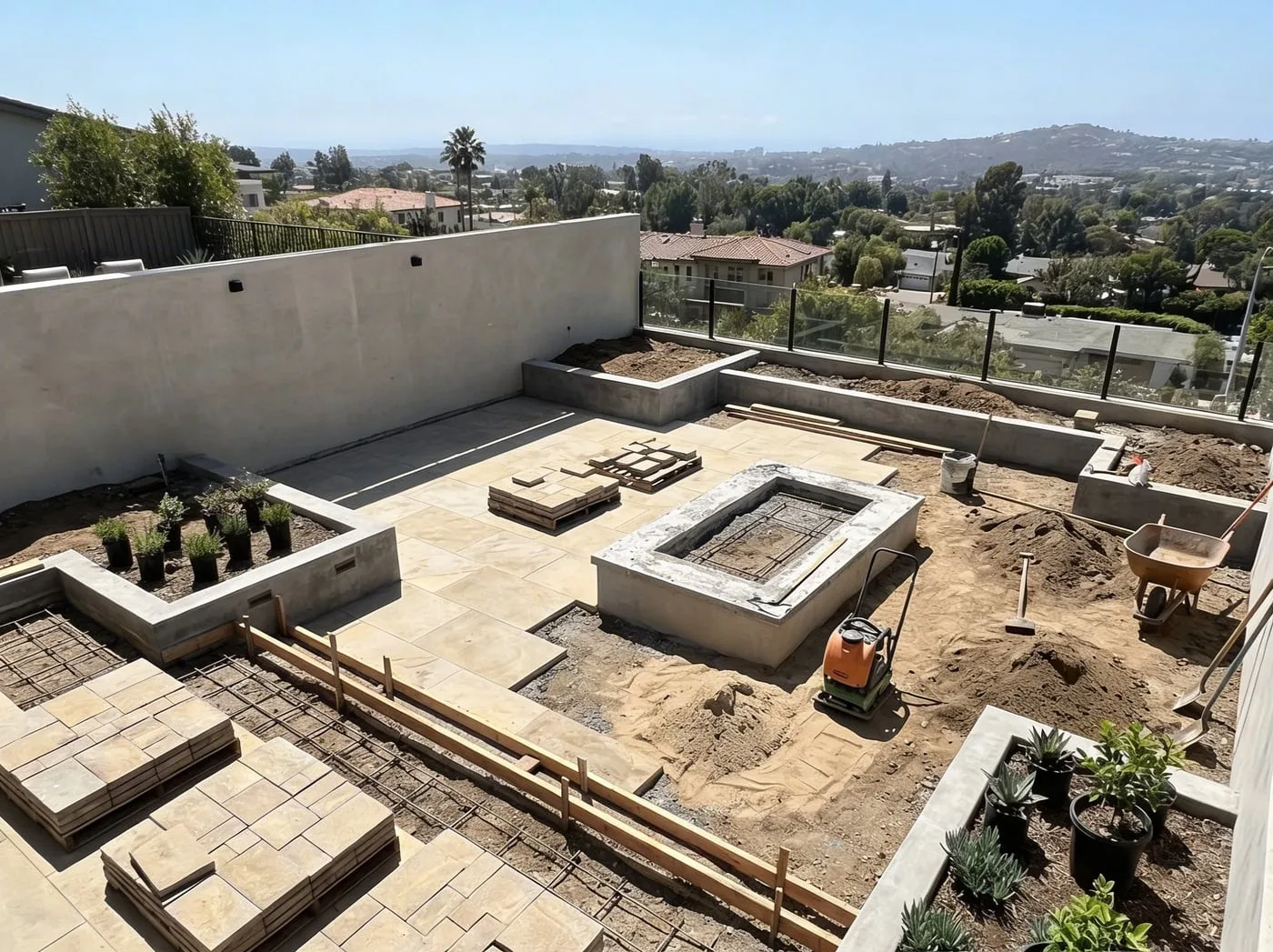
In the field
This is what mid-project looks like. Clean lines, staged materials, crew on-site. The finished product is the point. The process is how we get there without surprises.
Stage one
The first conversation.
Thirty minutes, by phone or on the property, at no cost. Gio or Mike personally — not an assistant, not a sales representative, not a junior estimator rehearsing a pitch. We listen to what the property is, what is not working, and what you want it to do for your family.
At the end of that conversation we tell you honestly whether we are the right firm for the work. If we are not — if the scope is wrong for us, if the budget is wrong for us, if the jurisdiction is wrong for us — we say so, and we will often point you to a firm that fits better. A thirty-minute call that ends in a referral is a better outcome than a signed contract we should not have taken.
What you do: tell us what you see when you walk outside. What we do: listen, ask, and tell you the truth about fit.
Stage two
The site walk.
If the fit is there, we walk the property together. Our Field Lead is typically present. We read the soil. We read the drainage. We read the sightlines from the rooms inside the house — because the best outdoor rooms are designed from the kitchen window looking out, not from the property line looking in. We read the house's architectural register so the new work belongs to the building it is attached to. We note the setbacks, the HOA overlay if one applies, and the permit jurisdiction the project will live under, whether that is the City of San Diego, the County, Encinitas, Carlsbad, La Mesa, Coronado, or another.
Photographs, notes, and rough measurements come back with us. This is the last stage where the project is still an idea.
Stage three
The design concept.
A single coordinated design across the whole outdoor footprint — not a patio drawn in isolation from the pergola, not the kitchen drawn in isolation from the pool deck. One plan. Rendered so you can see the finished space on your actual property before a single paver is laid. Materials are chosen by name, not by category. Grading is thought through. Lighting is on the drawing from the beginning, not bolted on at the end.
Revisions happen here. This is where the project takes its real shape — where a client sees a render and realizes the outdoor kitchen wants to sit four feet the other way, or that the fire feature belongs at a different axis. We would rather that decision be made on a screen in your living room than be made the morning of the pour.
This is not a moodboard. It is an instrument for making the build decisions that come next.
What you do: react honestly, edit freely. What we do: draw, revise, and bring the space forward until it is right.
Ready to begin?
Start with a thirty-minute call.
No cost, no obligation. Gio or Mike personally — not a call center, not an assistant. We'll tell you honestly whether we're the right firm for the work.
Stage four
The proposal and contract.
Line-item pricing, with the assumptions written plainly underneath. You will see what the grading allowance is. You will see which stone is priced and from which supplier. You will see the electrical scope, the drainage scope, the structural scope. If a line depends on something we cannot yet confirm — an HOA approval, a soils report finding — we tell you that in the line.
We do not run budget tiers. We do not send a good-better-best menu. We give one honest number for the work we will put our name on. We do not price-match. A competitor's lower number usually means a different scope, a different crew, or a different definition of finished — and we would rather lose the project than win it by shrinking what we would build.
Once signed, the project enters our construction calendar with a deposit schedule written into the contract. Licensed and insured general contractor, operating under Mike's Class B license — CSLB #1139785.
Stage five
Permitting and procurement.
We handle the drawings, the submittals, plan check, and the scheduling with the reviewing jurisdiction — City of La Mesa CDD, City of San Diego DSD, San Diego County PDS, City of Encinitas, City of Carlsbad, and others as the property requires. Where the property sits inside a coastal zone, we coordinate with the California Coastal Commission.
In parallel, we procure the long-lead materials. The stone your design specifies may come from a quarry with a finite shipping window. A custom-fabricated steel member may run eight weeks. A specified lantern may be on back-order from its maker. We order in the right sequence so the build, when it begins, does not stall on a pallet that never arrived.
What you do: sign what needs signing, approve what needs approving. What we do: everything else.
Stage six
Construction.
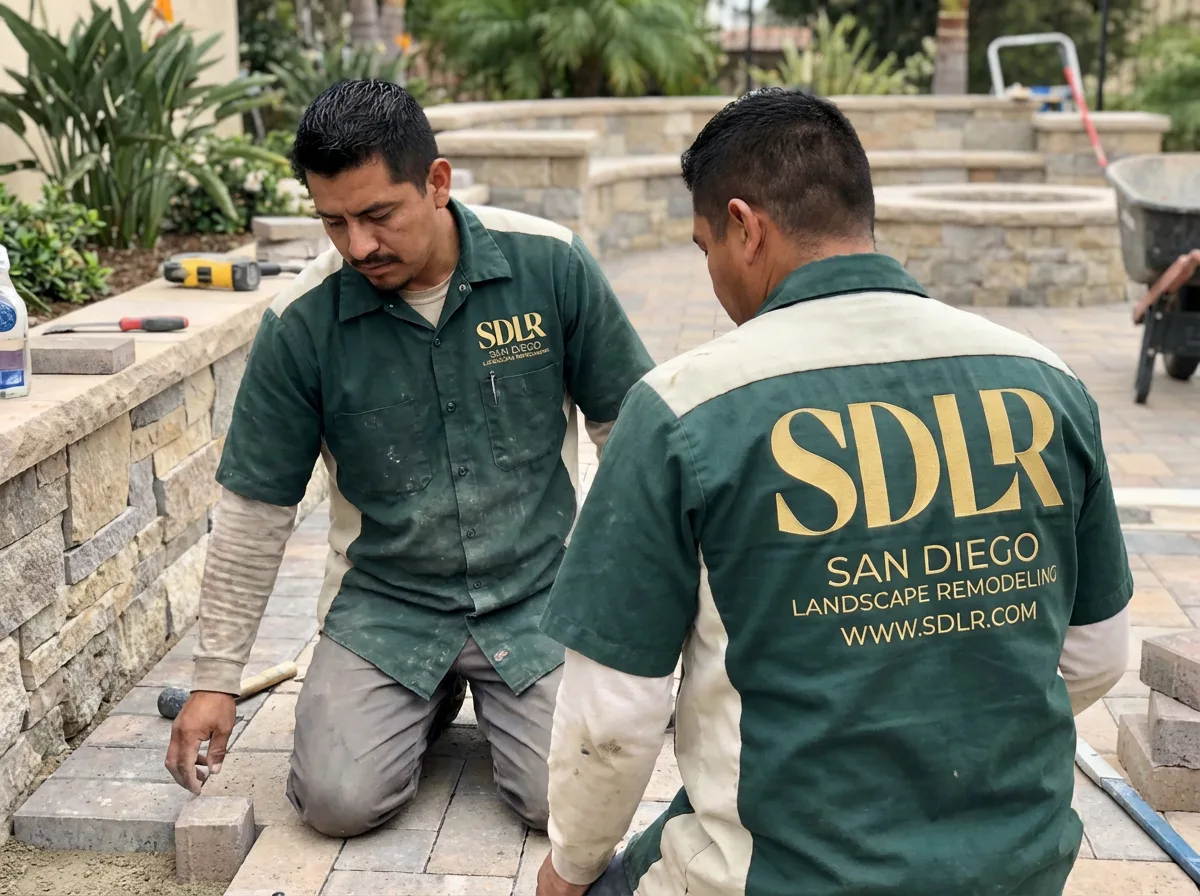
One crew, first cut to final clean. Typical on-site duration is two to four months, depending on scope. The same hands that break ground are the same hands that set the final stone. There is no subcontractor chain to coordinate and no fresh crew handed the drawings halfway through.
Gio or Mike is personally on the project. Our Field Lead runs the day-to-day. There is no account manager between you and the people doing the work, no phone tree, no ticketing system. You have our cell phones.
Weekly progress updates. The property is protected — planting beds covered, access paths laid, neighbors informed. The site is cleaned down at the end of every working day. That is not a perk. That is how we work.
Stage seven
The 10-Month Walk-Through.
Ten months after final handover — through a full winter and the first real summer of wear — we return to the property. We inspect joints, finishes, grading, drainage, and any structures we built. We address what the seasons have exposed. A stone that has moved a hair. A joint that wants resealing. A drain that needs a clear. A fixture that has drifted out of aim.
There is no invoice for this visit. It is part of the product. Our workmanship warranty is one year, and the 10-Month Walk-Through is how we make that warranty mean something in the real world rather than on paper. A firm that disappears at handover and reappears only to sell the next project was never standing behind the first one.
What will not happen
What a project here does not include.
No handoff to a subcontractor chain you did not meet and did not hire. No sales representative standing between you and the founders. No phantom timeline quoted to win the meeting and renegotiated the week before groundbreak. No price-match, ever — we give one honest number and we build to it.
No upsell at month three, where a crew halfway through a pour suddenly needs another ten thousand dollars to finish what was already promised. No surprise change-orders outside the contract lane — a change-order here exists to cover a genuine change you asked for, or a site condition no one could have known. Not as a profit lever.
The governing idea
By design, not by dispatch.
A dispatched firm answers the phone, sends a truck, and moves on. Whatever is in front of the crew that week is the work. Quality is whatever is left over after speed is served.
We work the other way. Projects are designed before they are built, scheduled months ahead of the first cut, and executed by a single crew from ground to final stone. A short list of projects in a year. Both founders personally on each one. A field team with enough tenure that craft is not rushed to meet a dispatcher's calendar.
That is what the phrase means in practice. Scarcity produces quality. Quality produces predictability. Predictability is why you hire a firm in the first place — so the conversation at the start of the project and the conversation at the 10-Month Walk-Through are the same conversation, with the same two people, about the same piece of work.
By design, not by dispatch. References available on request.
Start at stage one.
A first conversation is thirty minutes, by phone or on the property, at no cost. If we are the right firm for the work, we will say so. If we are not, we will say that too.