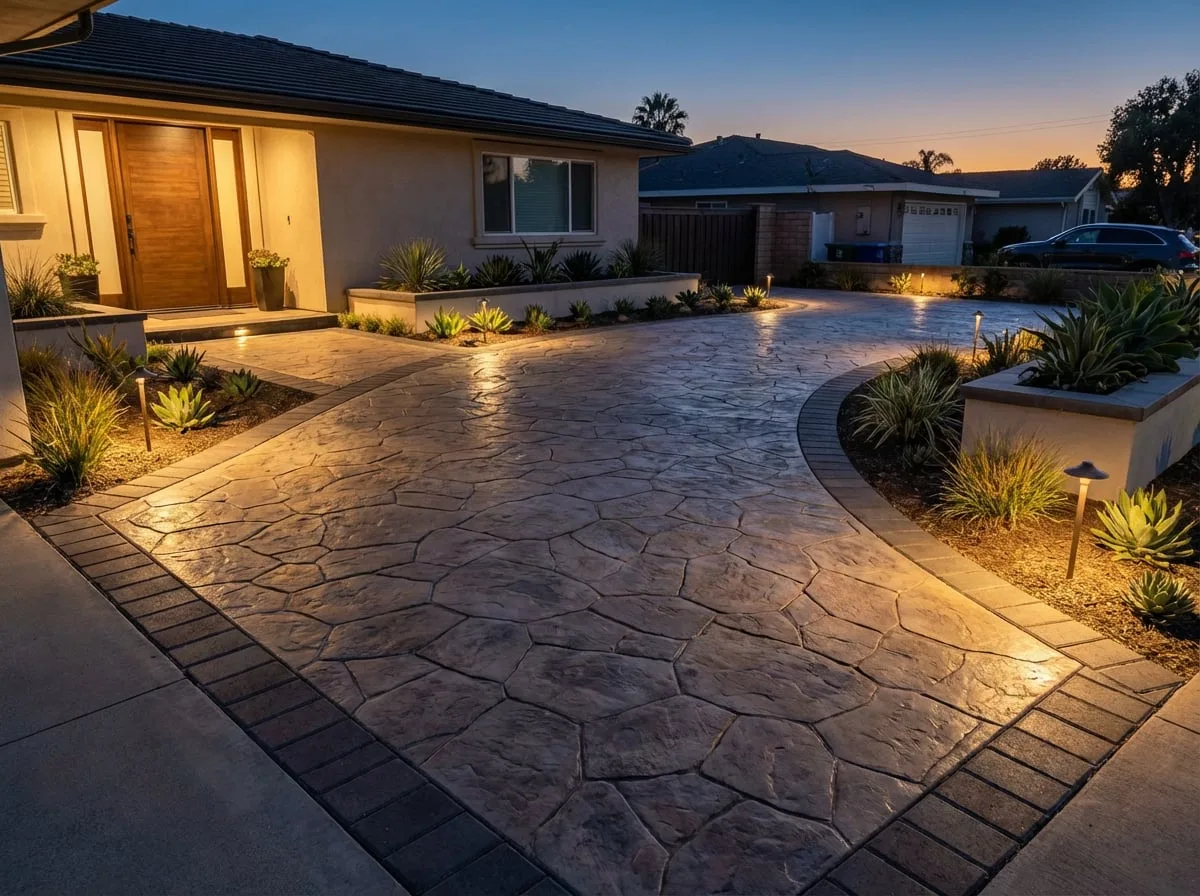
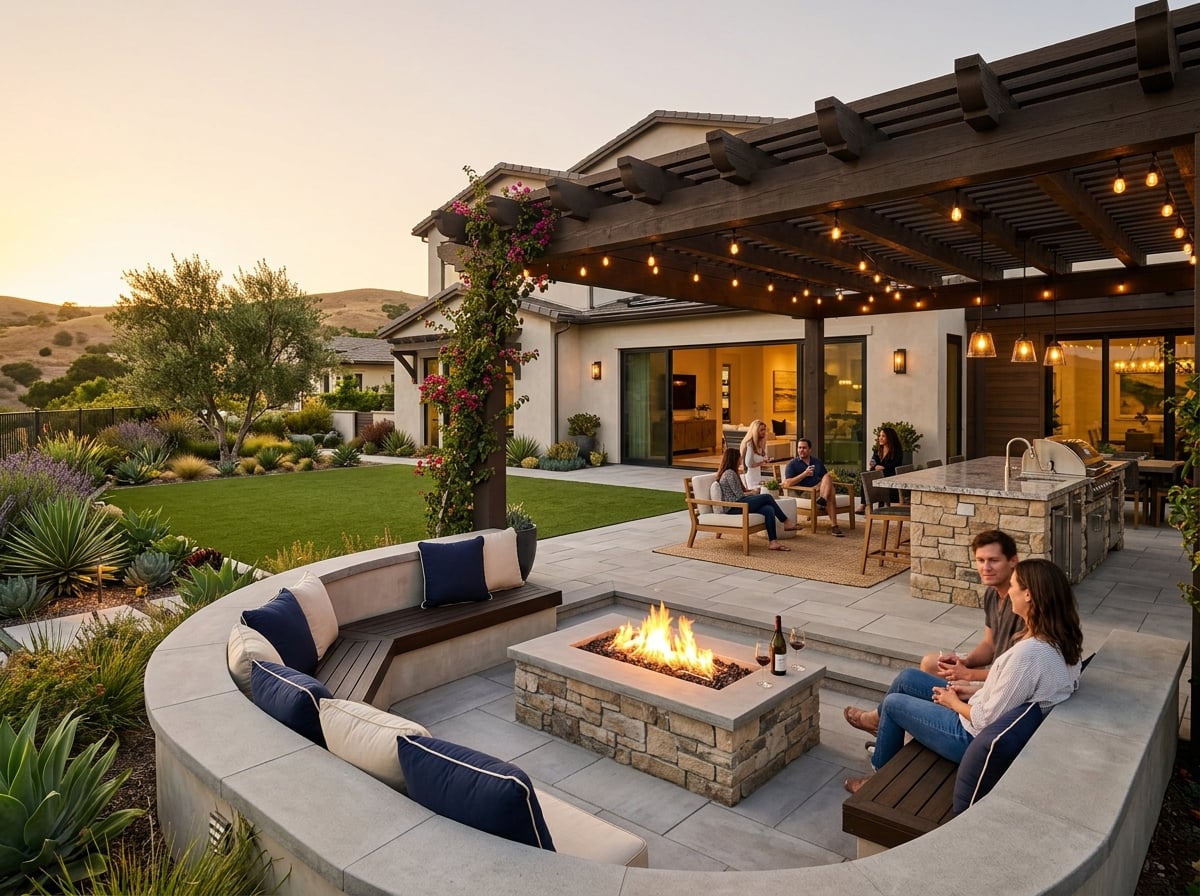
The hour after sundown is the one you will actually live in
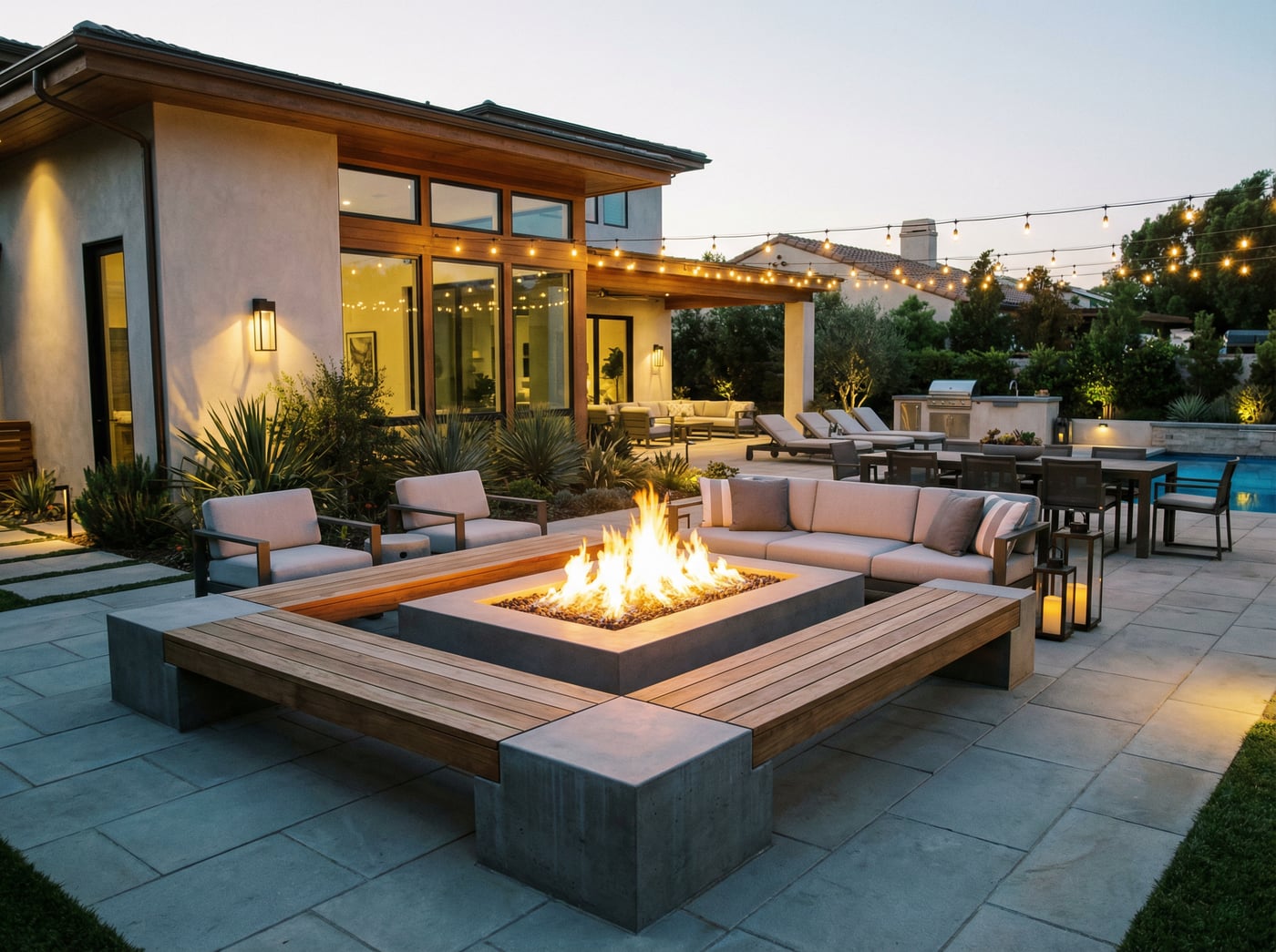
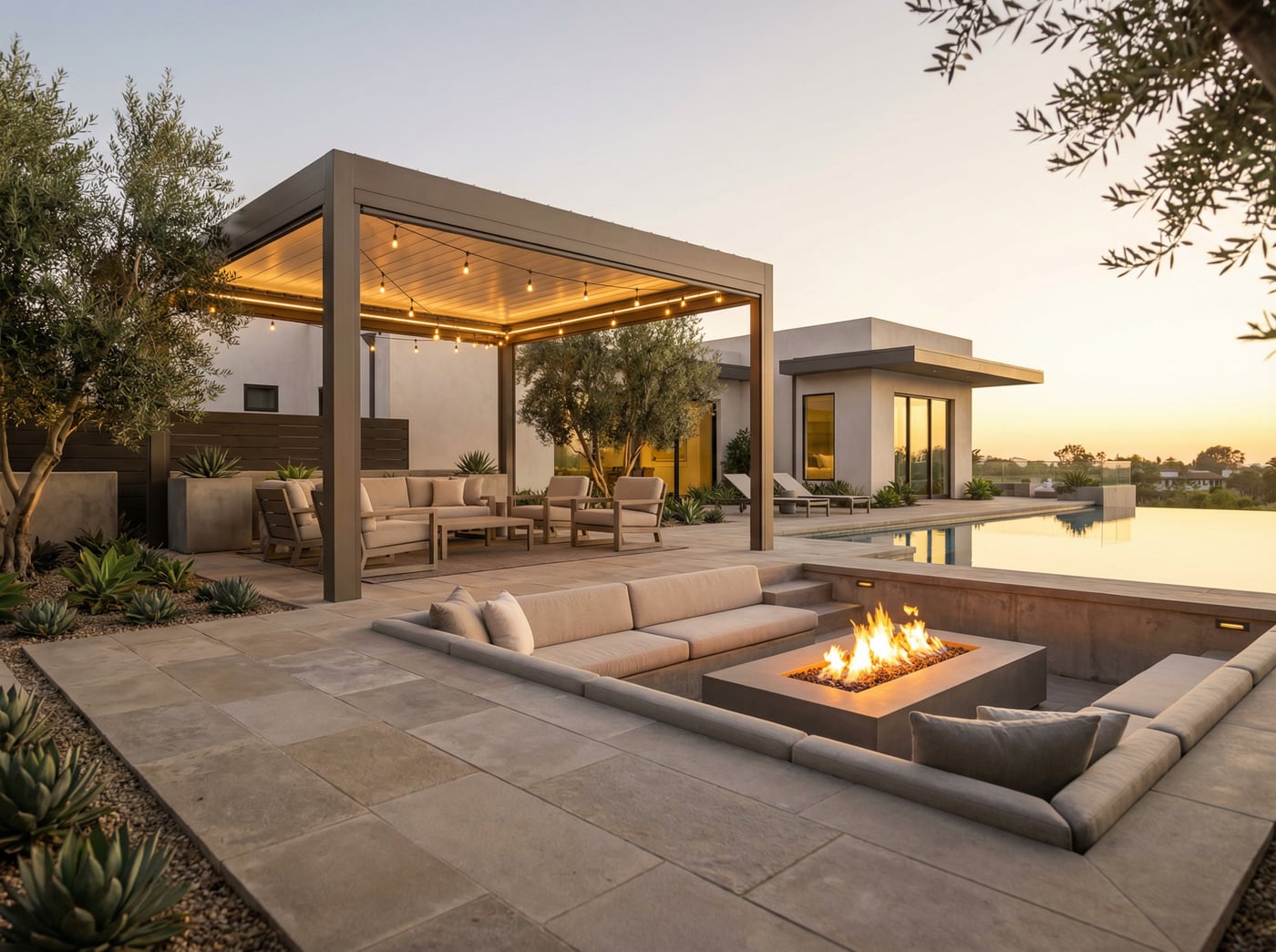
Eight o’clock in July. The light has gone. A single olive tree reads three-dimensional against the back fence, the pergola posts carry a low wash that stops exactly where the beam should stop, the path to the spa glows at knee height and nowhere else, and the dinner you started at six is still happening because nobody has noticed it is now night. Nothing on the property is shouting. Nothing reads as a fixture. The yard is simply legible — the architecture the designer drew is the architecture your eye is seeing, two hours after the sun left.
That is what landscape lighting is for. Not decoration. Revelation. A well-lit outdoor room is the same room it was at four in the afternoon — the eye still reads the depth, the material, the grade change, the tree canopy — only now you can feel the temperature change and hear the neighborhood settle.
It is also the single detail most outdoor remodels get wrong, because it was not drawn. Lighting that is sketched into the first design pass — alongside the hardscape grading and the structure footings — looks architectural. Lighting added at the end, after the pavers are set and the stucco is dry, looks bolted on no matter how expensive the fixtures are. The visible wire on the back of the pergola post. The uplight that misses the canopy and hits the fence behind it. The path light in line with the door that the eye catches before the door does. These are not fixture problems. They are sequencing problems.
The Rolls-Royce version of this work is invisible. You should never see a source. You should only see what the source is revealing.
What our lighting work includes
We design and build low-voltage landscape lighting systems as part of a larger outdoor remodel, and as standalone projects where the hardscape is already set and we have the access to do it right.
- Path and area lighting that reads feet and the edge of a paver run, not the whole yard.
- Uplighting on specimen trees — olive, oak, palm, specimen pine — sized to the canopy and aimed so the light stops where the tree stops.
- Downlighting from structures — the moonlight effect, where fixtures are hidden in the rafters of a pergola, cabana, or mature tree and the yard reads as if lit by a fuller moon than the one actually in the sky. See our pergolas and shade structures scope for how the wiring is carried inside the build.
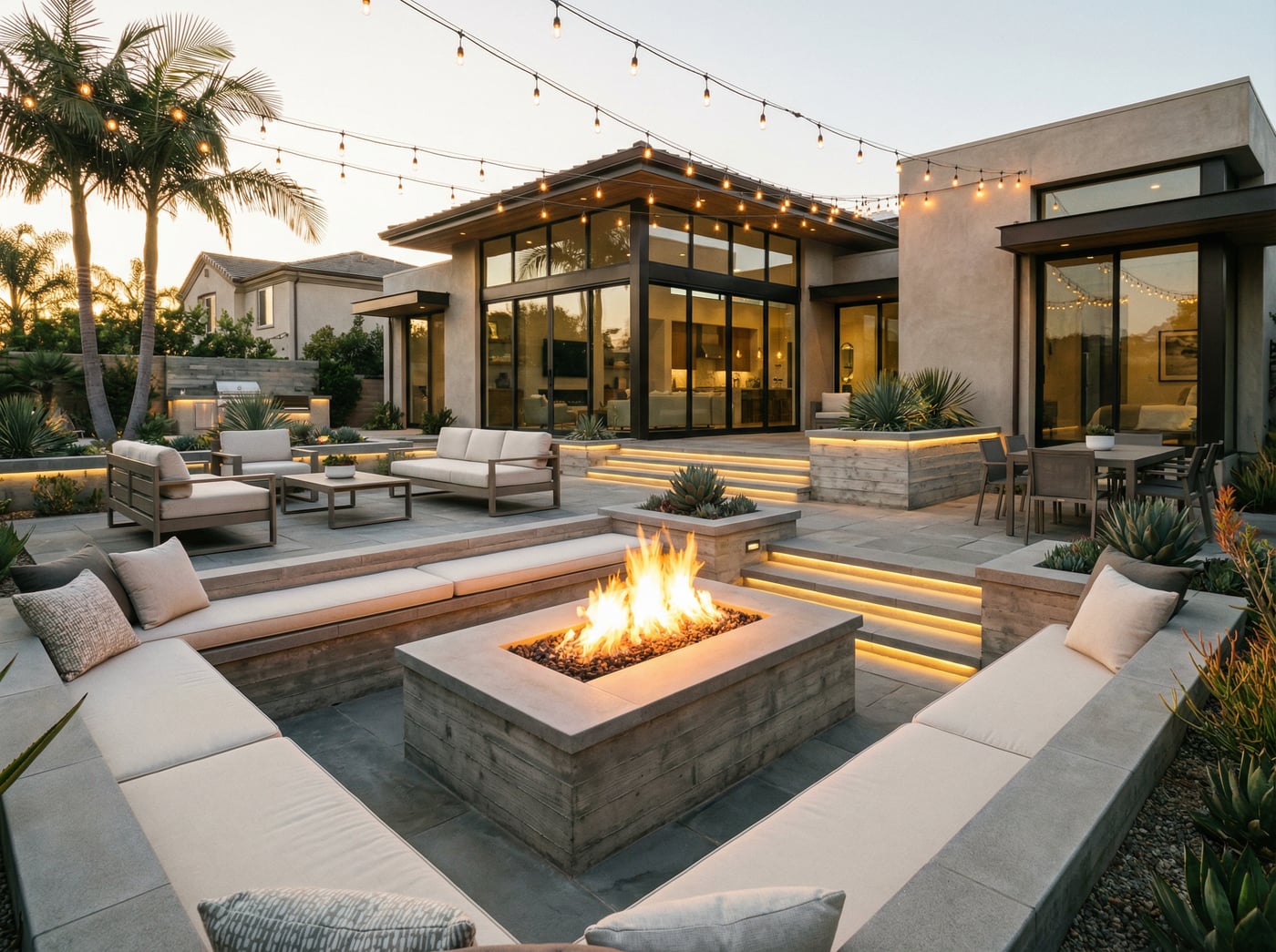
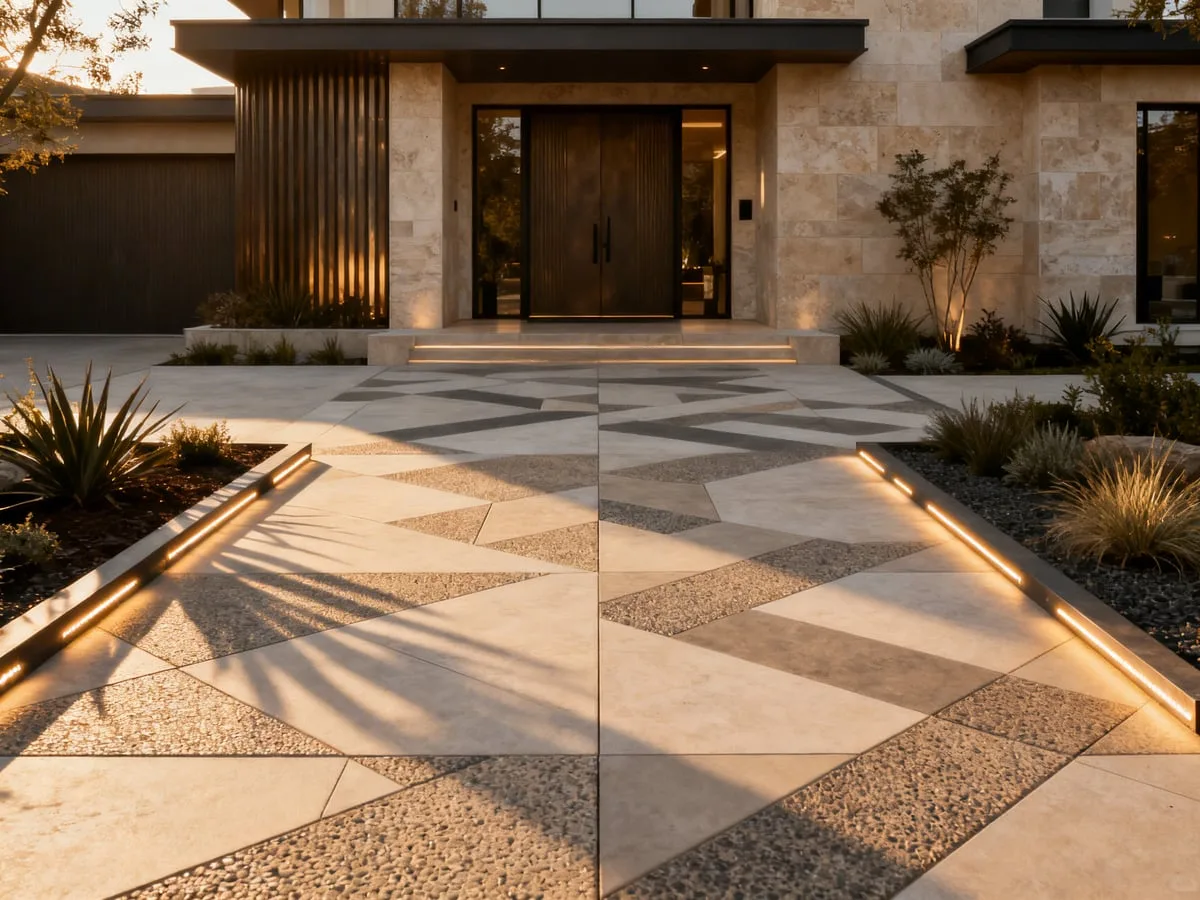
- Step, riser, and grade-change lighting integrated into the hardscape pour or set inside the paver course — never surface-mounted after the fact. Coordinated with our patios and hardscape work.
- Hardscape integration lighting — under seat walls, inside planter wall caps, inside the hearth detail of a fire feature.
- Water-feature lighting — submersibles for spas, pools, and fountains, selected to match the system’s color temperature above the water.
- Transformer sizing and placement. One transformer is rarely enough on a real property. We size for load plus headroom and place them where service is possible without disturbing finish work.
- Smart control. Zoning, scenes, astronomical timing, and app control where the client wants it.
Wire runs belong under the hardscape. Retrofitting lighting through a finished patio costs roughly five times what it costs to install the sleeves while the base is still open.
Our process
We run every lighting project — standalone or inside a full remodel — through the same seven-chapter sequence.
The first conversation. Thirty minutes, by phone or on your property. What do you want the space to feel like at nine at night? What are you lighting for — entertaining, safety, architecture, all three? We tell you honestly whether a standalone lighting job will land, or whether it belongs inside a larger scope.
Nighttime walk of the property. This is the chapter most lighting installers skip, and it is the one that decides whether the final product reads as designed. We walk the yard with you after sundown. We note which trees want to be seen, which corners want to stay dark, where the eye wants to travel, and where a guest’s foot needs a cue. A lighting plan drawn in daylight is a guess.
Layered lighting plan. The plan identifies four layers — path (where the foot goes), accent (what the eye lands on), architectural (structure and material), and ambient (the overall feel of the room) — and specifies every fixture, lumen, beam spread, and color temperature against a drawing of your actual yard. No catalog dumps.
Transformer placement and sizing. Load calculated per zone, with 20 to 25 percent headroom so the system is not running at redline from day one. We spec transformer count, location, and the service path so a failed unit can be swapped in an hour, not a day.
Wire routing coordinated with the hardscape build. Sleeves under patios, conduit through structure posts, wire under seat walls. On a concurrent hardscape project, the routing is drawn before a single paver is cut. On a retrofit, we route with the minimum disruption the finished space allows.
In-field mockup. Before the final install, we set temporary fixtures in the planned positions and check them after dark with you on the property. Beam spreads get confirmed. Aim points get moved. We would rather move a fixture on a stake than on a finished wall.
Aim-in walk at night with the client. The last night of the build, we walk the property with you with the system on, and we aim every fixture by eye, in front of you. The photometric calculation is a starting point; the final aim is a human decision.
The 10-Month Walk-Through. Ten months after completion — through a wet winter, a hot September, and the first real wear on the system — we return. We check every fixture, every joint, every lens, every aim. Tree growth gets re-aimed. Burned-out drivers get swapped. No invoice. Almost no one in this industry comes back at all. That is exactly why we do.
Materials and the brands we install
Fixture material matters because a landscape lighting system lives outside, year-round, in irrigation spray and salt air and direct sun. Plastic reads as plastic by the second summer.
We install solid brass for the majority of our work — brass patinas into the landscape rather than against it, and the fixture’s body will outlive the bulb inside it by a factor of many. We specify copper where the client wants the patina to move faster and further, and marine-grade aluminum for coastal properties where weight and corrosion resistance both matter.
Our manufacturer roster runs to four names we trust: FX Luminaire, Kichler, Unique Lighting Systems, and Vista Professional Outdoor Lighting. For smart control, we deploy FX Luminaire Luxor and Lutron systems — zone, scene, astronomical timing, and app control without the flakiness of a consumer smart-bulb retrofit.
Color temperature is a decision we make with the client, and our default recommendation is the Rolls-Royce choice: 2700K integrated warm-white. Neutral 3000K has its place on modern architecture where the material palette is cooler, but for the large majority of San Diego landscapes — Spanish, Mediterranean, contemporary warm — 2700K is the temperature your eye has been trained by firelight to read as “intended.”
LED drivers are where systems live or die. We spec drivers with documented 50,000-plus hour life and replaceable boards, and we install them where service is actually possible. We also design to International Dark-Sky Association principles — shielded fixtures, downward aim where possible, zoning that allows the system to be dimmed or off when the yard is not in use. The night sky is part of the product.
Investment and cost drivers
A San Diego Landscape Remodeling lighting project runs between $10,000 and $40,000 in the large majority of cases.
$10,000 is a modest, well-executed system — path lights along the primary circulation, a handful of uplights on the trees that deserve them, a single correctly sized transformer, and straightforward wire runs. At this tier, the work is nearly always installed alongside a concurrent hardscape job, because the sleeve-and-conduit access is already open and the cost to do it right is dramatically lower than a later retrofit.
$20,000 to $28,000 is the full layered plan across the property — path, accent, architectural, and ambient layers all drawn and installed together, smart control deployed, multiple zones, solid-brass fixture package, and a transformer sized for real load plus headroom.
$35,000 to $40,000 and above is a large estate system. Multiple transformers distributed across the property, extensive downlighting from pergolas and mature trees, water-feature integration above and below the surface, step and riser lighting integrated into long hardscape runs, and smart-system programming — scenes for entertaining, scenes for late evening, scenes for away, tuned with you on the property after install.
Cost drivers worth understanding before the first conversation:
- Fixture count and material. Brass is the honest long-run choice and is priced accordingly; marine-grade aluminum is the right call on some coastal properties and comes in meaningfully lower.
- Wire run distance. A compact urban yard and a half-acre Rancho Santa Fe property are different propositions.
- Transformer count and sizing. Load determines count; property geometry and service access determine placement.
- Retrofit vs. integration. Installing lighting alongside an active hardscape build is materially cheaper than cutting into finished work later.
- Smart control tier. A simple astronomical timer is one number. Full zoning, scene programming, and app control is another.
- Specimen tree count. Each meaningful tree is a fixture, an aim, and often a wire run of its own.
- Water-feature integration. Submersible fixtures and the sealed drivers they require add real line items.
We do not run “budget” tiers, we do not price-match, and we do not take lighting projects that cannot be delivered to the standard the rest of our work holds to.
Where we work
We design and install landscape lighting across San Diego County — by design, not by dispatch. The work shows up most often on estate properties in Rancho Santa Fe, where specimen canopies and long driveway approaches reward a layered plan, on coastal properties in La Jolla and Del Mar, where marine air drives fixture material choice and where dark-sky considerations on bluff lots are a real design input.
Each city carries its own permitting, HOA, and coastal-overlay reality. Where the transformer load, service location, or exterior circuit work requires a permit, we handle it through the San Diego County permit portal or the equivalent municipal office.
Frequently asked
Why install lighting with the hardscape instead of retrofitting later?
Because sleeves, conduit, and wire runs go in while the base is still open. Retrofitting the same system through a finished patio means cutting and patching pavers, tunneling under slabs, or running surface conduit that reads as exactly what it is. The cost is typically four to five times higher, and the result is almost never as clean. If you are building hardscape now, lighting is the cheapest it will ever be to install correctly.
Brass or aluminum?
Solid brass for the majority of properties — it patinas into the landscape, resists corrosion, and outlives the bulbs inside it. Marine-grade aluminum for coastal properties where salt air and weight both matter, and where the client prefers a powder-coat finish that stays matte black or bronze. Plastic fixtures are not on our roster at any price point; they read as plastic by the second summer and fail well before the system does.
What color temperature is right outdoors?
2700K integrated warm-white is our default recommendation and the temperature we specify on the large majority of projects. It reads the way firelight and low sun read, which is the temperature your eye associates with being outside in the evening. 3000K neutral has a place on contemporary architecture with a cooler material palette, but anything above 3000K outdoors reads as institutional — parking lot, not patio.
How does smart control work?
A transformer-mounted controller — typically FX Luminaire Luxor or a Lutron system — holds the zones, scenes, and schedule for the system. You control it from an app, a wall keypad, or astronomical timing that fires on sunrise and sunset at your actual latitude. Scenes let you set an “entertaining” look, a “late evening” look, and an “away” look once, then call them with a tap.
How long do LED landscape fixtures last?
The LED itself is rated for 50,000-plus hours — roughly 15 to 20 years at typical evening burn times. The driver is the service item; most drivers last 8 to 12 years, and we spec drivers with replaceable boards and install them where service is physically possible without taking apart finish work. Bulbs on legacy halogen systems we retrofit get swapped to LED integrated heads during the project.
Does lighting increase property value?
On properties in this price range, lighting affects perceived value and listing presentation far more than it shows up as a line-item bump. A well-lit yard photographs at night. It also extends the usable hours of every square foot of outdoor living space you have already paid to build — which is the real return. We do not market lighting as a renovation-ROI play; we design it as the reason the outdoor room you just built is actually used.
What about dark-sky considerations?
We design to International Dark-Sky Association principles on every project — shielded fixtures, downward aim where the design allows, and zoning that lets the system dim or go dark when the yard is not in use. On bluff properties and rural-facing lots, this matters for the neighbors and for the night sky itself. It is also almost always the more disciplined lighting design.
What is the workmanship warranty?
We warranty our lighting workmanship for a minimum of one year, with fixture and LED warranties extending longer per manufacturer. More importantly, the 10-Month Walk-Through is built into every project — ten months after completion we return to the property, walk the system with you at night, re-aim for tree growth, swap any failed drivers, and handle anything the seasons have exposed on our dime. You can verify Mike’s active Class B general contractor standing any time through the CSLB license lookup.
Who do we talk to during the project?
Gio or Mike. Every project is personally run by one of the founders — no account managers, no handoffs. You have both cell phones from the first call. Our Field Lead runs the day-to-day on the ground, and the nighttime walk, the mockup, and the final aim-in are done with one of us on the property with you. Direct-founder access is part of the product, not an add-on to it.
Can we see a lit property in person?
Yes. References available on request. During discovery we are glad to drive you past completed properties after dark — seeing a real system on a real yard at nine at night is worth more than any photograph, and it is the honest way to evaluate lighting work. Photographs flatter bad lighting and understate good lighting; the eye, on the property, does not.
References available on request
We do not publish testimonials. When a lighting project is complete, we invite future clients to speak directly with the homeowners who have lived with the finished system through a full year. During discovery, we will also drive you past completed properties after sundown. It is the old-fashioned way to vet a builder, and on this kind of work — where the product reveals itself only at night — it is still the best.
When you are ready
If you are building hardscape now, this is the right moment to have the lighting conversation. If the yard is already finished and the evenings are not working, that is worth a conversation too — we will tell you honestly what a retrofit can do and what it cannot. A first conversation is thirty minutes, by phone or on your property, at no cost. We will listen, we will walk the yard at the hour it matters, and we will tell you whether we are the right team for the work.
Licensed and insured general contractor, operating under Mike’s Class B license — CSLB #1139785.