
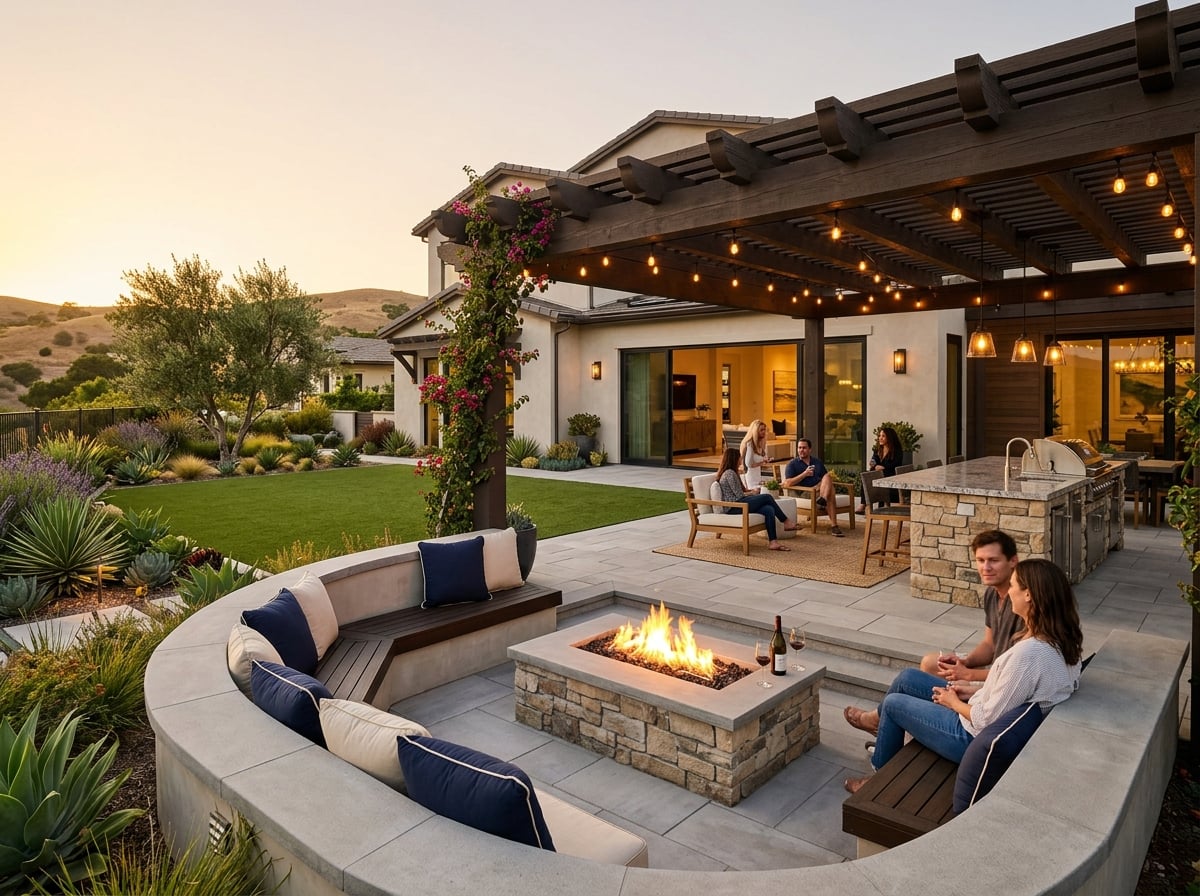
A neighborhood that rewards standing still
There is a particular hour in Mission Hills — late afternoon, after the jacaranda has dropped its second wave and before the evening walk down the hill — when the yard becomes the best room in the house. The canyon opens west from the edge of Sunset Boulevard. The light flattens along a stucco wall the color of weak coffee. A terra-cotta tile holds the warmth of the day under your bare foot. Somewhere two streets over, a Craftsman door closes and a dog is called back inside. You can hear it from your own patio.
That is what makes this neighborhood worth the work. The houses were designed to be lived with, not around. Spanish Colonial Revival, Mediterranean, a run of well-kept Craftsman and Tudor Revival from the 1910s through the 1930s — a pocket of San Diego that did not get erased in the mid-century. Little Italy is twelve minutes on foot down Washington. Old Town is five minutes the other direction. The airport is so close you can watch the approach lights turn on from your own back garden.
Most of our Mission Hills clients have been in the home for decades. The roof has been done. The kitchen has been done twice. The last thing standing between the house and the life they actually want inside it is the yard — and the yard, on a lot this old, on a slope this particular, is the hardest piece to get right. That is the piece we build.
The property profile
Mission Hills was platted between the late 1880s and the 1920s, and most of what you see today went up between 1910 and 1935. The architectural stock is tight and coherent — Spanish Colonial Revival dominates, with Mediterranean, Craftsman bungalows, Tudor Revival, and a thin layer of Mission Revival scattered along the ridge and down into the canyon edges.
Lots tend to run between 0.15 and 0.3 of an acre on the interior streets. Canyon-edge parcels — the ones with the view — are often larger on paper but carry a substantial unbuildable slope inside the lot line. The buildable footprint on a half-acre canyon lot can be closer to a quarter. The slope is not wasted land; it is the view that sold the house. But it changes what can be built, where drainage has to go, and how the hardscape has to step down.
Owners in Mission Hills are long-tenured. Many have lived in the home for twenty or thirty years. A serious number are second-generation residents — the house was in the family. That tenure shows up in the yards: mature avocado, mature Canary Island pine, mature podocarpus hedges that have been pruned into architecture. When we remodel a Mission Hills backyard, we are almost always working around trees older than the client’s oldest child.
Soil and climate
The flats of Mission Hills — along Fort Stockton, Washington Place, the interior grid — sit on clay loam. It holds water, it holds nutrients, and it moves under a poorly engineered patio. Any hardscape worth keeping begins with a proper sub-base, compacted lifts, and a geotextile separation layer where the native clay meets the aggregate. Skip that and you will read the mistake in the joint lines within two winters.
The canyon-edge parcels — off Sunset, along the western drop, the lots that sit above Mission Valley — transition to decomposed granite at the slope face. Decomposed granite drains well but moves under concentrated water flow. A downspout aimed at a DG slope is a gully in the making.
Drainage is the engineering reality of a canyon lot. Every full remodel we run in Mission Hills begins with a grading and drainage plan — where the water goes when it rains hard in February, how it is collected, where it is discharged, and how the slope is kept from contributing soil to Mission Valley. Our drainage and grading work is what makes the rest of the scope hold its line for the long term.
Permits and historic review
Permitting in Mission Hills runs through the City of San Diego Development Services department. For outdoor work — patio structures, retaining walls, gas and electrical runs for kitchens and fire features, any pergola over the footprint threshold — that is the front door.
The other door, and the one that matters most in this neighborhood, is the Mission Hills Heritage Area and the San Diego Historical Resources Board. If your home is individually designated as a historic resource, or sits inside a designated district contributor list, exterior work that affects the character-defining features of the property requires Historic Resources Board review before a permit is issued. That includes a lot of what a full backyard remodel touches — visible hardscape at the front and sides, garden walls, gates, accessory structures, fences and courtyards that face the street, lighting fixtures attached to the primary structure.
A historic designation is not a no. It is a different timeline and a different drawing set. HRB review adds weeks — sometimes months — and requires a design that reads as period-appropriate to a board of professionals who have seen every shortcut. A non-designated parcel around the corner from a designated one moves on a normal municipal clock. Knowing which side of that line your home is on is the first question we answer on the site visit.
Design character
Mission Hills is not a place to impose a style on a house. The house already has one. A full backyard remodel here is an exercise in reading the architecture and answering it — in hardscape, in planting, in structures, in the quiet choices of color and material that either look intended or look tolerated.
Spanish Colonial and Mediterranean gardens. The vocabulary is courtyard geometry, stucco walls with a hand-float finish, decomposed-granite pathways, terra-cotta and saltillo tile accents, wrought iron where iron belongs, a restrained planting palette — olive, rosemary, citrus, agave, bougainvillea. Water as a quiet feature, not a spectacle. A wall fountain against stucco, not a modernist trough in black steel.
Craftsman gardens. Restrained structure, honest materials, native and Mediterranean planting. Clear vertical-grain cedar pergolas with visible joinery. Stacked stone or rough-face masonry at the low walls. Path lighting that reads as lanterns, not as fixtures. The garden is meant to feel built by a careful hand, not engineered on a computer.
Tudor Revival gardens. More formal structure — clipped hedges, defined beds, brick or stone paths, a single well-placed specimen tree. Shade is part of the plan.
A modernist treatment on a 1925 Spanish Colonial reads wrong. Not because the modernist treatment is bad — because the house is already speaking, and the yard has to speak the same language. That discipline is most of the work.
Where we fit
San Diego Landscape Remodeling takes a small number of full remodels in the central and urban corridor each year. Mission Hills sits inside that short list.
On a designated property, we run Historic Resources Board review as scope. That means our design drawings are prepared to the standard the board expects, the submittal package is assembled and filed from our office, we handle the correspondence with the HRB staff and any required on-site visits, and we walk your project through the review calendar. You sign the forms. We do the walking.
On a non-designated property, we move on the normal municipal clock and fold the Development Services permit track into the build schedule.
Either way, both founders are personally on your project — Gio running the plan, Mike running the build, our Field Lead running the day-to-day with a crew of trade pros with 25-plus years in high-end outdoor work. And ten months after completion, we return for the 10-Month Walk-Through: a fine-toothed inspection of every square foot of the work we delivered, through a wet winter and a hot September. Anything that needs attention gets attention. No invoice. We are the firm you want to call because we are the firm that comes back.
Services we run in Mission Hills
Full scope of outdoor work, delivered as one plan under one crew:
- Full backyard remodels
- Outdoor kitchens and BBQ islands
- Patios and hardscape design
- Fire pits and fireplaces
- Pergolas and shade structures
- Retaining walls and seating walls
- Artificial turf installation
- Landscape lighting
- Pool decks and poolside hardscape
- Drainage and grading
Neighbors: we also work in Point Loma, La Jolla, and Coronado.
Frequently asked
How long does Historic Resources Board review take on a designated Mission Hills property?
The honest answer is that it varies — typically several weeks to several months from a complete submittal to a final determination, depending on scope, board calendar, and whether staff can clear the work at the counter or the project has to go to a full board hearing. Minor, clearly period-appropriate exterior work can move faster. Anything that modifies a character-defining feature takes longer. We scope the review track into the project calendar at the proposal stage so the schedule you sign reflects the real timeline, not a hopeful one.
Can you design a garden that matches the period of my Spanish Colonial?
Yes — it is most of what we do in this neighborhood. Period-match is not imitation. It is a disciplined reading of the house: the wall finish, the tile, the ironwork, the roof pitch, the proportion of door to window. From that reading we choose the hardscape material, the planting palette, the structures, and the light. The finished yard reads as though it has always been there. That is the goal.
My lot is on the canyon edge. How do you handle drainage and retaining?
With a drainage and grading plan drawn before any hardscape is designed. On a canyon lot we map where water collects, where it has to be discharged, and how the slope face is stabilized. Retaining is engineered where the height and soil condition require it — and on many Mission Hills canyon lots, a low seating wall doing double duty as retaining is the right answer, not a taller structural wall. The first question is always where the water goes when it rains hard in February.
Mission Hills lots are not huge. Can you design a full remodel on a quarter-acre?
The best work in this neighborhood is on smaller lots. A well-designed 2,000-square-foot backyard reads larger than a 5,000-square-foot yard done without a plan. The tool is zones — a dining terrace, a seating zone at the fire feature, a small lawn or turf inset for children and grandchildren, a kitchen run that borrows the house wall. Each zone has a purpose and a scale. Nothing is oversized. Nothing competes.
What does a full remodel in Mission Hills actually cost?
Most of our full remodels land between $50,000 and $300,000. A refresh of an existing footprint — new hardscape, a pergola, lighting, finish planting — can land near the floor. A coordinated remodel of a canyon-lot property with kitchen, fire feature, retaining, drainage, and planting program typically falls in the $150,000 to $300,000 range. We also build to the $500,000-plus tier where the property and program support it. We do not take on small-scope work, and we do not price-match.
My house is not historically designated but my neighbor’s is. Does that affect my project?
Not the review track — your permit moves through standard Development Services. It can affect design judgment. Character in Mission Hills is a street-by-street reality; a yard that ignores the neighborhood reads as an outsider even if the city has no authority to say so. We design to the block, not just the lot. That is a choice, not a rule, and we walk you through it.
What am I actually allowed to build on a designated property?
More than most owners assume, if the design is period-appropriate and the work respects character-defining features. You can add a pergola, a fire feature, an outdoor kitchen, a pool deck, a garden wall, a lighting program. What gets scrutinized is how the addition reads from the public right-of-way, whether the materials and proportions match the era of the house, and whether the character-defining features — original wrought iron, original tile, an original garden wall, an original gate — are preserved in place. Guidance lives with the Historical Resources Board and is resolved case by case.
Do you handle the permit and HRB paperwork yourselves?
Yes. Permitting and historic review are inside our scope on every full remodel we run in Mission Hills. We prepare the drawings, assemble the submittal, file with the city, respond to plan-check and HRB comments, and schedule inspections. You sign. We do the walking.
References available on request
We do not publish testimonials. When a Mission Hills project is complete, we invite future clients to speak directly with the homeowners who live in the finished work — a real conversation, not a cropped quote. During discovery we will also walk you past completed projects in the neighborhoods where they sit. On this kind of work, in this kind of neighborhood, it is still the best way to vet a builder.
When you are ready
If the property is in Mission Hills, the scope is serious, and the timeline is planned rather than urgent, we would like to hear about it. A first conversation is thirty minutes — by phone or on your yard — and there is no cost to begin. We will listen, we will tell you what we see, and we will tell you honestly whether we are the right firm for the work.
Licensed and insured general contractor, operating under Mike’s Class B license — CSLB #1139785. Verify any California contractor at the CSLB license lookup.