
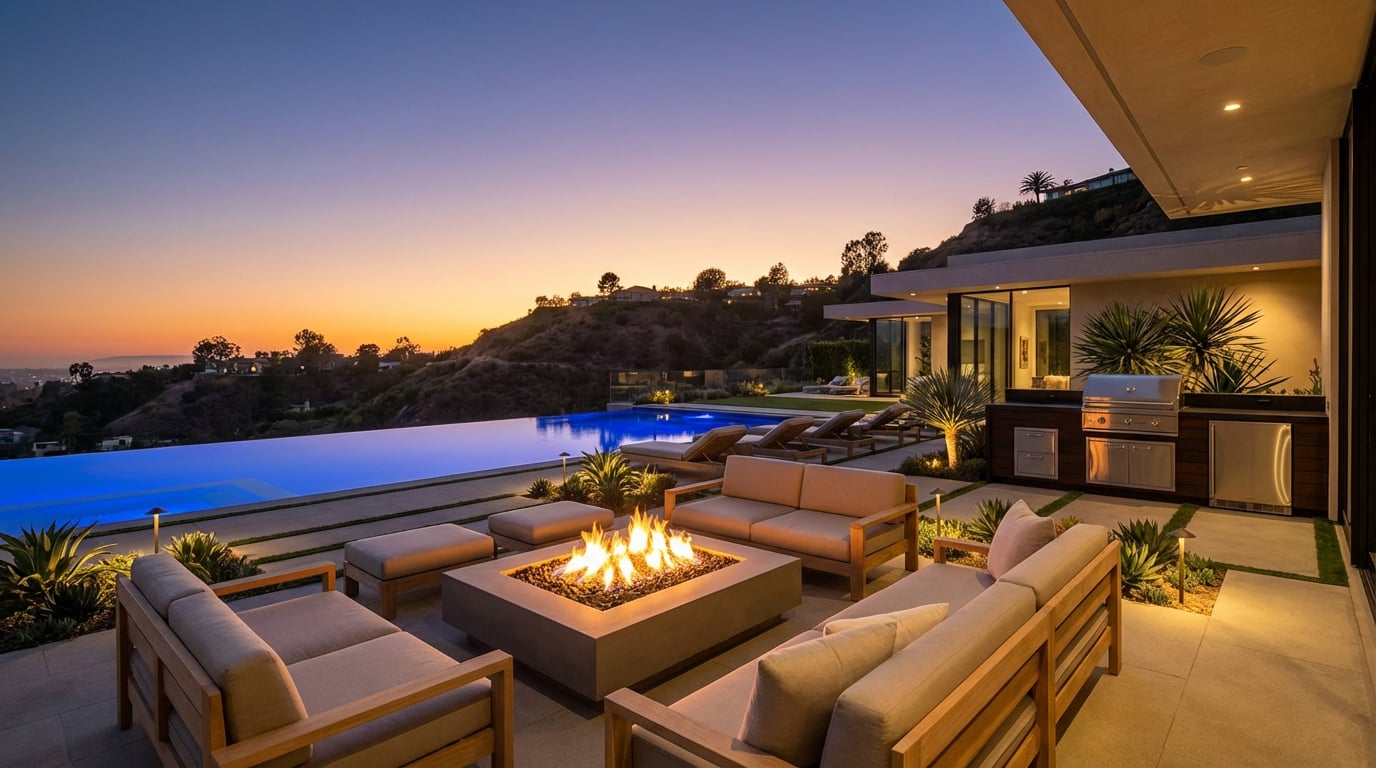
A La Jolla morning, and the yard that earns it
The day starts before you do. The light off the water at Bird Rock arrives first — thin, silver, the kind of coastal morning that turns the tide pools into a quiet grid of mirrors — and by the time you are on the back terrace with a cup of coffee, the marine layer is lifting off the Muirlands in the slow, unhurried way it lifts off nothing else in the county. A walk down Nautilus or along Coast Walk Trail turns into a second cup outside. The paper never makes it in.
A La Jolla backyard is not a feature of the house. It is how you actually live in the house. The kitchen sliders stay open from April through October. The grandchildren eat lunch outside because outside is the better room. The friends who drive in from Rancho Santa Fe or Del Mar stay an hour longer than they meant to because the fire is lit and the bougainvillea is doing what bougainvillea does on a warm evening in La Jolla.
That is what the yard has to support. Not a photograph. Not a feature list. The long, unhurried days that are the reason you bought here — and the evenings that keep people on the terrace until the ocean has gone black and only the path lights are visible. The work has to be quiet enough to hold that. Most yards in this zip code are not.
The property profile
La Jolla is not one market. Bird Rock sits low, salt-close, and tight-lotted — $3M to $8M cottages and contemporary rebuilds on parcels that rarely exceed a fifth of an acre. The Muirlands climbs from there: larger estate lots, architect-signed homes, and the coastal eucalyptus that shades half the street in mid-afternoon, with budgets that cover $5M to $15M. La Jolla Shores leans beach-house and Mid-Century on flatter parcels. La Jolla Farms is its own country — bluff-edge estates on one to several acres, $15M to $30M-plus, with ocean-weather exposure that dictates every material on the plan. Country Club and The Barber Tract sit between — old-money long-tenured owners next to a young family who closed last quarter. Hidden Valley tucks into the canyon side, green and quiet, with drainage realities the flatter parcels do not face.
Lots run from roughly 0.15 acres in the Bird Rock grid to an acre-plus on the western edge of La Jolla Farms. Bluff lots, view lots, and canyon lots are not three flavors of the same project. They are three different jobs.
Soil and coastal climate
Near the coast, soils are sandy over the rocky bluff substrate that defines the shoreline — a profile that drains easily in Bird Rock and along the Shores, and that behaves predictably under pavers when the base is built right. Move inland through the Muirlands and Hidden Valley and the soil shifts toward clay, which holds water, expands, and asks more of the grading plan and the drainage detail.
The air is the other factor. Salt carries further inland in La Jolla than most clients expect, and it is the quiet material-selection factor on every project in this zip code. Unprotected steel corrodes. Standard galvanized hardware degrades. Softer woods check and cup inside two summers. The yards that still look intended a decade later were built with that in mind from the first line on the drawing.
Permits and jurisdiction
Outdoor work in La Jolla runs through the City of San Diego Development Services Department, and the review is more textured here than elsewhere in the county. Coastal parcels fall inside California Coastal Commission jurisdiction, which means longer review windows, stricter habitat and bluff-setback findings, and the possibility of appeal by an adjacent owner or a standing organization. Plan on the coastal layer adding meaningful time, and build that time into the calendar rather than the last week of it.
The La Jolla Community Planning Association provides advisory review on projects within its boundary. It is not regulatory, but the input shapes Development Services decisions, and projects that arrive at LJCPA without a clean presentation tend to lose weeks they did not need to lose. Certain Muirlands estates carry historic-home considerations as well, with Historical Resources Board review required when a designated resource is touched. We read the jurisdictional layers into the schedule from the first site visit, rather than discovering them at plan check.
Design character
The houses that read right in La Jolla sit inside four architectural families: coastal contemporary, Mediterranean, Spanish Revival, and the quieter end of modern. Each one asks for an outdoor language that extends the house rather than argues with it — a Muirlands Spanish Revival wants hand-set stone, honest masonry, and deep-shade structures in cedar, not a gray-plank paver and a stainless railing. A Bird Rock contemporary wants restraint, large-format hardscape, and light wells that hold up against the salt, not a Tuscan fountain.
What reads wrong is almost always the same thing: a suburban-tract material palette placed on an estate lot. Stamped concrete, big-box modular pavers, and applied-stone veneer do not survive the context. The eye sees them immediately, and the value the architecture worked to build quietly leaks out of the yard.
What reads right is restrained, architect-coordinated, material-honest. A short list of materials, chosen for the climate and the house, detailed at the joints the way the interior is detailed. The finished yard should look inevitable — as if the house was always going to end this way.
Where we fit in La Jolla
La Jolla is not a city we drive through on the way to somewhere else. It is one of the handful of zip codes the firm was built for — view-driven design, bluff-lot complexity, coastal material discipline, and owners who can tell the difference between intended and tolerated.
We run California Coastal Commission submittals, La Jolla Community Planning Association presentations, and Historical Resources Board reviews as scope, not as an afterthought billed later. We work alongside your architect when you already have one — we bring the build discipline, the material knowledge, and the coordination of a single set of drawings rather than two. When there is no architect in place, our in-house design process handles the program from the first hand sketch on the property to photorealistic 2D and 3D renderings of the actual yard.
Founder access is part of the product here for a reason. On a La Jolla project, the client is speaking directly to Gio or Mike from the first call through the 10-Month Walk-Through — the return visit, ten months after completion, where we walk every square foot with you and handle anything the seasons have exposed on our dime. That is how a yard at this level stays at day-one condition.
Our services in La Jolla
- Full backyard remodels — one plan, one crew, the entire outdoor footprint.
- Outdoor kitchens and BBQ islands
- Patios and hardscape design — paver, concrete, stone.
- Fire pits and fireplaces
- Pergolas and shade structures
- Retaining walls and seating walls
- Artificial turf installation
- Landscape lighting
- Pool decks and poolside hardscape
- Drainage and grading
Clients in La Jolla often also look at our work in neighboring markets: Del Mar, Mission Hills, and Point Loma.
Frequently asked
How long does California Coastal Commission review actually take?
Longer than Development Services alone, and the honest range is months rather than weeks. For coastal parcels inside CCC jurisdiction, we plan for a deliberate front-end window — pre-application coordination, LJCPA advisory review, the Coastal Development Permit submittal itself, and the appeal period that follows approval. We build that sequence into the project calendar from the first conversation rather than attaching it to the back end. Clients who need to be in the ground next month are not served by pretending the timeline is shorter than it is.
What do projects typically run in La Jolla Farms versus Bird Rock?
Bird Rock projects generally sit in the $75,000 to $200,000 range for a considered full-yard scope on the smaller parcels common to the neighborhood. La Jolla Farms is a different conversation — parcels are larger, program is broader, and the coastal material discipline required at that exposure is not optional. Full remodels there routinely fall between $250,000 and $500,000, with the larger estate programs going above that when bluff-edge work, pool-deck integration, and architect-coordinated structures are inside the scope. The Muirlands, Country Club, and The Barber Tract tend to land between those two poles.
How do you handle view preservation?
With restraint. The reason a La Jolla yard is worth the investment is almost always the view, and the fastest way to damage the value of a property here is to install something that blocks it — a pergola placed a foot too high, a planting program that matures into the sightline, a structure that fights the horizon. We plan every vertical element against the primary view axes from the house and the primary outdoor rooms. Where a neighbor’s view is protected by ordinance or custom, we design to that as well. The best La Jolla outdoor work is the work you almost do not notice until you sit down in it.
Do you work with architects who are already engaged?
Yes, and often. La Jolla projects frequently arrive with an architect already on the design. We coordinate directly — one set of drawings, one material schedule, one construction sequence — and we bring the build discipline and the outdoor specialist knowledge to a team that already has the house handled. The point is a yard that extends the architecture, not one that competes with it.
How is drainage handled on bluff lots?
Carefully, and as engineered scope rather than as field decisions. Bluff-adjacent parcels carry real consequences when water is routed wrong — surface flow, geotechnical stability, and habitat protection all sit on top of the drainage plan. We work from the topography, the soils report, and the coastal overlay, and we design the grading and drainage package alongside the hardscape rather than after it. Our drainage and grading service page covers the broader approach.
What about Muirlands estates with historic-home status?
Historic designation changes the review path, not the quality of the work. Where a designated resource is involved, Historical Resources Board review applies, and the exterior work has to meet the standards that protect the resource. We have run the process before, and we build it into the schedule rather than discovering it at plan check. The outcome the client cares about — a yard that matches the estate — is entirely achievable inside that review. It simply demands a firm that treats the process as scope.
What materials actually hold up in coastal salt exposure?
The short answer: stainless hardware at a marine-grade spec, hot-dip galvanized or powder-coated steel detailed for the climate, hardwoods and modified woods that hold their geometry under salt, natural stone, and dense porcelain pavers where the program allows. What does not hold up: standard carbon steel, untreated softwood, budget-grade hardware, and applied-veneer systems with improper flashing at the joints. A La Jolla yard built with coastal-appropriate materials still looks intended a decade in. A La Jolla yard built with inland specifications does not make it to year five.
Can we see La Jolla work in person before committing?
References available on request. During discovery, we are glad to take you past completed projects in the neighborhoods where they sit — in La Jolla and in adjacent coastal markets — so you can see how the work behaves in the same light and the same climate your property lives in. It is the old-fashioned way to vet a builder, and on this kind of work, it remains the most useful one.
References available on request
We do not publish testimonials. When a project is complete, we invite future clients to speak directly with the homeowners who have lived in the finished work — a real conversation, not a cropped quote. You can also verify Mike’s active Class B general contractor standing any time through the CSLB license lookup.
When you are ready
If the property is in La Jolla and the scope is serious, we would like to hear about it. A first conversation is thirty minutes — by phone, or on your yard — and there is no cost to begin. We will listen, we will tell you what we see, and we will tell you honestly whether we are the right firm for the work.
Licensed and insured general contractor, operating under Mike’s Class B license — CSLB #1139785.