
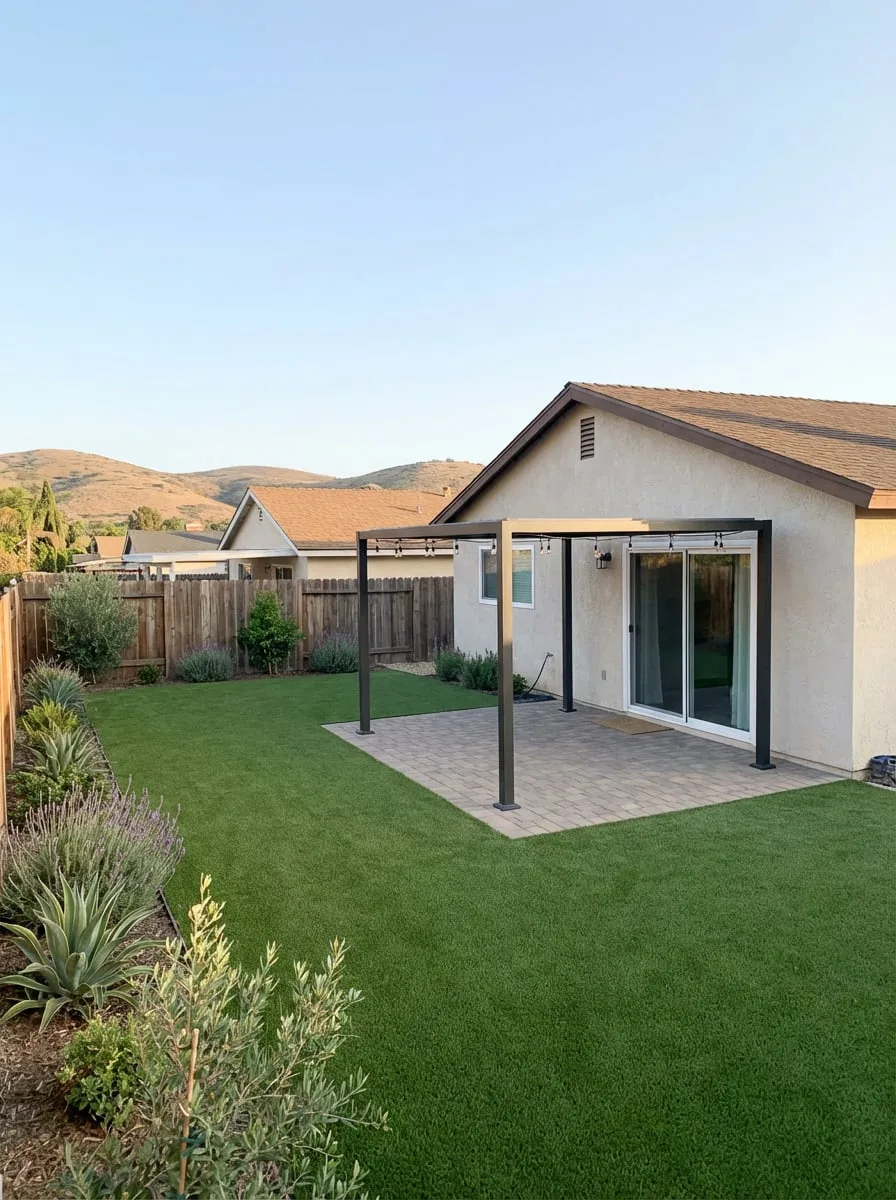
There is a specific quality to a neighborhood that has been lived in for thirty years. The trees have grown past the fence lines. The neighborhood Facebook group argues about the same intersection that it has always argued about. The families on your street have cycled twice — the original owners who bought new in 1991 are either grandparents in the house now or have been replaced by the generation that bought their equity and started over. The yards carry the evidence of all of it: a patio poured when Clinton was in office, a retaining wall that moved a little every winter for a decade before finally tilting enough to matter, irrigation that was designed for a lawn that nobody has wanted for fifteen years. Sunbow looks good from the street. Around back, on most of these properties, is where thirty years of deferred landscape decisions have quietly accumulated.
The property profile
Sunbow is one of Chula Vista’s earlier master-planned communities, developed primarily between the late 1980s and the mid-1990s along the East H Street and Olympic Parkway corridors. The community has the settled character that comes with mature trees, established neighbor relationships, and infrastructure that has had time to find its weaknesses. The housing stock is predominantly California Ranch and early Mediterranean Revival — long, low profiles, warm stucco in the color palettes that master-plan architects were approving in the late 1980s, clay-tile roofs and solid double-car garages. Lot sizes run from about 5,500 to 8,500 square feet, meaningful middle ground between Millenia’s compact urban lots and Rolling Hills Ranch’s canyon parcels.
The ownership profile in Sunbow leans toward long tenure. Many of the homes are on their second family, and some are still with the original buyers — people who moved to Chula Vista in 1993 and never found a reason to leave. That shapes the brief almost every time. The project is not typically about moving into a new house. It is about a property that deserves to be finished the way the house itself has been maintained — carefully, for the long term.
The HOA is less restrictive than Otay Ranch’s village ARCs, but architectural review still applies to structural modifications and significant exterior changes. The palette review tends to be less prescriptive than newer communities, reflecting a CC&Rs regime that was written in an era before the HOA documentation got as granular as it is in post-2000 master plans. That relative latitude is real, but it is not the same as no review, and any structural scope — pergola, outdoor kitchen, wall work at the property line — requires a submittal before work begins.
Soil and climate
Sunbow’s soils are clay-dominant throughout, consistent with the South Bay mesa profile that underlies most of Chula Vista’s eastern residential development. Thirty years of established landscape means the clay has had time to behave in ways that show themselves in the hardscape: a concrete patio slab that was poured four inches thick on a minimally prepared base will have begun to telegraph its expansion-and-contraction history as surface cracks, joint separation, and the occasional lifted edge where a clay pocket held more moisture than the surrounding soil. This is not a failure of maintenance — it is the mechanical consequence of an undersized base on expansive material, and it is the most common condition we encounter when a Sunbow client calls about a backyard renovation.
The typical Sunbow project starts with removal before it starts with installation. Aging concrete that has moved, irrigation systems designed for planting that no longer exists, a retaining wall that shifted two inches over twenty winters and is now borderline on structural serviceability — these are the existing conditions that the design has to account for. Demolition and grading are real line items on a Sunbow proposal, not small ones, and they need to be factored into the budget conversation before the finish-material conversation.
Where the existing patio drained correctly and the existing retaining wall is structurally sound, those elements can sometimes be incorporated or built from rather than replaced. Where they cannot, the honest thing is to remove them rather than build new work on a compromised substrate. We assess each existing element during the site walk and give a clear recommendation in the proposal.
Permits and jurisdiction
Sunbow is within the City of Chula Vista. Building permits are handled by the City of Chula Vista Development Services department. The permit categories are the same as for any Chula Vista outdoor remodel: structural permits for patio covers and pergolas above the square-footage exemption threshold, electrical permits for lighting and kitchen circuits, gas permits for built-in appliances. On properties with existing retaining walls that are being replaced or modified, the permit scope may include grading if the replacement wall involves a grade change or if the existing wall’s permit history creates a review obligation.
One Sunbow-specific permit reality: on properties with original 1980s and 1990s construction, the existing permits for original hardscape and structures may or may not be documented in a way that the current city records reflect. When a project involves work adjacent to or incorporating original structures, we confirm the permit status of those elements before proposing to build on or from them. An existing retaining wall built without a permit in 1993 carries a different legal posture than one that was permitted and inspected. That is the kind of detail that surfaces during the permit application process, and knowing it in advance prevents surprises.
Design character
The California Ranch and early Mediterranean Revival architecture of Sunbow calls for materials that carry warmth and permanence without the ornamental complexity of the later master-plan phases. A bluestone or concrete paver patio in a larger format with a simple bond pattern — fieldstone set, herringbone, or a clean grid — reads correctly against a ranch-style house without the decorative ambition that would sit awkwardly on a low, horizontal elevation. A pergola in clear-stained cedar or painted Douglas fir, with timber proportions rather than dimensional-lumber proportions, reads as the outdoor room the house was always gesturing toward from its wide rear elevation.
The California Ranch house, in particular, is one of the best outdoor-living platforms in San Diego residential architecture. The wide rear elevation, the generous sliding doors, and the low-pitch roofline create an indoor-outdoor transition that was designed for long afternoons outside — it just needs the outdoor room to meet it at the right level. A well-resolved patio that extends the house’s floor line, a shade structure that follows the roof pitch rather than fighting it, and a kitchen or fire feature that anchors one end without enclosing the space — this is the Sunbow Ranch move, and it works every time.
On the Mediterranean Revival houses, the same principles apply with a richer material vocabulary available: travertine and limestone, plaster-finished masonry, arched or corbeled overhead elements where the architecture supports them. The outdoor room should read as the same house, not as a different one dropped into the yard.
Where SDLR fits
A Sunbow project almost always begins with a site walk that is diagnostic before it is creative. We are looking at existing conditions — the concrete slab that has moved, the retaining wall that is compromised, the irrigation that needs to be abandoned before the new installation goes in — before we are looking at what comes next. The assessment drives the proposal’s scope and sequence, and that sequence matters: removing failing infrastructure before installing new hardscape, rather than installing over it, is the difference between a yard that holds and one that shows problems in three years.
The base-preparation discipline that applies on any South Bay clay project applies here with the added variable of thirty-year-old construction in the way. We work around existing site conditions rather than assuming they are correct, and we give a clear recommendation on every existing element — keep it, modify it, remove it.
The HOA process is less burdensome in Sunbow than in the newer Otay Ranch villages, and we prepare our submittals to the Sunbow standard: a complete package that addresses the relevant review criteria without over-engineering the submittal for a committee with less granular requirements. Clear, accurate, and complete is what moves through review the fastest.
Either Gio or Mike is on every project. The 10-Month Walk-Through is part of every Sunbow scope — on a community where the existing hardscape has already demonstrated what one wet season can do to undersized base preparation, having a return visit after the first winter tests our work is the honest way to stand behind it.
For comparison on newer master-plan properties in the same part of the South Bay, the Otay Ranch and Rolling Hills Ranch pages cover the HOA and soil realities in detail. The Millenia page covers the most compact end of the Chula Vista lot spectrum.
The outdoor services we bring to Sunbow
Most Sunbow projects encompass more than a single service category — the removal of aging infrastructure, the base preparation underneath it, and the new outdoor program above it constitute a full backyard remodel in function even when the lot is not large. Within that scope or as defined standalone work, we build outdoor kitchens, patios and hardscape, fire pits and fireplaces, pergolas and shade structures, retaining walls, artificial turf, landscape lighting, pool decks, and drainage and grading. On established Sunbow properties where the original hardscape has aged past its useful life, drainage and grading are almost always part of the scope — not by choice, but because the base under the existing concrete has its own history and it shapes what comes next.
Frequently asked
The concrete patio from the original build is cracked and uneven. Should we repair it or replace it?
In most cases, replace it. A concrete slab on a clay substrate that has cracked and moved has done so because the base under it was either inadequate in depth, improperly compacted, or both. Resurfacing or patching a slab on a compromised base produces a better-looking surface for a few years before the same movement pattern resumes. Replacement — full removal, proper subgrade preparation, and reinstallation on a correctly specified base — is the repair that actually addresses the cause rather than the symptom. We make this recommendation on a case-by-case basis; some existing slabs are structurally sound and can be built from. But in Sunbow, where the original construction is thirty years old and the clay has had thirty winters to move, the threshold for replacement over repair is often met.
My retaining wall has tilted and cracked. Is that structural or cosmetic?
It depends on the degree of tilt, the wall type, and what is behind it. A CMU block wall that has tilted two inches and shows horizontal cracking at the mid-course has likely failed its original structural design — the drainage behind it has pressured the block over many wet seasons, and the wall is no longer providing the retention it was built for. That is a replacement conversation, not a repair one. A wall with surface staining and some small cracks in the stucco finish, but no movement or horizontal cracking, is cosmetically aged. We assess retaining walls during the site walk and give a specific recommendation on each one before the proposal is written.
Does Sunbow’s HOA require approval for a pergola?
Yes. Any structural addition that has a visual impact on the exterior of the property — a pergola, an outdoor kitchen with vertical mass, a shade structure — requires an ARC submittal before construction begins. Sunbow’s review process is less granular than the newer Otay Ranch village ARCs, but it is not optional for structural scopes. We prepare the submittal packet, handle the review cycle, and track the approval timeline as part of the project management. For most straightforward pergola and patio cover submittals in Sunbow, the review cycle is shorter than in communities with more detailed CC&Rs.
What does a full remodel typically look like in Sunbow?
A typical Sunbow remodel starts with demolition and removal — the original concrete patio, aging landscape features, sometimes a retaining wall — followed by subgrade preparation and base work, then the new hardscape program. The surface area is usually a mid-sized patio in natural paver or concrete with a defined fire or kitchen area at one end and a shade structure anchoring the rear elevation. Artificial turf and lighting complete the program on most properties. The total scope runs from a partial replacement of the hardscape on a single outdoor zone to a full reimagination of the outdoor footprint from house to fence line.
References available on request
We do not publish client testimonials. When a project is complete, we invite future clients to speak directly with the homeowners who have lived in the finished work. During discovery in Sunbow, we are glad to walk you past completed projects in person — including on properties where we replaced original hardscape with new work — so you can see the quality and the scope as they actually live.
When you are ready
If your Sunbow property has accumulated thirty years of good intentions and no follow-through in the backyard, we would like to hear about it. A first conversation is thirty minutes, by phone or on the yard, and there is no cost to begin. We will assess what is there, tell you what it costs to address it honestly, and tell you what comes next.
Licensed and insured general contractor, operating under Mike’s Class B license — CSLB #1139785. Verify any California contractor’s active standing through the CSLB license lookup.