
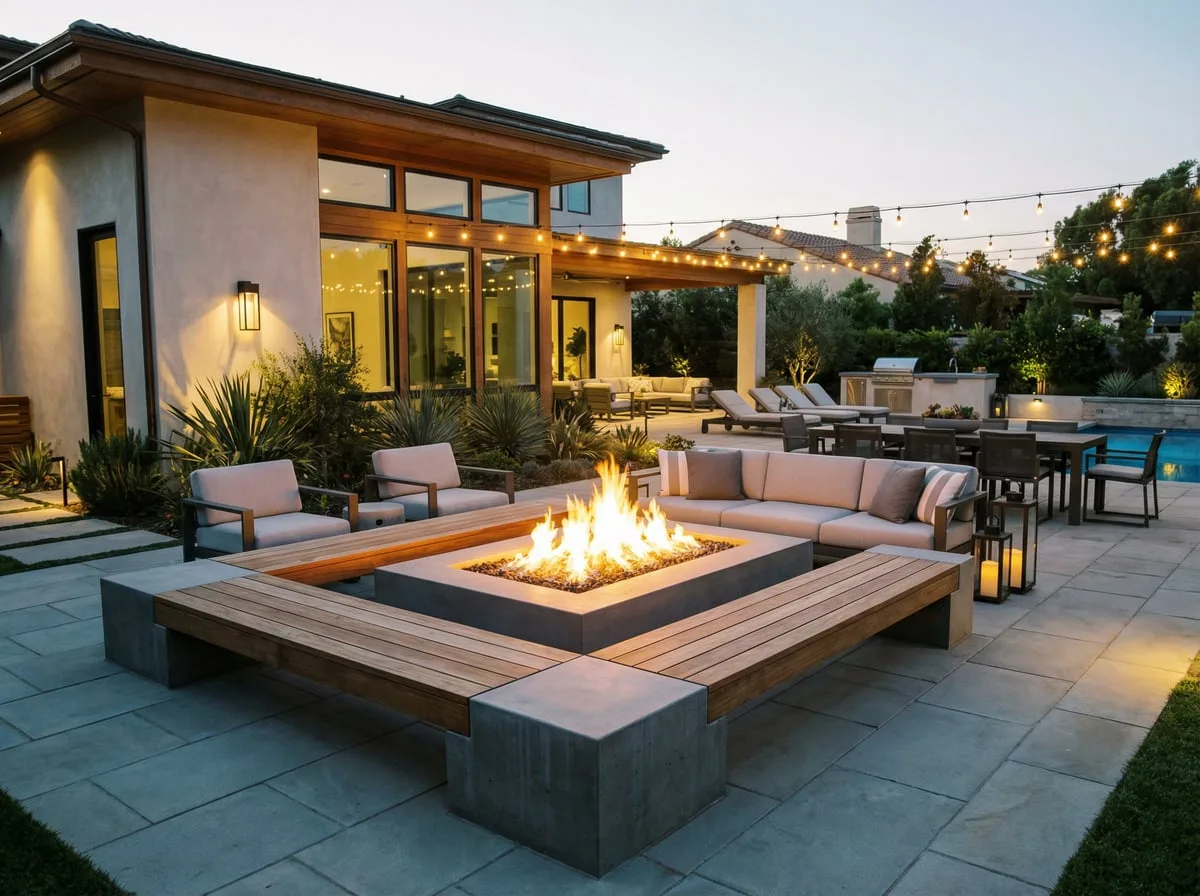
Rolling Hills Ranch sits at the top end of the South Bay’s elevation band, and on the right evening that position pays off in a way most of Chula Vista cannot claim. The coastal air arrives a few degrees cooler than it does at Eastlake down the hill. The canyon to the rear opens south toward the Otay Valley, and on the clear evenings after a winter front has moved through, the view extends further than you remember it does. The houses up here were built on terrain that the earlier master-plan phases left alone because it was harder to grade and harder to serve with infrastructure — which is precisely why the lots are larger, the backs are steeper, and the sightlines are better. What they were not built with is a finished outdoor program that knows what to do with that elevation. The rear elevations of most Rolling Hills Ranch homes face the best view in the South Bay from a slab of concrete and a length of chain-link.
The property profile
Rolling Hills Ranch is a gated community positioned on the ridgeline above Otay Ranch’s eastern villages, accessed from Hunte Parkway and developed primarily in the early 2000s. The architecture is predominantly Spanish Colonial Revival and Mediterranean Revival — clay-tile roofs, warm stucco, arched entries — with the heavier massing that tends to appear at this elevation because the lots are large enough to support it. Typical lot sizes run from 8,000 to 15,000 square feet, with select estate parcels above that. Canyon-facing rear elevations are common, and some of them are working with a rear yard that begins at grade and drops sharply after a few feet toward the open space below.
The defining feature of Rolling Hills Ranch is slope. Not the soft grade of a Eastlake Greens parcel, where a modest retaining wall resets the terrace and the patio lays flat. Here the slope is a genuine build variable — rear yards that descend four, six, or eight feet from the house pad to the property line are not unusual, and the lower lots drop into the canyon beyond with no natural landing. Before a patio program begins, before a kitchen or a pergola or a fire feature is drawn, the question of how to create a usable, level outdoor surface from that terrain is the project. Terracing, retaining, and structural tie-backs are not line items on a Rolling Hills Ranch remodel; they are the first act.
The HOA architectural review process covers all visible exterior modifications and places particular attention on materials and palette coherence, view-corridor preservation, and setback compliance at the canyon-facing property line. The review is real and it is the governing creative constraint on what can be built and how it is detailed.
Soil and climate
The soils at Rolling Hills Ranch mirror the broader Otay Hills profile: predominantly expansive clay in the graded pad areas, with decomposed granite appearing on the steeper canyon faces where the original grading cut deeper into the native material. On a flat-graded lot the clay behavior is manageable with correct base preparation and drainage design. On a sloped lot the clay adds a dimension — water that infiltrates the slope finds the clay horizon and travels along it laterally rather than draining straight down, which is how retaining walls that look dry at the surface fail from behind.
The honest build sequence on a Rolling Hills Ranch slope is this: the drainage plan precedes the structural design, the structural design precedes the hardscape layout, and the hardscape layout precedes the finish material selection. Any contractor who begins with the paver and works backward to drainage is beginning in the wrong place. The failures we see on South Bay canyon properties — retained walls that have tilted, patios that have settled at one corner, drains that work until the first storm — almost always trace back to a drainage conversation that happened too late or not at all.
The microclimate at this elevation is one of the genuine pleasures of the address. Summer evenings are cooler than the valley below by several degrees — enough to make an outdoor kitchen and fire feature program genuinely comfortable from May through October, the full arc of San Diego’s outdoor-living season.
Permits and jurisdiction
Rolling Hills Ranch is within the City of Chula Vista. Permits are pulled through the City of Chula Vista Development Services department. Structural permits are required for patio covers, pergolas, and outdoor kitchens beyond the applicable square-footage exemptions; electrical permits cover lighting circuits and kitchen runs; gas permits apply to built-in appliances. Where the project involves grading and retaining walls above a certain height, the city’s grading and drainage review applies, and on canyon-adjacent lots that review can involve slope-stability calculations from a soils engineer.
The HOA architectural review process is the second track, operating separately from the city permit timeline. The HOA reviews material palette, color selections, structure heights and setbacks, and — on the canyon-facing elevations — view-corridor compliance. We prepare drawings that satisfy both the municipal plan-check format and the HOA submittal requirements, and we run the two reviews in parallel. The HOA review on a well-prepared packet typically runs four to six weeks. Building permit plan-check for structural scopes runs on a city timeline. Both are real calendar items and neither is a rubber stamp.
Design character
The Spanish Colonial and Mediterranean Revival architecture of Rolling Hills Ranch calls for materials with weight, warmth, and the suggestion of permanence. Travertine and natural stone patios with close-set joints, plaster-finished masonry walls in a color that matches the house, wood-and-iron pergola structures at a scale that anchors the rear elevation rather than decorating it — these read as the houses completing themselves outward, which is exactly the right frame.
The canyon view is the design’s organizing element. On lots where the rear elevation faces the open space, the outdoor room is not designed to enclose a volume; it is designed to frame an aperture. A pergola that marks the edge of the patio rather than covering it entirely. A fire feature positioned so the seating faces both the fire and the view rather than choosing between them. A retaining wall at the grade break that creates a lower terrace for planting without interrupting the sightline from the upper patio. These are spatial moves, and they require a design that has actually looked at the property rather than redrawn a plan from somewhere else.
What reads wrong at this elevation is the same thing that reads wrong in the denser Otay Ranch villages, only more visible because the lots are larger: suburban-scale moves applied to canyon-scale terrain. A small paver patio floating in the middle of a 12,000-square-foot sloped yard with no organizing structure around it. A fire pit ring dropped on a slab with nothing tying it to the house or the view. Scale and connection are the Rolling Hills Ranch design discipline.
Where SDLR fits
The slope is what we are solving first, and that requires a specific kind of preparation before the first drawing is useful. Every Rolling Hills Ranch engagement starts with a walk of the rear yard — measuring the grade change, identifying the drainage patterns, locating any existing retaining structures, and reading the relationship between the house’s rear elevation and the view beyond. From that site read, the design sequence makes sense: stabilize the grade, establish the terraces and retaining program, then build the outdoor room on terrain that has been resolved rather than improvised around.
The ARC process is managed as a standard part of the project. We prepare the full submittal packet — drawings, material samples, color specifications, renderings — and carry the review to sign-off before the crew mobilizes. The review calendar is built into the project schedule from the first conversation, not added to it at the point of permit submittal.
Our Field Lead, with 25-plus years in high-end outdoor construction, has run retaining, terracing, and canyon-adjacent hardscape work at this scale. The calibration between structural necessity and design intention — how a retaining wall becomes a seating wall, how a drainage swale becomes a planting edge — is craft knowledge, not just engineering, and it matters on properties where the terrain is the first problem the yard has to solve.
Either Gio or Mike is personally on every project. The 10-Month Walk-Through is part of every Rolling Hills Ranch scope — returning to walk the property after one full wet season has tested the retaining, the drainage, and the base preparation is particularly meaningful on a hillside property where those elements carry real structural consequence.
Clients considering Rolling Hills Ranch alongside nearby communities will find detailed soil and HOA context in our Otay Ranch and Eastlake pages. The Bonita page covers canyon-adjacent build realities on unincorporated parcels with similar topographic character.
The outdoor services we bring to Rolling Hills Ranch
On most Rolling Hills Ranch properties, the work begins as a full backyard remodel — a coordinated program that addresses the slope, the drainage, and the outdoor living surfaces in one plan and one build sequence rather than three separate contractors across as many years. Within that scope or as defined standalone work on the right property, we build outdoor kitchens, patios and hardscape, fire pits and fireplaces, pergolas and shade structures, retaining walls, artificial turf, landscape lighting, pool decks, and drainage and grading. On this terrain, the last two are rarely optional components — they are the structural foundation the rest of the project stands on.
Frequently asked
My rear yard drops six feet from the house pad to the property line. What does that require?
Terracing, retaining, and a drainage plan that manages water through the grade change rather than around it. The typical approach on a lot with that elevation change is a primary terrace at or near the house pad — hardscape, outdoor living surfaces, kitchen if it’s in scope — with a retained step-down to a lower level that can be planted or turfed or left as a managed edge toward the canyon. The retaining wall between the two levels does real structural work and is engineered accordingly. The drainage behind it is designed to carry water along the base and out without building pressure against the structure. This is a standard Rolling Hills Ranch scope, not an unusual one — the terrain drives this conversation on most of the properties up here.
Does the HOA review apply to the canyon-facing side of my property?
Yes, and that is often where the review pays closest attention. View-corridor preservation is a priority in the CC&Rs, and structures, tall planting, or wall work at the canyon-facing property line that would interrupt a neighbor’s view are reviewed carefully. On some lots the setback at the rear property line is wider than the standard side setback precisely because of view considerations. We confirm the applicable setbacks and view easements before drawing a single line, so the design is correct from the beginning rather than revised after an ARC comment.
Can a sloped lot support a pool deck?
Yes, with the right structural approach. Pool-deck work on a sloped Rolling Hills Ranch lot usually involves a combination of grade preparation, retaining to create a level pool pad, and a deck surface that manages the transition from pool elevation to yard elevation cleanly. The structural and grading scope is larger than on a flat lot, and it requires engineering coordination. Where a pool is already in place and a deck remodel is the scope, we work from the existing pool structure and coordinate the deck design with the pool’s existing drainage and coping conditions.
What does the ARC look for on material palette submissions?
The HOA review in Rolling Hills Ranch focuses on material coherence — whether the proposed palette works with the house’s existing stucco color, roof tile, and window trim — and on finish quality. Raw CMU block or exposed concrete aggregate that reads unfinished will typically draw a comment; smooth plaster, faced stone, and stained wood in the warm neutral range the community approves generally move through cleanly. We submit physical material samples, not just a color description, and we key every sample to the approved community palette so the committee can compare directly rather than interpret.
References available on request
We do not publish client testimonials. When a project is complete, we invite future clients to speak directly with the homeowners who have lived in the finished work. During discovery in Rolling Hills Ranch, we are glad to walk you past completed projects on comparable terrain so you can see how the slope work and the outdoor room program come together as they actually live, not as they appear in a photograph.
When you are ready
If your Rolling Hills Ranch property has terrain that has kept you from doing anything with the rear yard — or a view that deserves an outdoor room equal to it — we would like to hear about it. A first conversation is thirty minutes, by phone or on the yard itself, and there is no cost to begin.
Licensed and insured general contractor, operating under Mike’s Class B license — CSLB #1139785. Verify any California contractor’s active standing through the CSLB license lookup.