
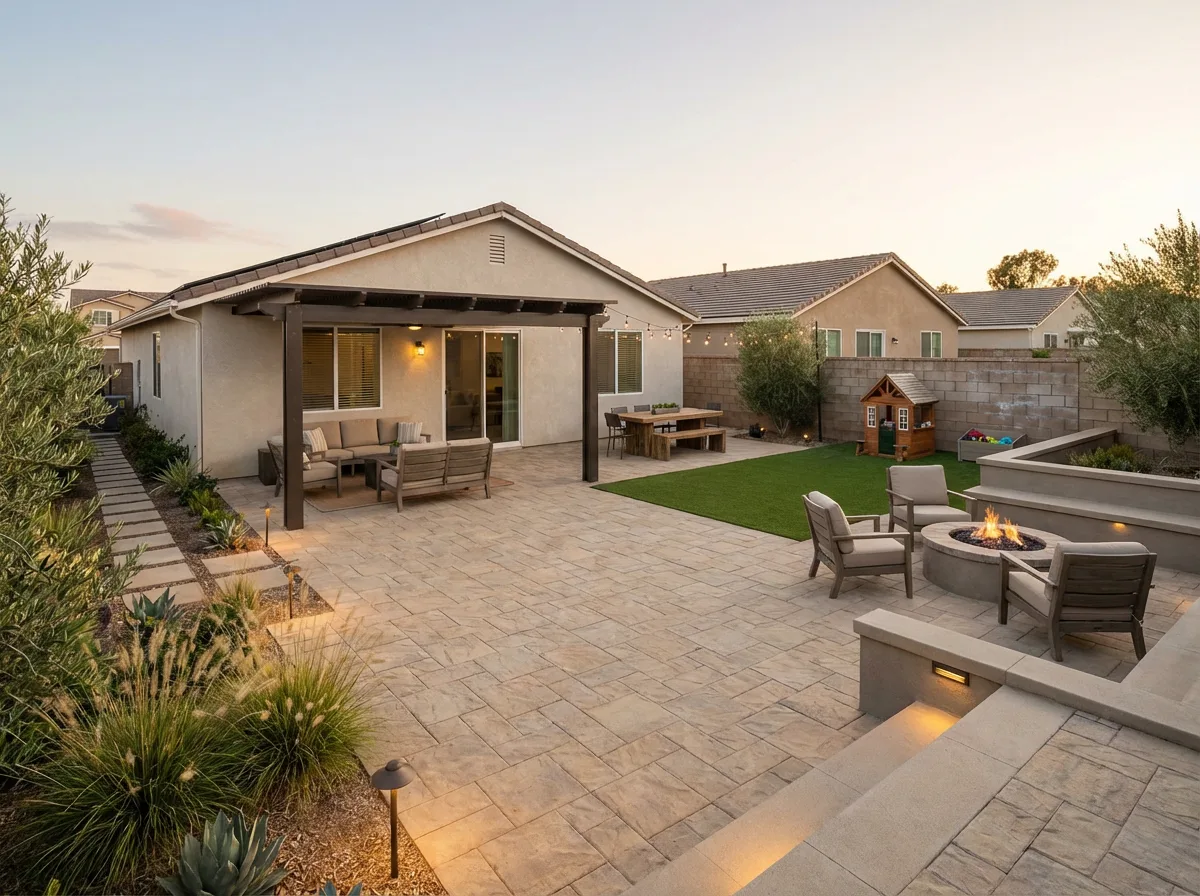
The drive out Eastlake Parkway at dusk, past the lake and up into the hills, has a specific quality in the fall — the light comes in at a low angle off the Otay Mountains, the Pepper Park trail empties of joggers, and the houses on the upper elevations catch a view toward the coast that only opens up on the clear evenings. From the street, the villages look finished. The streets curve according to plan, the stucco is the right color, the rooflines match the design code the Otay Ranch Company approved before the first subdivision map was recorded. Around back is where the built environment often stops being intentional. A small concrete slab. A strip of water-hungry lawn that catches every inch of clay-heavy grade. A fence line with no room to think. The master plan handed the builder the bones; the builder handed you the shell; and what happens on your rear elevation has been waiting, often for a decade, to become something you actually use.
The property profile
Otay Ranch is not one neighborhood — it is thirteen villages, each with its own recorded CC&Rs and its own Architectural Review Committee, all operating under the umbrella governance of the Otay Ranch Company. Heritage, Ranch del Rey, Village 2, Village 7, Montecito, and the others were built out in phases beginning in the mid-1990s and continuing through the 2010s, and the built character shifts meaningfully between them. The denser villages along Olympic Parkway — Village 1, Village 2, parts of Heritage — run 5,000 to 7,000 square feet of lot area. The upper-elevation parcels in Montecito and the eastern ridges push 12,000 square feet and higher, with canyon views and rear elevations that face open space rather than a neighbor’s block wall.
Architecture throughout Otay Ranch is predominantly Mediterranean Revival and transitional contemporary — clay-tile roofs, stucco in the warm neutral palette the ARC approves, arched entries in the older villages, flatter and cleaner lines in the phases built after 2005. The two languages coexist across the community, and the outdoor vocabulary that reads correctly in one village sometimes reads slightly off in another. Getting this right is a design judgment more than a rules compliance, and it begins with knowing which village you are in.
Every exterior modification on every Otay Ranch lot — a pergola that shows above the fence line, a patio material change visible from the street, a fire feature with any vertical mass, a lighting scheme — requires submission to the relevant village ARC before work begins. The ARC process typically includes a site plan, elevations, material samples, and color specifications referenced to the community-approved palette. Submittal to approval runs four to six weeks on a well-prepared packet; revisions are normal and do not indicate a rejection, they indicate a committee doing its job.
Soil and climate
The soil beneath Otay Ranch is predominantly expansive clay — the same San Diego mesa clay that underlies most of Chula Vista’s eastern hills, with some isolated pockets of decomposed granite on the steeper ridge-faces where the grading cut deeper during construction. Expansive clay has a specific behavior that a contractor unfamiliar with it will eventually teach your patio to perform: it swells when the winter rains arrive and contracts as the summer dries it out, and that cycle of expansion and contraction is what cracks a hardscape surface that was laid over an undersized base without adequate moisture management.
The honest conversation on any Otay Ranch patio project begins with base depth, not with paver color. A properly prepared Otay Ranch base means subgrade excavated to a meaningful depth below frost, moisture-conditioned and compacted before anything is placed on top, a geotextile layer where the design calls for it, and a clean aggregate base built in lifts and compacted to specification. The setting bed above that is chosen for the material, not for what was left on the truck. Every one of those steps is a line item. None of them are where cost gets cut on a project that is supposed to be standing in twenty years.
Drainage on sloped lots is the companion conversation. Otay Ranch’s civil infrastructure was designed to move water from lot to curb along a predetermined path, and a patio program that redirects water toward a neighbor’s fence, ponds against the house foundation, or creates a problem at the sidewalk scupper will fail both the ARC review and the first February storm. Drainage is designed alongside the hardscape program, not after it.
Permits and jurisdiction
Otay Ranch sits entirely within the City of Chula Vista. Building permits for outdoor work are pulled through the City of Chula Vista Development Services department. Structural permits are required for pergolas, patio covers, and outdoor kitchens above certain square-footage thresholds; electrical permits cover lighting runs and kitchen circuits; gas permits apply to built-in appliances; and mechanical permits apply where the scope requires them. Chula Vista’s plan check and inspection schedules run on city timelines, which are real calendar variables and not something any contractor controls.
The municipal permit process and the village ARC process run on separate tracks with separate documents and separate review bodies. Both are real. We prepare drawings that satisfy the Chula Vista plan-check format and the village ARC submittal format simultaneously, so the two reviews can proceed in parallel rather than sequence. When the ARC signs off and the city issues the permit, the crew breaks ground. The first conversation we have with any Otay Ranch client includes which village their parcel sits in, which ARC governs the review, and what the current typical review cycle looks like — that information sets the actual start-of-construction date.
Design character
The Mediterranean and transitional contemporary languages of Otay Ranch reward materials that read warm, textured, and deliberate. A travertine patio laid with tight joints, a pergola in stained Douglas fir, a plaster-finished outdoor fireplace matched to the house color and capped in a stone that belongs to the same geography as the rest of the yard — these read as the outdoor rooms that the architecture was always pointing toward. What reads wrong in Otay Ranch is the same thing that reads wrong in any master-planned Mediterranean community: contemporary minimalism dropped onto a Spanish Colonial house without translation, high-contrast materials that shout over the palette the ARC approves, and scale choices lifted from a magazine photograph taken on a half-acre lot applied to a 6,500-square-foot parcel.
Scale is the most common design error in Otay Ranch back yards. A pergola sized to a 20-foot patio on a 0.15-acre lot reads as furniture moved outside; a pergola sized to the house massing, positioned so it anchors the rear elevation rather than floating in front of it, reads as architecture. The same calibration applies to fire features, kitchen structures, and seating walls. Restraint and proportion are the design discipline here, not minimalism — there is a meaningful difference.
Color palette is almost always ARC-constrained, and working within that constraint produces better outcomes than resisting it. The approved community palette is narrow by design. Stone colors, stucco finishes, paver blends, wood stains, and metal finishes all sit in a warm neutral band that weathers well in the San Diego climate and coheres across the village streetscape. Materials and finishes selected inside that band will look right not just at handover but a decade later, which is the actual measure of whether the design worked.
Where SDLR fits
The ARC process is part of the job in Otay Ranch, not a variable we route around. A remodeler who treats the architectural review as an afterthought either delivers a yard that the committee will comment on mid-build or produces work that reads out of place on the parcel. We prepare the drawing set the village committee expects — site plan, elevations, material samples keyed to the community palette, renderings showing the project in context — and we manage the revision cycle on the same project calendar we use to track permit plan-check and material lead times. The typical four-to-six-week review window is planned for from the first conversation, not discovered at the start of construction.
One crew, from demolition through final clean. Our Field Lead carries 25-plus years of high-end outdoor work, runs the daily site operations, and answers to a standard that does not change based on the lot size or the village. Either Gio or Mike is personally involved on every project — on the phone, on the site, in the review meetings. Both cell numbers are yours from the first call. No account managers, no hand-offs.
The 10-Month Walk-Through is part of every Otay Ranch project. Ten months after the yard is handed over — after the clay has cycled through one full wet season and the hardscape has settled into its first summer — we come back and walk every square foot with you. Anything that shows itself under those conditions gets addressed. No invoice. In a community where the soil behavior is a real variable, having that return visit baked into the project is not a gesture. It is the honest minimum.
Projects near the Eastlake border often make sense to consider alongside Eastlake, where the property profile and ARC realities overlap closely. Clients with a second property or a family connection in Coronado or Bonita will find that the same operating standard applies across all three.
The outdoor services we bring to Otay Ranch
Most Otay Ranch projects are scoped as a full backyard remodel — one plan across the entire outdoor footprint, executed by one crew, rather than five separate trades showing up across two years. Within that scope, or as defined standalone work on the right property, we build outdoor kitchens, patios and hardscape, fire pits and fireplaces, pergolas and shade structures, retaining walls, artificial turf, landscape lighting, pool decks, and drainage and grading. On sloped Otay Ranch lots, drainage and retaining are often the structural anchor of the scope even when the visible program centers on a kitchen and a terrace — the two conversations are not separable.
Frequently asked
How does the Otay Ranch ARC process work, and how long does it take?
Each Otay Ranch village maintains its own Architectural Review Committee operating under its recorded CC&Rs and the Otay Ranch Company’s umbrella governance. A typical submittal packet includes a site plan showing the project footprint and setbacks, elevations drawn to the scale the committee requires, physical material samples, color specifications keyed to the community-approved palette, and — for projects with meaningful vertical mass — a rendering showing the project in context with the house and the adjacent fence line. Well-prepared submittals that land inside the palette and address the setback rules tend to move in four to six weeks. Revisions are a normal part of the cycle; they reflect a committee doing genuine review, not an objection to the project. We build the ARC calendar into the project schedule from the first conversation rather than discovering it at the point of mobilization.
My lot is on a slope with a clay-heavy grade. Where do we start?
With the drainage design, before the patio program. Sloped Otay Ranch lots with expansive clay soils need a drainage plan that is coordinated with the hardscape layout from the beginning — swales, channel drains, and surface slopes that move water where it needs to go without compromising the base or directing flow toward a neighbor. Once the drainage logic is resolved, base preparation and hardscape specification follow from it. Starting with the paver selection and working backward to drainage is the sequence that produces the cracked patios and moved retaining walls we see on properties where a previous contractor did it in the wrong order.
Can you build an outdoor kitchen in Otay Ranch?
Yes, and outdoor kitchens in this community read correctly when the structure respects the house’s architectural language. Mediterranean-scale masonry with a plaster finish, stone cladding in the approved palette, and a roof line that matches the pergola or patio cover above it will pass ARC review and read as intentional. A prefabricated stainless module dropped into a concrete slab will do neither. The kitchen is a structural and mechanical scope — gas, electrical, and drainage all require permits and inspection — and it is designed as a piece of architecture, not as appliances arranged outside.
What is a realistic timeline for a full remodel in Otay Ranch?
The full timeline from first conversation to project completion includes a design phase, the ARC review cycle, the Chula Vista permit plan-check, material procurement, and construction. A mid-scale remodel — hardscape, shade structure, fire feature, lighting, and finish planting — typically runs four to six months from signed contract to final clean when the ARC and permit processes move on a normal schedule. Larger remodels with outdoor kitchens, pool-deck integration, and retaining work run longer. We give an honest schedule the first time we quote it and we do not accelerate the ARC or the city on your behalf by skipping steps that protect the project.
References available on request
We do not publish client testimonials. When a project is complete, we invite future clients to speak directly with the homeowners who have lived in the finished work — a real conversation, not a cropped quote on a website. During discovery in Otay Ranch, we are glad to walk you past completed projects in person so you can see the work as it lives rather than as it photographs.
When you are ready
If your Otay Ranch property is ready for an outdoor room that was designed for where it actually sits, we would like to hear about it. A first conversation is thirty minutes — by phone, or on your yard — and there is no cost to begin. We will listen, we will tell you what we see on your specific lot and in your specific village, and we will tell you honestly whether we are the right firm for the work.
Licensed and insured general contractor, operating under Mike’s Class B license — CSLB #1139785. Verify any California contractor’s active standing through the CSLB license lookup.