
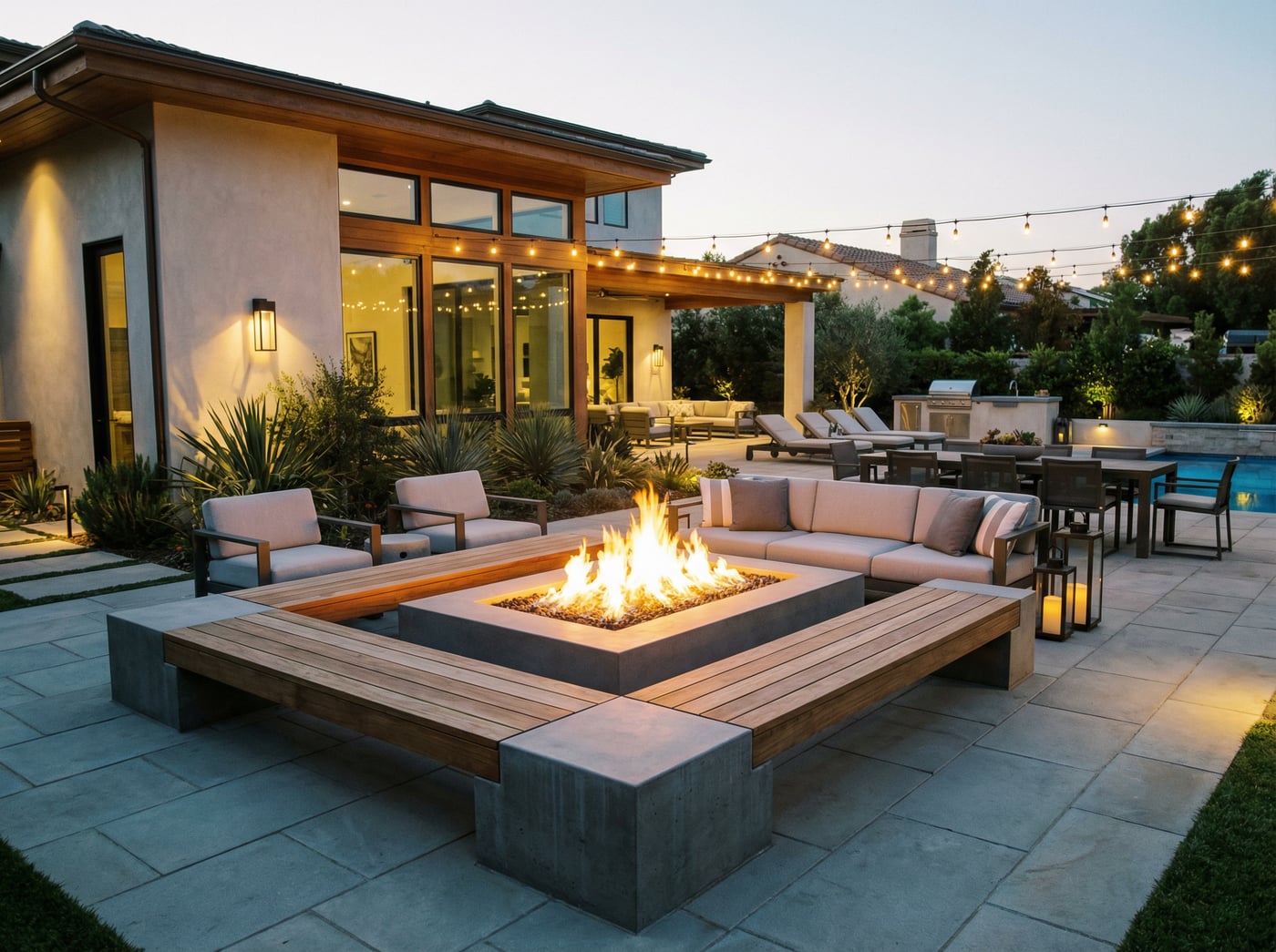
A quieter piece of North County
Santaluz reads differently from the rest of San Diego, and anyone who has driven through the gate at dawn knows it. The light comes up behind the Santaluz Club, the Rees Jones course is still held in marine layer, and a pair of early golfers is walking the first hole in near silence. The coastal chaparral on the Carmel Valley view lots — the sages, the toyon, the low manzanita — looks like it was planted there by nature, because in most cases it actually was. Homes are set deliberately. Roofs sit low against ridge lines. Driveways curve rather than cut. The palette is earth and bone and muted terracotta, not the bright white of a new subdivision.
You chose Santaluz for a reason. The privacy of the gate. The long horizon over Carmel Valley that holds its own against anything in Rancho Santa Fe. The walkable club at the center of the community — the pool, the short course, the spa, the clubhouse where your neighbors actually are on a Thursday evening. The quiet architecture. The fact that nothing here is trying to shout.
The yard should match that. Not a backyard that performs for photographs. An outdoor room you move through — coffee at the view edge in the morning, a long lunch under cover, an evening your grandchildren will remember in thirty years — that reads as part of the house and part of the land. Built for the way you already live here, not rebuilt every five years because a trend moved.
Property profile
Santaluz is a gated, master-planned community of roughly 650 homes set across a former 3,800-acre ranch, organized around the Santaluz Club and the Rees Jones-designed championship course. Construction began in the early 2000s, with homes continuing to come online through the 2010s, and the community now reads as settled — the planting is mature, the stonework has weathered in, the hedges have grown to their intended height.
Lot sizes range from roughly a quarter acre on the interior streets to an acre and more on the Carmel Valley view rim. The view-lot product is the reason a significant part of the community exists: long, open looks west and north across preserved chaparral and canyons, with sunset lines that nothing else in the inland corridor quite replicates. Homes were built by a short list of custom and semi-custom builders, which means the stock is consistent in quality but wide in architectural range. Market values run from roughly $3M at the smaller interior end to $15M and above on the larger view lots, with the top of the range continuing to move.
Owners here tend to be golf-and-club-oriented, long-tenured in the home, and in no hurry. The community is genuinely a community. The yard decision is usually a long-horizon decision, not a flip.
Soil, climate, and the land itself
The substrate across Santaluz is mostly decomposed granite over coastal chaparral — the lean, fast-draining, mineral soil that supports sage scrub and manzanita and has supported it for a long time. On a graded pad it feels like sandy clay; on an undisturbed slope it feels closer to gravel. It will carry a properly built patio well, and it will murder a planting scheme that was designed for Midwestern topsoil.
The climate sits in the mild coastal-influenced band — warmer than Del Mar, cooler than Poway, with a marine layer that holds into mid-morning most of the spring and early summer. Winters are gentle. Summers are dry. Wildfire risk is real enough that Cal Fire defensible-space guidance is part of any serious planting plan along the chaparral edge.
Drainage varies sharply by parcel. A graded interior lot drains predictably. A view lot with a natural slope to preserved open space is its own engineering problem, and the answer is almost never “add another surface drain.” It is grading, subsurface routing, and restraint at the hardscape edge.
Permits and jurisdiction
Most of Santaluz sits in unincorporated San Diego County, which means building permits, grading permits, and structural approvals go through the County’s Planning & Development Services department. PDS handles hillside and grading review, structural drawings for pergolas and cabanas over the threshold, electrical and gas permits for outdoor kitchens and fire features, and the inspections that close them out.
On top of County review, the Santaluz HOA Architectural Review Committee reviews every exterior project inside the community — hardscape, structures, fencing, exterior lighting, planting plans visible from the street or a neighbor, and any modification to the envelope of the home. The ARC has published design guidelines with material, color, height, and setback language, and review timelines that prospective clients consistently underestimate. Submissions are expected to be complete: dimensioned site plan, elevations where relevant, material and color samples, lighting specifications, planting schedule.
Sections of the community that back to the native habitat preserve carry additional restrictions on grading, planting, and fencing at the preserve edge. Violations are not trivial. The preservation rules exist because the community agreed to them as part of entitlement, and they are enforced that way.
A project built without both ARC approval and County permits in hand is a project you will rebuild. We do not start work until both are signed.
Design character
The architecture across Santaluz is tighter than a casual drive suggests. Contemporary Mediterranean and modern Spanish are the dominant voices — low roof pitches, earth-tone stucco, clay tile, iron and timber detail — alongside a strong California Ranch presence on the earlier lots and a quieter line of transitional and contemporary homes on the newer or rebuilt parcels. What holds it together is the material restraint: muted tones, natural stone, cedar and walnut and ipe, and a deference to the chaparral setting that keeps the community from reading like a catalog.
The right outdoor palette stays inside that discipline. Natural stone veneer or honed limestone where a wall needs weight. Muted stucco in the same earth tone as the home, not a brighter or whiter version of it. Decomposed-granite pathways where a softer edge is wanted. Cedar or Accoya for shade structures. Corten steel for a quieter architectural edge at a planter or retaining line. Hardscape that reads warm and dry, not wet and polished.
View-lot siting has its own discipline. Glossy or reflective surfaces glare into the home from the west in the afternoon and flash across the valley at sunset — neither is what anyone chose Santaluz for. Honed, sandblasted, or matte finishes answer the problem. Infinity edges, if they are used, are placed to disappear rather than announce. The point of the view lot is the view. The hardscape’s job is to hold the ground and get out of the way.
Where San Diego Landscape Remodeling fits
For a Santaluz project, the run through HOA ARC and County PDS is not a logistics footnote. It is a meaningful share of the scope, and it is inside our scope on every job we take here. We prepare the ARC submittal as a coherent package — site plan, elevations, material samples, lighting and planting specifications — and we hold plan-check comments, revisions, and inspection coordination with PDS for the life of the build. You sign. We do the walking.
Beyond the paperwork, Santaluz is the kind of project the firm was built for. Both founders are personally on every project — Gio on program and client-side, Mike on build discipline and license — with direct cell access from the first conversation through the final walk-through. There is no account manager, no handoff, no learning curve for the third person assigned to your property in month two. Our Field Lead runs the day-to-day on site. One crew, from first cut to final clean.
We work across San Diego County by design, not by dispatch. Projects are planned months ahead and executed on a short annual list, which is why we ask for a real first conversation rather than a same-week site visit.
Every project includes The 10-Month Walk-Through — ten months after completion, through a wet winter and a hot September, we return to your property and inspect every square foot with you. Anything the seasons have exposed is handled. No invoice. Almost no one in this industry does this, which is exactly why we do.
Our services in Santaluz
We run every service below as part of a coordinated plan for the whole outdoor footprint. Single trades do not show up in sequence to hand your house off to each other.
- Full backyard remodels
- Outdoor kitchens and BBQ islands
- Patios and hardscape design
- Fire pits and fireplaces
- Pergolas and shade structures
- Retaining walls and seating walls
- Artificial turf installation
- Landscape lighting
- Pool decks and poolside hardscape
- Drainage and grading
If your Santaluz project belongs in North County Inland but your peer shortlist runs wider, our Rancho Santa Fe, Fairbanks Ranch, and 4S Ranch pages cover the neighboring markets we also work in.
Frequently asked
How does the Santaluz HOA Architectural Review Committee process work?
The ARC reviews every exterior modification in the community against published design guidelines — materials, colors, heights, setbacks, lighting, and planting visible beyond the property. Submittals are expected to be complete and professional: dimensioned site plan, elevations where relevant, material and color samples, lighting and planting specifications. We prepare the package, submit it, hold the comment round, and carry it through approval before any work starts. Review windows vary with scope and meeting cadence; we plan the build around the real timeline, not an optimistic one.
What about lots that back to the native habitat preserve?
Certain sections of Santaluz back to preserved native chaparral and carry additional restrictions on grading, planting species, irrigation at the preserve edge, and fencing type. The rules exist because the community committed to them during entitlement, and enforcement is real. On those lots we design inward from the preserve line — hardscape and structures stay inside the approved envelope, planting at the edge stays within the native-appropriate species list, and irrigation is zoned so nothing runs into the preserve. The restrictions are not a problem. They are a design constraint, and the best yards on those lots lean into them.
How do you approach view-lot siting?
The view is the reason the lot exists. Our job is to protect it. That means patio placement that frames rather than obstructs, low retaining and seating lines at the view edge, matte and honed finishes to kill afternoon glare from the west, and shade structures whose rooflines sit below the primary sightline from inside the home. Infinity edges, where they belong, are designed to disappear into the horizon rather than announce themselves. Lighting is zoned and shielded so the view still reads at night.
How do golf-course lot setbacks affect the design?
Homes adjacent to the course carry setbacks from the cart paths and fairways, and the ARC treats the golf-facing elevation as a visible neighbor in its own right. Materials, heights, and lighting on that side are reviewed accordingly. Practical implications: most shade structures can be sited, most outdoor kitchens can be sited, some perimeter fencing and tall screening cannot. We confirm the envelope against the parcel before we draw anything you will fall in love with.
What does a Santaluz project typically cost?
Our full backyard remodels run $50,000 to $300,000 for the large majority of our work, with larger Santaluz view-lot builds — kitchen, structure, pool-deck integration, grading, planting program — falling between $150,000 and $300,000, and the ceiling moving to $500,000 and beyond where the property and program support it. We do not take on small-scope work. We do not price-match. We give an honest price, on a line-item proposal, before a contract is signed.
How does Santaluz compare to Fairbanks Ranch or 4S Ranch?
Fairbanks Ranch is lower-density, larger-lot, and more equestrian — the work tends toward longer sightlines, entry sequences, and larger grading programs, with the Fairbanks Ranch Association’s own architectural review in the mix. 4S Ranch is a younger, tighter community with newer construction and smaller lots — projects are often courtyard-scaled and HOA-reviewed through a different set of guidelines. Santaluz sits between them in scale and above both in architectural discipline around the club and view lots. The right answer depends on your property, not the ZIP.
Can we really plant a lush garden in coastal chaparral?
Not the version you might be picturing — and honestly, not the version you want. The chaparral substrate rewards restraint: Mediterranean and dry-climate species, layered textures, mature specimen trees placed deliberately, decomposed-granite pathways between. It looks quieter than a wet-climate garden and ages better in place. It also aligns with defensible-space thinking along the preserve edges, which in Santaluz is a real consideration, not a line item. The result is a yard that reads as part of the land rather than applied to it.
Do you work on occupied homes during the build?
Almost always, yes. Our crews work a defined zone, protect the rest of the property, and clean at the end of every day. We coordinate access with the household weekly, and for homes with grandchildren visiting or pets on the property we walk the containment and safety plan before the first delivery truck arrives.
References available on request
We do not publish testimonials. When a project is complete, we invite future clients to speak directly with the homeowners who live in the finished work — a real conversation, not a cropped quote. During discovery, we are glad to walk you past completed projects in Santaluz and the neighboring North County Inland communities so you can see the work as it lives, not as it photographs.
When you are ready
If you own a home in Santaluz and the timeline is right, we would like to hear about the property. A first conversation is thirty minutes — by phone or on your yard — and there is no cost to begin. We will listen, we will walk the lot, we will tell you honestly whether the scope, the budget, and our calendar align. If they do, we will draw a real plan. If they do not, we will say so.
Licensed and insured general contractor, operating under Mike’s Class B license — CSLB #1139785. Verify any California contractor’s active standing through the CSLB license lookup.