
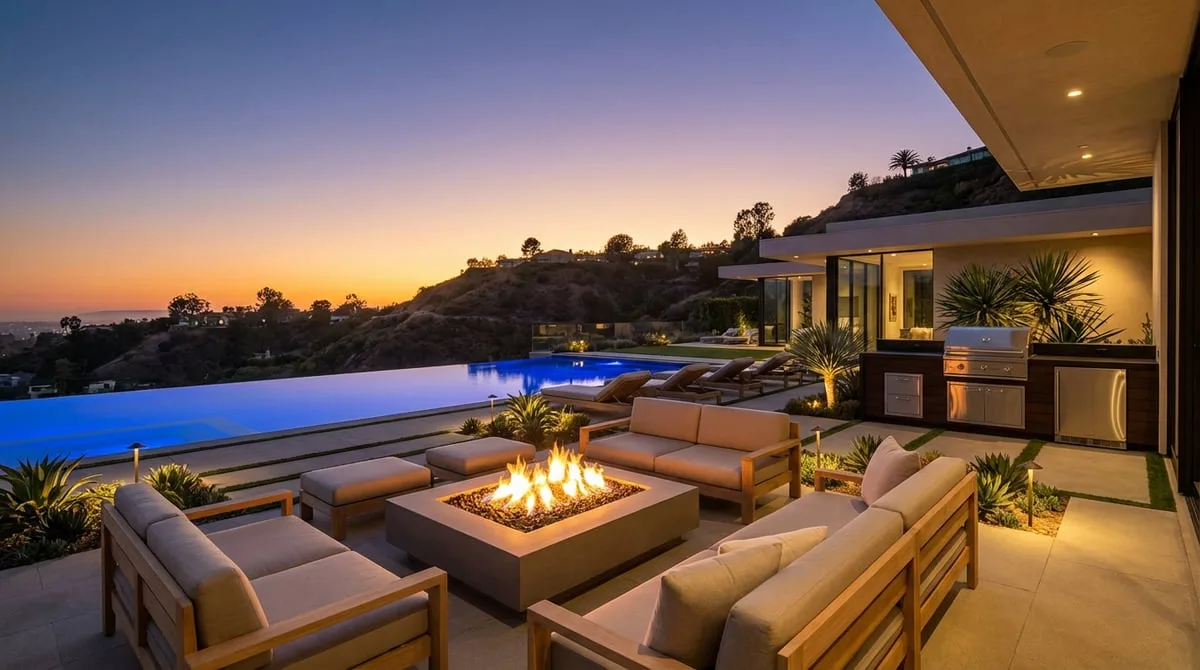
Del Sur sits in the northwestern corner of what San Diego’s real estate brokers call the Black Mountain corridor — the upland strip between Carmel Valley’s coastal influence and Rancho Bernardo’s older inland character, organized around the Black Mountain Open Space Preserve and the trail network that runs through it. The community was developed between 2006 and 2016 with a design intent that is distinct from the communities to its south and east: the architecture is cleaner, the material palettes are more current, and the relationship between the built environment and the open-space edge is written into the street layout rather than incidental to it. From the higher elevations, the view opens south toward Black Mountain and west toward the coastal ridge. From the trail network, you are in the preserve in less time than it takes to back out of the driveway. The outdoor rooms on most of these properties have not quite caught up to the setting they are in.
The property profile
Del Sur is a master-planned community organized around a town center and trail network, developed in phases from 2006 through approximately 2016. The architecture throughout is contemporary Mediterranean — cleaner lines, lower ornamentation, and material palettes that are more restrained than the older South County communities built under the same general vocabulary. The design language reads as the 2010s version of Mediterranean rather than the 1990s version: cooler-toned stucco, flat and low-pitch rooflines mixed in the upper phases, metal accents instead of wrought iron, a general shift toward simplicity over ornament.
Lot sizes cover a meaningful range. Townhome-scale parcels in the community’s denser sections run 4,500 square feet and below. Standard single-family lots through the core of the community average 6,000 to 8,000 square feet. The higher-elevation single-family parcels at the community’s edges — the ones that look out toward the open space or down into the canyon system — reach 10,000 to 12,000 square feet and above on the larger estate parcels. The design brief changes significantly across that range, and the projects on the estate parcels in the upper elevations are a different scope from the projects on the standard lots near the town center.
The Del Sur HOA maintains one of the more detailed ARC processes in the North County Inland corridor. The review covers material palettes, color selections, structure heights, setback compliance, and — on open-space-adjacent lots — rear-property-line conditions. The documentation for submittals is detailed and specific; the committee expects color samples referenced to the approved community palette, accurate dimensions on elevation drawings, and materials described at the product level rather than the category level. This is a community where a complete, professionally prepared submittal moves through review in normal time and an incomplete one does not.
Soil and climate
The soil profile across Del Sur shifts meaningfully from the South Bay communities. Decomposed granite and sandy loam dominate the upland areas — the opposite of expansive clay, these soils drain well under normal conditions and compact readily. That drainage performance is an asset in some respects and a liability in others. A hardscape base installed in DG without proper compaction and stabilization will settle under load because the material does not bind the way a well-prepared clay base does. DG-over-DG base preparation sounds intuitive — the soil is already granular — but it requires attention to compaction verification and, on sloped lots, to the erosion potential of a poorly stabilized surface.
The open-space-adjacent rear grades at Del Sur create a specific drainage condition: the native preserve grades often slope toward the open space, which means rear-yard grading on those lots needs to manage how water moves from the house pad to the property line and what happens when it crosses it. Directing unmanaged storm flow into the open-space corridor is not an acceptable design outcome, and it is the kind of condition that the HOA’s ARC review will identify and require resolution for before sign-off.
Del Sur’s elevation and inland position produce a climate that is notably different from the coast — hotter in summer afternoons, cooler on winter nights, with real frost potential in the low spots from December through February. Outdoor plant material, hardscape grout specifications, and fire-feature design all account for that temperature swing. Summer evenings in the upper elevations, with the coastal breeze arriving from the west after the afternoon heat breaks, are what make the outdoor-room investment at this address particularly worthwhile.
Permits and jurisdiction
Del Sur is within the City of San Diego. Building permits are handled by the City of San Diego Development Services department. The applicable categories are the same as for any City of San Diego outdoor remodel: structural permits for patio covers and pergolas above the square-footage exemption, electrical permits for lighting and kitchen circuits, gas permits for built-in appliances. Grading permits apply where the project involves grade changes above the City of San Diego’s grading-permit threshold, which on sloped open-space-adjacent lots is a real consideration.
The Del Sur HOA ARC review is the second track, separate from the city permit process. As noted, Del Sur’s ARC is one of the more detailed review bodies in the North County Inland corridor — the submittal requirements are specific, and the expectation is a professionally prepared packet on the first submission. We prepare drawings that satisfy both the city plan-check format and the HOA submittal requirements, submit both in parallel, and manage the two review calendars as a single project-management function. A well-prepared Del Sur ARC submittal on a standard residential scope typically moves in four to six weeks.
On open-space-adjacent lots, we confirm the applicable rear setback rules, any open-space-buffer conditions, and the HOA’s specific requirements for structures and planting near the preserve boundary before any design work begins. These conditions vary by parcel and by position within the community, and they are design inputs rather than permit-phase discoveries.
Design character
The contemporary Mediterranean architecture of Del Sur rewards materials that are cleaner and more current in their application than the older South County communities. Large-format concrete or natural stone pavers with minimal joint, plaster-finished masonry in a cool-to-warm neutral range, powder-coated steel overhead elements or clean cedar-and-steel pergola structures, and a planting palette that has the regional character of the Black Mountain corridor — olive, manzanita, native grass, Bougainvillea used sparingly as accent — rather than the lush tropical palettes that read correctly closer to the coast.
The open-space-adjacent lots in Del Sur carry the same design organizing principle that the canyon-rim lots in Tierrasanta carry: the view and the natural edge beyond the property line are the design’s reference point. An outdoor room that turns its back on the open space loses the best thing the lot offers. The ones that face it — seating program oriented toward the preserve, fire feature positioned so the evening use looks south toward Black Mountain, overhead structure at a height that frames rather than blocks the sightline — read as intentional architecture rather than a patio that happened to be placed in a large backyard.
Interior Del Sur lots, without open-space adjacency, are a different brief: a well-proportioned outdoor room that coheres with the contemporary Mediterranean house, built on a lot that has enough room to be generous without requiring the spatial discipline of a canyon-edge parcel. These lots have the full outdoor-kitchen, pergola, and fire-feature program available to them, and the ARC’s material requirements are a design constraint that, followed well, produces consistently good results.
The Del Sur estate parcels in the upper elevations — the 10,000-to-12,000-plus square-foot lots with views and open-space adjacency — are the address’s highest-expression outdoor-living opportunity. The scope on those properties is typically a coordinated full program: a primary outdoor living room, a secondary seating or pool zone, a kitchen, a fire feature, a shade structure, and a lighting plan that makes the property usable from blue hour through midnight. This is the brief that rewards the most design investment and produces the most consequential outcomes.
Where SDLR fits
Del Sur’s ARC process is the variable that most affects the project schedule and the design preparation requirements. We approach it as a professional obligation rather than a bureaucratic obstacle: the submittal is complete on the first submission, the material samples are physical and referenced to the community palette, the elevation drawings are dimensioned and in context with the house and adjacent fencing, and the color specifications are specific enough to leave the committee nothing to clarify. That preparation is what moves a four-to-six-week review in four to six weeks rather than eight or ten.
The DG-and-sandy-loam soil profile is familiar territory for our Field Lead — it requires different base-preparation attention from clay soils, not less. Compaction verification, surface stabilization on slopes, and base specifications appropriate to the DG subgrade are handled as standard practice rather than as project-specific customization.
On open-space-adjacent estate parcels, the design process begins with the site and the view rather than with a service catalog. We walk the property, read the grade toward the preserve, identify the sightlines that the outdoor room should capture and the ones that the structure should not interrupt, and design from that read. The program follows the place, not the other way around.
Either Gio or Mike is on every Del Sur project personally. The 10-Month Walk-Through is standard — returning after one season to walk the DG-substrate hardscape and the open-space-adjacent grade work on a North County Inland property where the climate swing from summer to winter is real is the honest way to stand behind the work.
For context on the surrounding North County Inland communities, the 4S Ranch page covers the adjacent master-planned community in detail. Rancho Bernardo and Poway cover the broader North County Inland property profile to the east and southeast.
The outdoor services we bring to Del Sur
Del Sur projects range from a focused outdoor-room renovation on a standard town-center lot to a full estate-scale program on an upper-elevation parcel with open-space adjacency. Most reach the scope of a full backyard remodel — a single coordinated program rather than a sequence of unrelated additions. Within that scope or as defined standalone work, we build outdoor kitchens, patios and hardscape, fire pits and fireplaces, pergolas and shade structures, retaining walls, artificial turf, landscape lighting, pool decks, and drainage and grading. On the open-space-adjacent lots, drainage and grading are part of almost every scope — managing the rear-grade condition responsibly is a condition of the ARC approval and the right thing for the preserve corridor.
Frequently asked
How detailed is the Del Sur ARC submittal process?
More detailed than most North County Inland HOA processes. The Del Sur ARC expects a complete submittal packet on the first submission: a site plan with accurate dimensions and setbacks, elevations to scale showing the project in context with the house and adjacent fence lines, physical material samples referenced to the community-approved palette, and color specifications at the product level rather than the color-family level. Projects with open-space adjacency or rear-property-line conditions require additional documentation addressing those conditions. We prepare the submittal packet as a standard part of the project scope — the fee for design and permit preparation reflects the level of documentation the Del Sur process requires.
What is the base-preparation process on DG soil?
Decomposed granite requires compaction verification rather than just compaction. DG will compact under a plate compactor or roller, but the result needs to be tested — either with a proof-roll or with a penetration test — before the base aggregate is placed above it. If the DG is loose or inconsistent, additional stabilization is required before the base course is placed. The base aggregate itself is specified to the hardscape material above: paver installations require a minimum base depth and setting-bed specification; concrete pours require a different base depth and often reinforcement details that account for the DG’s tendency to settle under thermal load. None of these are extraordinary requirements — they are the standard for a correctly built hardscape on a DG substrate.
Can I build a pool and a deck on a Del Sur estate lot?
Yes, and the larger upper-elevation lots in Del Sur have sufficient footprint for a pool, a deck, an outdoor kitchen, and a shade structure as a coordinated program. Pool construction is typically performed by a licensed pool contractor working in sequence with our hardscape scope — the deck is designed to meet the finished pool coping and the pool contractor’s finished elevations, not to be coordinated post-installation. We plan the sequence in the project schedule from the beginning so the two scopes work from the same set of finished dimensions.
What happens if my property backs directly to the Black Mountain Open Space?
The HOA ARC will review the rear-property-line conditions carefully. Structures, retaining walls, and hardscape within a certain setback of the property line require specific documentation, and any planting or grade change that could affect water flow into the preserve corridor is a review item. The city’s grading-permit review may also apply depending on the scope and proximity to the open-space boundary. We confirm the applicable setbacks and review requirements for your specific parcel before any design work begins, so the program is accurate from the first sketch rather than revised after an ARC comment or a permit rejection.
References available on request
We do not publish client testimonials. When a project is complete, we invite future clients to speak directly with the homeowners who have lived in the finished work. During discovery in Del Sur, we are glad to walk you past completed projects in person — on standard lots and on open-space-adjacent estate parcels — so you can evaluate the quality and the scope as they live in real conditions.
When you are ready
If your Del Sur property is ready for an outdoor room that meets the setting it is in — the open space, the view, the contemporary architecture — we would like to hear about it. A first conversation is thirty minutes, by phone or on the yard, and there is no cost to begin.
Licensed and insured general contractor, operating under Mike’s Class B license — CSLB #1139785. Verify any California contractor’s active standing through the CSLB license lookup.