
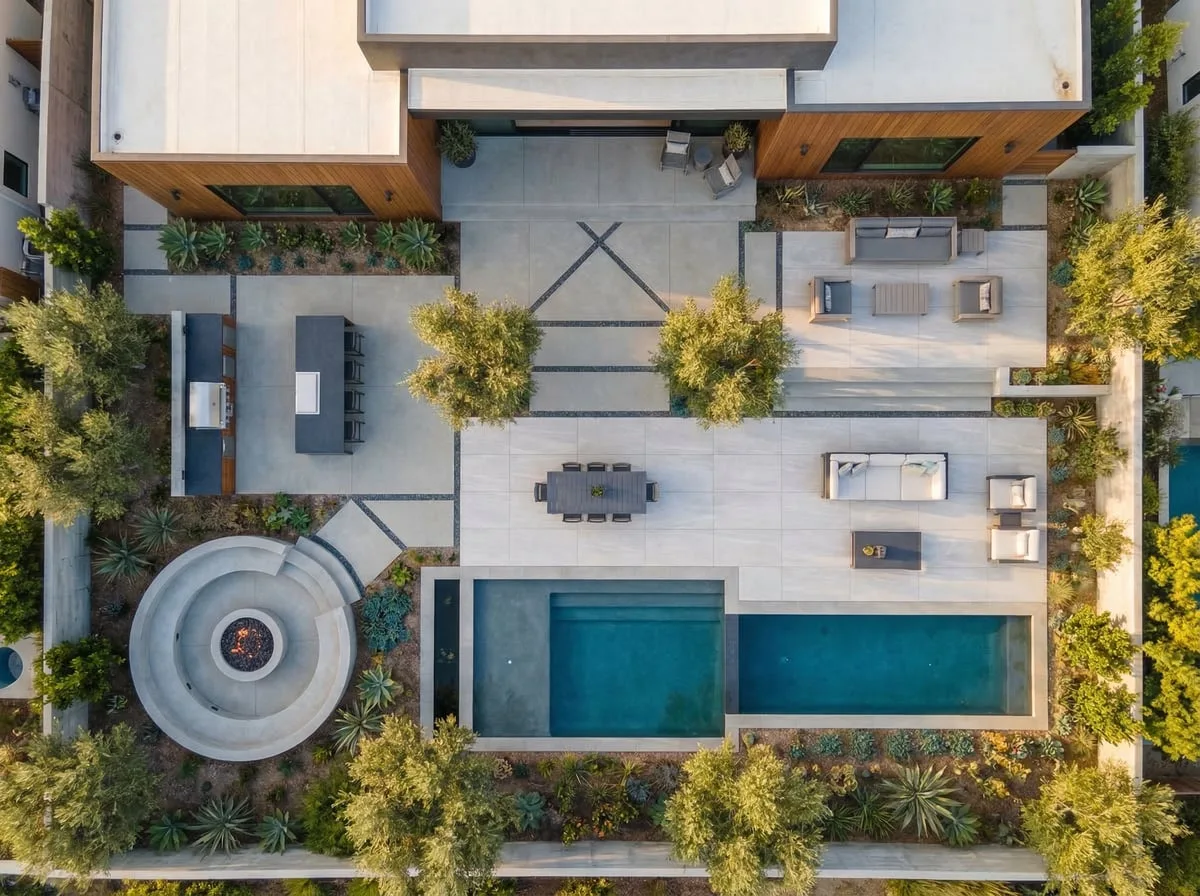
San Miguel Ranch has a particular quality of stillness at the northern edge, where the streets end at the open-space boundary and there is nothing beyond the fence line but the mountain and the trail that curves up toward it. The community was drawn with that adjacency in mind — organized around a town center and a trail network that connects back to the open space preserve, with the residential fabric arranged so that a meaningful number of homes sit against the wilderness edge rather than against another row of houses. On those backing-open-space lots, the rear elevation looks out at native scrub, cactus wren habitat, and a mountain profile that does not change. What the builder gave those lots was a concrete pad and an HOA fence. What they warrant is something more considered.
The property profile
San Miguel Ranch was developed between 2000 and 2010 on the northern flank of Chula Vista, below the San Miguel Mountain Open Space Preserve. The community is more compact in its total footprint than Otay Ranch to the south, but the character is similarly curated — consistent architectural language, strong HOA governance, and a streetscape that has been maintained with a coherent intent. The housing stock is predominantly Spanish Mediterranean and transitional contemporary, and the two vocabularies coexist more gracefully here than they sometimes do in master-planned communities because the later phases were designed with the earlier ones in view.
Lot sizes average 6,000 to 9,000 square feet through most of the community, with backing-open-space parcels running larger when the rear property line falls against the preserve boundary rather than another lot line. Those larger lots carry a different design challenge: more usable area, yes, but also the responsibility to design a rear yard that responds to the open-space edge rather than ignoring it or simply fencing it off.
The HOA is active and the Architectural Review Committee process is consistent. Every visible exterior modification — structures, hardscape materials visible from common areas, lighting schemes, wall heights, finish palettes — requires ARC review before work begins. The submittal package follows the standard format: site plan, elevations, material samples keyed to the community palette, and color specifications. Review to approval on a complete submittal typically runs four to six weeks.
Soil and climate
The soil profile at San Miguel Ranch is a combination of the clay-dominant substrate common across Chula Vista’s eastern hills and, near the mountain interface at the northern edge of the community, a rocky substrate layer that sits closer to the surface than it does in the graded interior lots. The clay fraction behaves as it does across Otay Ranch and the broader South Bay: expansive in wet season, hard-packed and cracked in summer, and unforgiving of base preparation that was done quickly or undersized.
The rocky substrate near the open-space edge introduces a different variable. Excavation into rocky ground costs more time and sometimes requires different equipment; the base preparation sequence changes when the subgrade is not consistent clay loam but instead a mix of clay and cobble-sized rock fragments from the mountain face. Neither scenario is unworkable — they are just different from the interior lots, and a base-price estimate built for one will surprise you when it encounters the other.
The backing-open-space lots at the northern and western edges of San Miguel Ranch sometimes carry native plant buffer requirements along the rear property line, particularly where the parcel boundary falls inside a wildlife corridor management zone. These requirements — typically a strip of native or low-water plantings maintained in a defined condition — are not a design obstacle, but they are a real boundary condition that shapes the layout of the outdoor room and should be understood before drawings are prepared.
The climate is mild and coastal-influenced, cooler than Otay Ranch’s eastern ridges in summer because the mountain open space to the north reduces reflected heat. Evening outdoor use from spring through October is comfortable on most lots.
Permits and jurisdiction
San Miguel Ranch is within the City of Chula Vista. Building permits run through the City of Chula Vista Development Services department, covering structural work for patio covers and pergolas above the applicable square-footage exemptions, electrical permits for lighting and kitchen circuits, gas permits for built-in appliances, and any grading work that meets the city’s grading-permit threshold. On backing-open-space parcels, a project that proposes grading, retaining, or significant hardscape within a setback of the rear property line may involve additional review related to the open-space adjacency — both from the city and from the HOA.
The HOA ARC review is the second track. It runs on its own calendar and is distinct from the city permit process. We prepare drawings that satisfy both review bodies simultaneously and run the two in parallel so the project is not waiting on one while the other completes. On parcels with open-space adjacency, we confirm the applicable rear-setback rules and native-buffer requirements before the design phase begins, so the plan is correct from the first draft.
Design character
The architectural vocabulary of San Miguel Ranch — Spanish Mediterranean and transitional contemporary — calls for materials that have warmth and specificity without ornament for its own sake. Limestone or travertine patios with close-set grout joints. Plaster-finished masonry structures in a color keyed to the house. Cedar or Douglas fir overhead elements stained to the mid-warm range the ARC will approve. Stone-faced retaining and seating walls that read as part of the same material family as the house foundation rather than arriving from a different design vocabulary.
On the backing-open-space lots, the design conversation has a second register that interior lots do not: the relationship between the built outdoor room and the open space beyond the fence. The most successful yards on those lots are designed so the outdoor room transitions rather than stops at the property boundary — a planting edge that carries native character into the manicured space, a view corridor from the patio toward the mountain that is left uninterrupted rather than fenced and planted over, a lighting plan that does not create a light-spill problem at the open-space edge. These are not restrictions on design quality; they are the specific conditions that give these lots their character, and a yard designed in response to them reads as intentional rather than generic.
Interior lots in San Miguel Ranch read best when the design focuses on enclosure, privacy, and the quality of the outdoor room itself — scaled correctly to the lot, anchored to the rear elevation, detailed with materials that match the house’s register.
Where SDLR fits
The open-space adjacency makes San Miguel Ranch a community where the early design conversation matters more than average. Knowing which parcels are in the wildlife corridor buffer zone, which require native planting along the rear line, and which have HOA setback rules that differ from the standard lot — that knowledge comes from reading the recorded documents for the specific parcel, not from a general familiarity with the zip code. We do that reading before the first drawing is made.
The ARC process is managed as part of the project scope. Our submittals are prepared to the committee’s standards, run through revision cycles without treating them as delays, and tracked on the same calendar as the Chula Vista permit plan-check. When both tracks sign off, the crew breaks ground.
Our Field Lead’s 25-plus years of high-end outdoor work includes properties with open-space adjacency, rocky substrate grading, and the kind of transition design that open-space-edge lots call for. Either Gio or Mike is personally on every project from first conversation to the 10-Month Walk-Through — the return visit ten months after completion, when one wet season has tested the base preparation and the drainage design and we address anything that needs attention at no charge.
The Otay Ranch page covers the adjacent master-planned community in detail; the soil and HOA dynamics are closely related. Clients with East County property comparisons will find the Rancho San Diego page useful for unincorporated parcel context.
The outdoor services we bring to San Miguel Ranch
Most San Miguel Ranch projects are approached as a full backyard remodel — a single plan, a single crew, a coordinated program rather than fragmented trades. Within that scope or as standalone work on the right property, we build outdoor kitchens, patios and hardscape, fire pits and fireplaces, pergolas and shade structures, retaining walls, artificial turf, landscape lighting, pool decks, and drainage and grading. On the rocky-substrate lots near the mountain edge, drainage and grading are often the conversation that precedes everything else — the site conditions require it.
Frequently asked
My lot backs up to the San Miguel Mountain Open Space. Are there restrictions on what I can build?
There can be, and they vary by parcel. Some backing-open-space lots in San Miguel Ranch carry a native-plant buffer requirement along the rear property line — a defined strip where the planting palette must meet certain native or low-water criteria. Others have HOA setback rules that widen at the rear property line for open-space adjacency. The city permit process may also involve additional review if the project proposes grading or structural work within a certain distance of the open-space boundary. We confirm the applicable rules for your specific parcel at the start of the engagement so the design is accurate from the first sketch.
What is the soil like near the northern edge of the community?
Closer to the mountain interface, the soil profile shifts from the clay loam of the interior lots to a mix of clay and rocky substrate — cobble and decomposed granite fragments from the mountain face that sit shallower than they do on the graded lots. Excavation in this substrate takes longer and requires different equipment in places. The base preparation specification also changes when the subgrade is inconsistent. Neither condition prevents a quality build; they are just real variables that need to be understood before a proposal is priced. We assess the subgrade conditions on every San Miguel Ranch site walk before the proposal is written.
How does the ARC handle fire features near the open-space edge?
With scrutiny, and rightly so. Fire features on lots adjacent to the open space preserve require compliance with Cal Fire’s defensible-space guidelines as well as the HOA’s material and placement requirements. The setback from the rear property line, the material specification of the fire feature itself, and the clearance to any combustible overhead element are all review items. We design fire features on open-space-adjacent lots to meet those requirements from the first drawing, so the ARC review confirms compliance rather than requiring a redesign.
Can I build a pool deck on a San Miguel Ranch lot?
Yes, and most of the San Miguel Ranch lots have enough footprint to accommodate a pool deck program alongside an outdoor kitchen and hardscape. Where a pool already exists, the deck remodel coordinates with the existing pool structure, coping, and drainage. Where a pool is proposed alongside the deck, the pool contractor and our scope run in a coordinated sequence rather than independently — the deck is designed to meet the pool as it will be finished, not to work around it. We coordinate that sequence in the project plan from the start.
References available on request
We do not publish client testimonials. When a project is complete, we invite future clients to speak directly with the homeowners who have lived in the finished work. During discovery in San Miguel Ranch, we are glad to walk you past completed projects in person — including on properties with open-space adjacency — so you can see how the outdoor room and its setting work together in real conditions.
When you are ready
If your San Miguel Ranch property is ready for an outdoor room designed for where it actually sits — the lot, the setting, the mountain edge — we would like to hear about it. A first conversation is thirty minutes, by phone or on the yard, and there is no cost to begin.
Licensed and insured general contractor, operating under Mike’s Class B license — CSLB #1139785. Verify any California contractor’s active standing through the CSLB license lookup.