
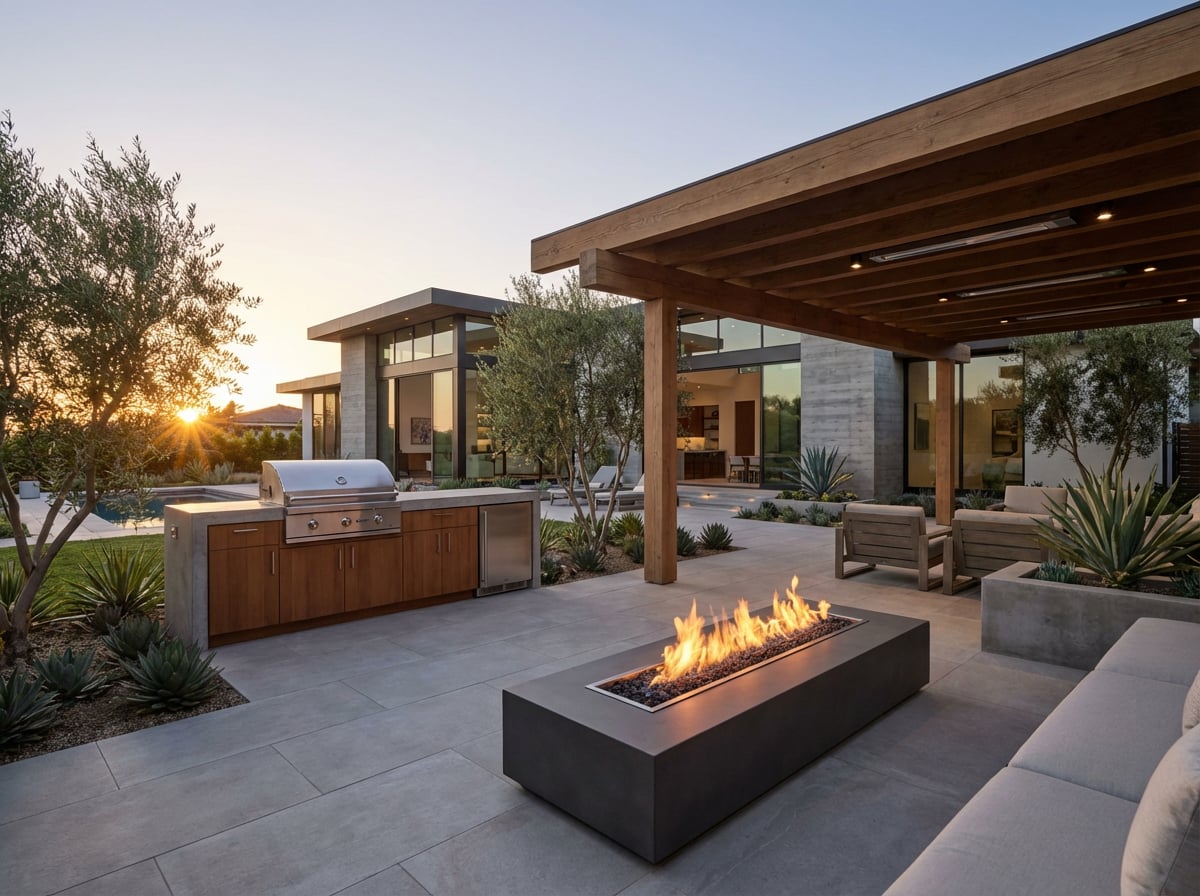
A country feel, ten minutes from the freeway
Drive Jamacha Road at six in the evening in late October and Rancho San Diego does something San Diego does not often let you do — it gets quiet. The light falls sideways off Cottonwood Golf Course in that particular dusk color East County keeps for itself. Coyotes start in the canyons behind Singing Hills. A horse trailer idles at a four-way on its way home from the trail. Ten minutes west, the 94 is moving at freeway speed; here, the pace belongs to the land.
The yards reflect it. A Rancho San Diego yard is lived-in in a way a coastal yard rarely is — half an acre, sometimes two, stretched behind the house with real grade, real sightlines, a real horizon where the canyon falls off. Kids grew up on these lots and came back to raise their own. Dogs actually run. A pasture may still be a pasture. The oak at the far corner has been there longer than the house.
What a yard in Rancho San Diego is being asked to do is different from what a yard in Del Mar is being asked to do. It is not a composition framed by a hedge and a neighbor’s wall. It is a piece of ground with weather moving across it — the afternoon wind off the canyon, the winter rain funneling toward Sweetwater, the September heat that sits in the dry grass. The work of remodeling it is first the work of understanding it.
By design, not by dispatch. That sentence was written for country lots.
The property profile
Parcels here run from half an acre to two-plus acres across most of the area, with pockets of smaller subdivision infill and a handful of estate parcels that run larger. Many lots have equestrian allowances written into the zoning — riding rings, small pastures, hay storage, and trail access into the network that threads through Sweetwater Regional Park and the Jamacha corridor. A neighbor with a horse is normal. A neighbor with two horses, a chicken coop, and an orchard is also normal.
Most of Rancho San Diego sits in unincorporated San Diego County. That is the single most important fact to understand about working here. There is no city hall, no municipal design review, no blanket HOA covering the place. The one meaningful exception is Cottonwood Country Club Estates, a gated pocket wrapped around the golf course with its own architectural review committee and its own way of evaluating submittals. A small number of other subdivisions carry light CC&Rs, most of them now decades old.
The owners tend to be long-tenured. Families who bought in the nineties and raised children here. Retirees who already know what a bad drainage job looks like because they lived through one. Buyers who came from Bonita or La Mesa because they wanted more land. They already know what they want. They are vetting whether you actually know what you are doing.
The soil and the climate
Most of Rancho San Diego sits on decomposed granite with pockets of expansive clay where the canyon soils sit longer and hold water. You will find both on the same parcel. A footing detail that works forty feet from the house can be the wrong detail ten feet closer. This is not a reason to fear the soil; it is a reason to look at it carefully before drawing the first line on a plan.
The climate runs hotter and drier than coastal San Diego and cooler at night than people expect. Summer afternoons break into the nineties. Winter mornings drop into the thirties. The real planning problem is not temperature; it is runoff. A Rancho San Diego winter storm moves serious water — down hillsides, across parcels, through driveways, and eventually into the Sweetwater Reservoir watershed. Every parcel sits somewhere in that flow path. Canyon-edge lots sit at the sharp end of it.
A yard built without respect for where the water goes in February is a yard that begins failing in March. Correct grading, correctly placed drains, and a subsurface detail that accounts for expansive pockets are the quiet work that keeps the finished hardscape looking finished ten years out.
Permits and jurisdiction
Because the area is unincorporated, nearly all permit work runs through the County of San Diego rather than a city planning department. The reviewing body is San Diego County Planning & Development Services. They handle building permits, grading permits, septic and well reviews where applicable, setback variances, and the fire-safety overlays that apply to canyon-adjacent parcels.
Grading permits are the trigger to watch. The county sets thresholds based on cubic yards of earth moved, cut-or-fill height, and slope — any serious hillside work, any retaining wall above a defined height, and any drainage redirection on a sloped parcel is likely to require one. Plan check on a grading permit is not a formality; the county reads the drainage calculations. Coastal-style overlays do not apply out here, but hillside-overlay and fire-hazard-severity considerations do.
Inside Cottonwood Country Club Estates, the architectural review committee reviews exterior changes in addition to county permitting. Submittals are expected to show material selections, structure elevations, and landscape intent. Outside that pocket, most Rancho San Diego homeowners deal only with the county. We prepare the drawings, submit, respond to plan-check comments, and schedule inspections. You sign. We do the walking.
Design character
Rancho San Diego is not one architectural style; it is three, and they coexist on the same street. The dominant note is California Ranch — low, wide, single-story homes with long roof lines and a generous relationship to the ground. Alongside that, a steady presence of Spanish Colonial and Mission-style houses with tile roofs and stucco mass. And a growing share of transitional modern remodels where owners have taken a ranch shell and opened it up to the yard with larger glass, cleaner rooflines, and quieter material palettes.
Each asks for something different outside. The ranch house wants horizontality — long paver runs, low retaining lines, a pergola that reads as shelter rather than as architecture, shade trees that pick up the roof plane. The Spanish house wants warmer stone, cast concrete with a hand-finish, terracotta and honed limestone, wrought-iron lanterns over the outdoor kitchen. The transitional remodel wants fewer materials doing more work — larger-format pavers, COR-TEN steel edges, one clean structure rather than three competing ones.
Horse properties add one more layer: restraint. On a parcel where a barn and a riding ring are part of the view, the outdoor living area has to hold its own without competing. Quieter palettes, longer sightlines, fewer ornaments. The yard sits inside the property rather than trying to be the property.
Large lots in general ask for quieter design. Noise reads differently at forty feet than at fifteen. The best Rancho San Diego yards we have seen are the ones that let the land do most of the talking.
Where San Diego Landscape Remodeling fits
We are a founder-run design-build firm working across San Diego County, and Rancho San Diego is home-field East County for us — a short run from our La Mesa office and the same soil our Field Lead has been building on for more than twenty-five years.
What that actually means on a Rancho San Diego project is this. We know the difference between the decomposed granite on one side of a parcel and the expansive clay pocket on the other, and we detail the build accordingly. We know the San Diego County Planning & Development Services permit office well enough to anticipate what plan check is going to flag before we submit. We know how winter storm water actually moves on canyon-edge lots because we have watched it, and we build the drainage before we build the hardscape.
Every project runs with Direct-Founder Access. Gio or Mike is personally on your project from the first conversation through the final walk. Our Field Lead — twenty-five-plus years on high-end outdoor work — runs the day-to-day on the ground. One crew builds the whole project, first cut to final clean.
And ten months after completion, we come back. We call it the 10-Month Walk-Through. On a Rancho San Diego lot, that return visit lands after the yard has seen a full winter — which is the only real test of the drainage and grading work, and which is exactly why we wrote the program the way we did.
Services we build in Rancho San Diego
Every service below is available under a single coordinated scope. Most Rancho San Diego projects use several of them.
- Full backyard remodels
- Outdoor kitchens and BBQ islands
- Patios and hardscape design
- Fire pits and fireplaces
- Pergolas and shade structures
- Retaining walls and seating walls
- Artificial turf installation
- Landscape lighting
- Pool decks and poolside hardscape
- Drainage and grading
Neighboring East and South County work: Mount Helix, Bonita, and El Cajon.
Frequently asked
We have horses on the property. Does that change how you plan the outdoor living area?
Yes, in the good sense. An equestrian parcel asks for a clear separation between the living area and the working area of the property — sightlines, dust, fly traffic, and noise all matter. We plan the outdoor living zone with that separation in mind, and we coordinate drainage so the living area is not sitting downstream of the paddock. Material choices lean quieter so the built work complements the barn and the pasture rather than competing with them.
When does a project in Rancho San Diego need a grading permit from the county?
The county triggers a grading permit based on cubic yards of earth moved, the height of any cut-or-fill slope, and any work that redirects surface drainage on a sloped parcel. Retaining walls above a defined height and most hillside work land on the permit side of that line. We evaluate this on the site visit and tell you straight whether your scope crosses the threshold. If it does, we prepare the grading plan, submit to San Diego County Planning & Development Services, and manage plan check through inspection.
Our lot sits on a canyon edge. What do we need to get right about drainage?
The drainage is the whole game. Canyon-edge lots sit in the active flow path of winter storm water on its way toward the Sweetwater Reservoir watershed. The mistakes we see on these properties are almost always the same: surface drains sized for a gentle year instead of a wet one, subsurface details that do not account for the expansive-clay pockets, and hardscape poured before the grading was corrected. We address the water first and build the patio on top of a site that already works.
How is working across the unincorporated county different from working inside an HOA?
Most of Rancho San Diego is unincorporated San Diego County, which means the reviewing body is the county rather than a city planning department and there is no blanket HOA covering design choices. The trade-off is that permits go through San Diego County PDS, plan check can be more rigorous on grading and hillside work, and fire-hazard overlays apply on canyon-adjacent parcels. Fewer design constraints. More technical review. We handle both.
We live inside Cottonwood Country Club Estates. How does that change the process?
Cottonwood is the one meaningful HOA pocket in Rancho San Diego, and the architectural review committee reviews exterior changes in addition to county permitting. In practice, that means our submittal package includes material selections, structure elevations, and a landscape intent sheet formatted for Cottonwood’s ARC in addition to the plan set we submit to the county. We build the committee review into the schedule up front so it is not a surprise on the back end.
Our property is flagged in a fire-hazard zone. How do you handle defensible space?
Canyon-adjacent lots across East County fall inside moderate-to-high fire-hazard severity zones, and the state sets defensible-space expectations for those parcels under the guidelines maintained by Cal Fire’s Ready for Wildfire program. We design planting, structure placement, and material choices with those zones in mind — noncombustible hardscape at the structure edge, species selection and spacing that respect the ember zone, and hardened detailing on pergolas and overhead structures where the code points that direction.
You work across the whole county. Why should we trust that East County is actually a home field for you?
Because our La Mesa office is ten minutes from most Rancho San Diego addresses, our Field Lead has been building on this soil for more than twenty-five years, and East and South County projects are the shortest drives on our board. Rancho San Diego, Bonita, Mount Helix, La Mesa, and El Cajon are operationally our home market. The work does not suffer because a crew drove forty-five minutes to reach it.
Can we verify your license?
Yes. We operate under Mike’s Class B general contractor license, and you can verify active standing at any time through the CSLB license lookup. License number is on our proposals and available on request.
References available on request
We do not publish client testimonials. During discovery, we are glad to walk you past completed projects in person and, where the homeowner is willing, introduce you directly so you can ask the questions that matter most to you. It is the old-fashioned way to vet a builder, and on work at this level, it is still the best.
When you are ready
If you own a property in Rancho San Diego and the timeline is serious, we would like to hear about it. A first conversation is thirty minutes — by phone, or on your yard — and there is no cost to begin. We will listen, we will tell you what we see on the ground, and we will tell you honestly whether we are the right firm for the work.
Licensed and insured general contractor, operating under Mike’s Class B license — CSLB #1139785.