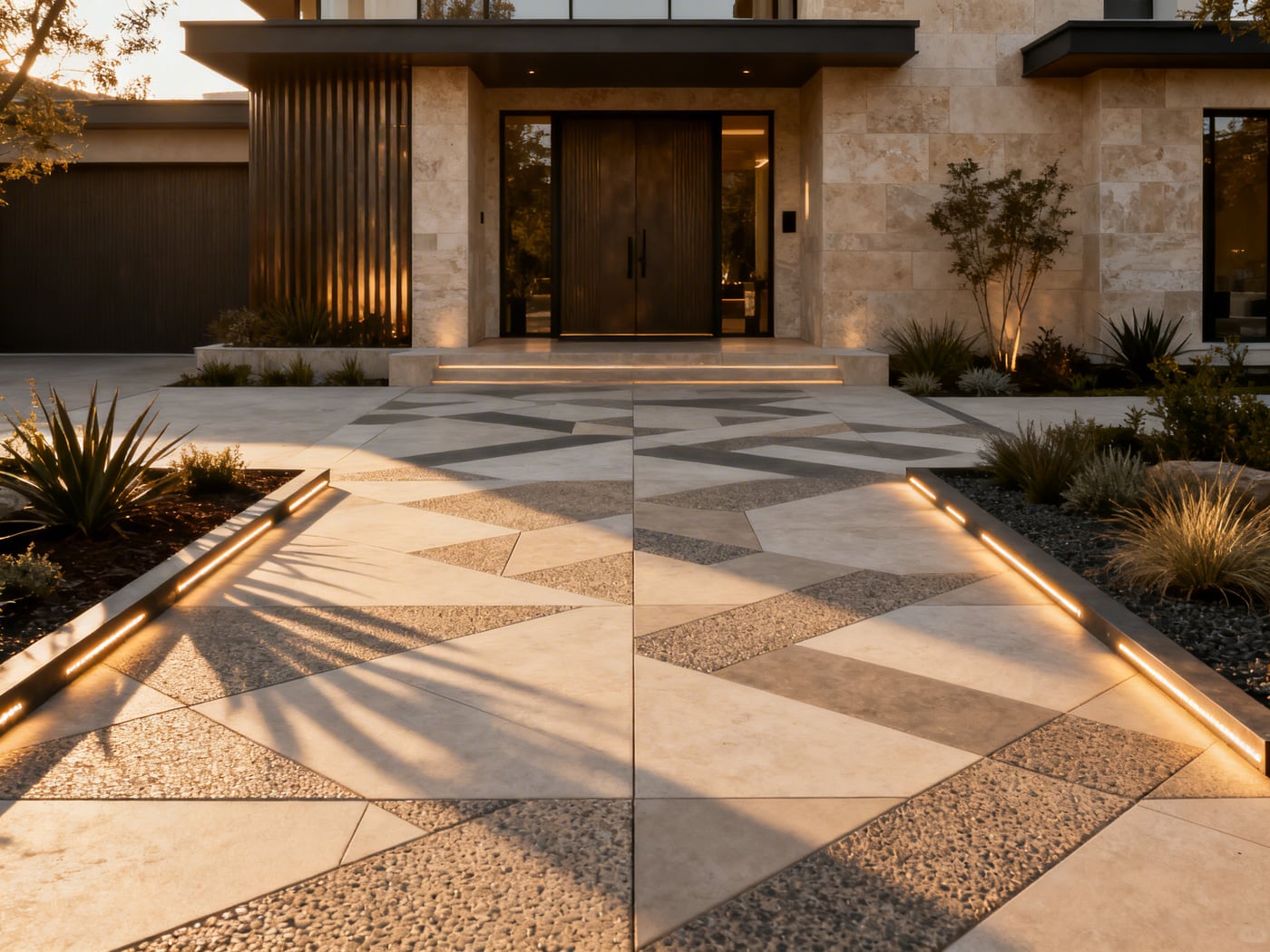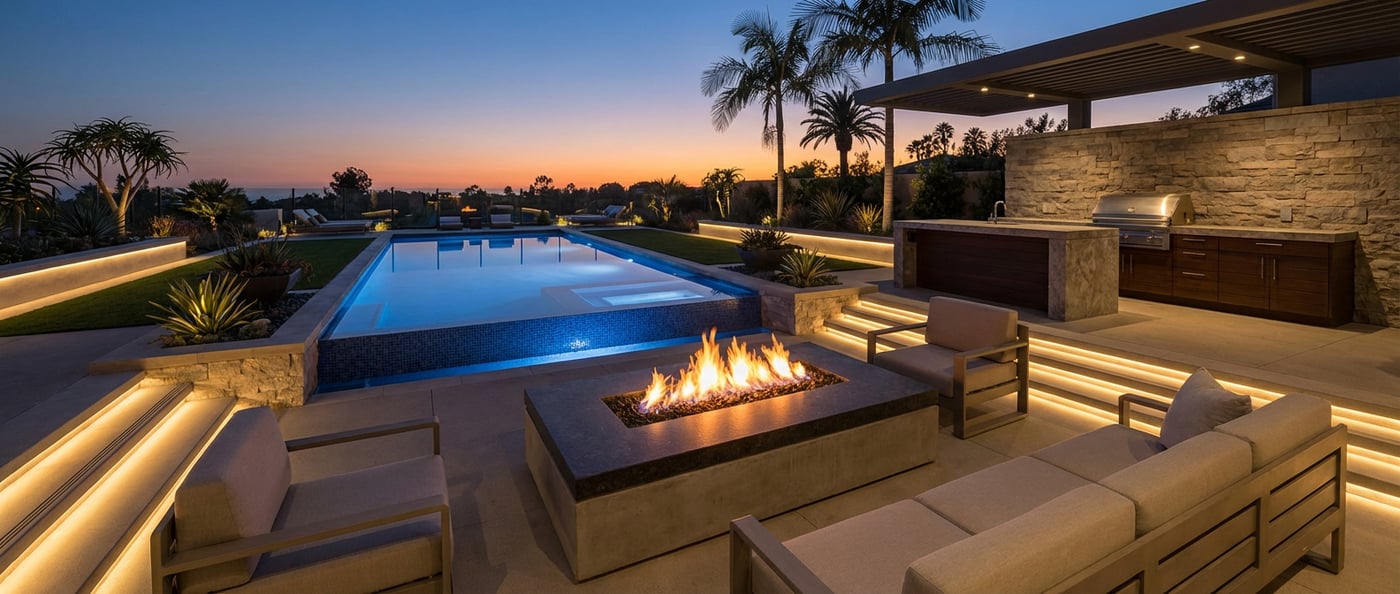
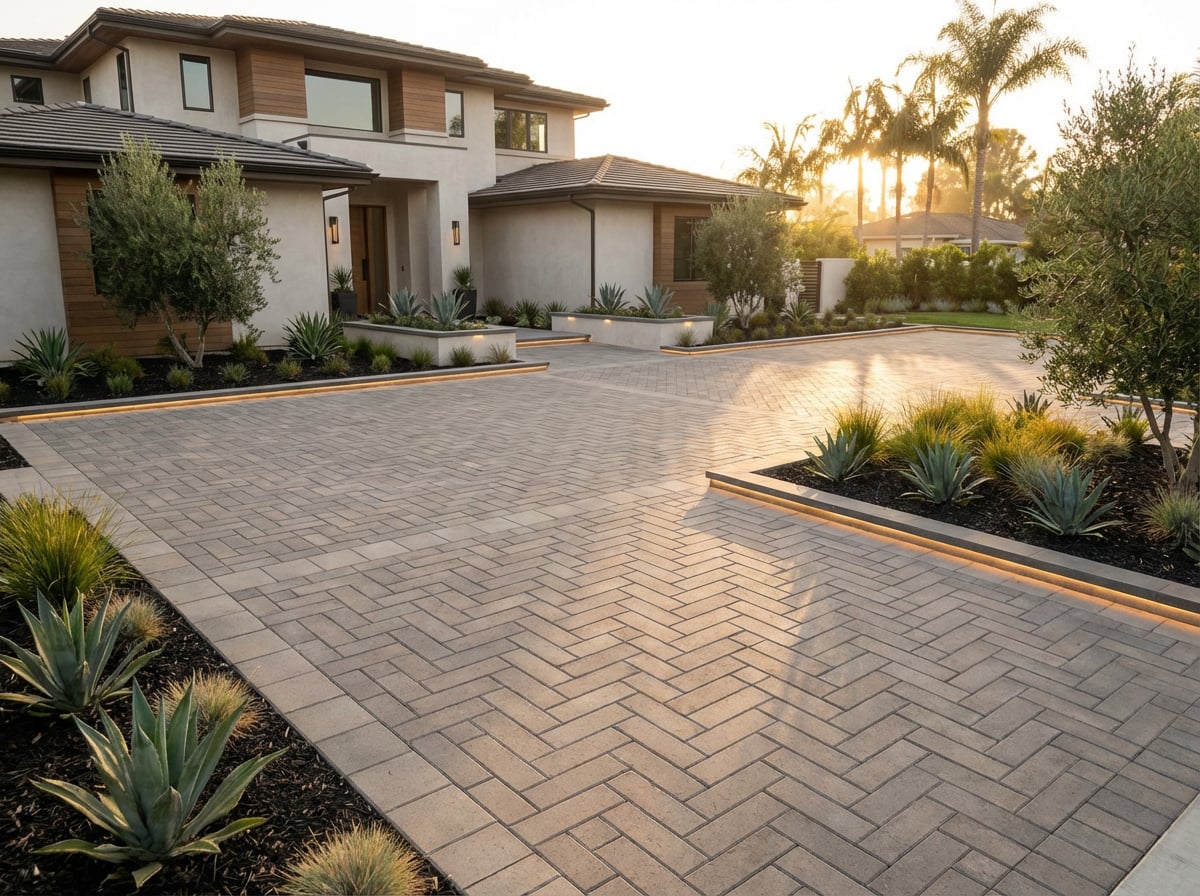
The pavers vs. concrete question comes up on almost every patio project we consult on. Both materials work well in San Diego’s climate. Neither is automatically the right answer. The choice depends on your budget, your aesthetic, and how the space will be used — and there are a few things about each option that most contractors undersell or skip entirely.
How San Diego’s Climate Affects the Choice
San Diego has one of the more forgiving climates for outdoor hardscape in the country. Freeze-thaw cycles — the primary reason concrete cracks in northern climates — are essentially absent here. That removes one of concrete’s biggest disadvantages.
What you do have in San Diego:
UV exposure. The sun here is intense. Poured concrete will gray and fade over time unless sealed regularly. Pavers hold color longer, and individual units can be replaced if they fade unevenly.
Coastal salt air. For properties within a mile or two of the coast, salt air accelerates surface degradation on some concrete finishes. Sealed concrete and quality pavers both handle this acceptably, but the sealing schedule matters.
Clay soil. A significant portion of San Diego County sits on expansive clay soils — soils that swell when wet and contract when dry. This is the primary driver of cracking in both poured concrete and poorly installed pavers. Proper base preparation is more important than which surface material you choose.
Poured Concrete: What It Costs and What It Does Well
Cost range: Poured concrete patios typically run from $10–$20 per square foot for basic broom-finished work, and $20–$40+ per square foot for stamped or decorative finishes.
Strengths:
- Lower initial cost for a large footprint
- Smooth, seamless surface (preferred for some uses like outdoor dining)
- Many finish options: broom, exposed aggregate, stamped, colored
Honest limitations:
- Cracks. All poured concrete cracks eventually — the question is where and how much. Control joints help manage this, but they do not eliminate it.
- Repairs are visible. When a slab cracks or a section heaves, patching it matches poorly. The repair is almost always noticeable.
- Sealing is required. Unsealed concrete stains easily and degrades faster in direct sun.
Stamped concrete note: Stamped concrete can look very good when new. It requires disciplined re-sealing every one to three years, and the color in the stamped pattern fades unevenly if that schedule slips. After ten years, a well-maintained stamped patio looks good; a neglected one looks poor.
Pavers: What They Cost and What They Do Well
Cost range: Standard concrete pavers run $15–$30 per square foot installed. Travertine, porcelain, or natural stone pavers run $30–$70+ per square foot depending on material and pattern complexity.
Strengths:
- Individual units can be replaced without visible patching
- Movement is managed unit by unit — settlement often appears as a slight unevenness rather than a crack across the surface
- Higher perceived value, and typically better resale return
- Wide range of materials, colors, and patterns
Honest limitations:
- Higher initial cost than basic poured concrete
- Joints require occasional re-sanding and weed prevention
- Quality of installation matters enormously. Pavers installed on a poor base will shift, sink, and look poor within a few years. The base is as important as the paver itself.
The Installation Quality Problem
Here is the thing most people do not hear: the difference between a paver patio that looks great after ten years and one that looks like a failure after three years is almost entirely in the base preparation, not the paver itself.
A proper paver base in San Diego requires:
- Excavation to the correct depth (typically 8–12 inches below final surface)
- Compacted aggregate base at the right thickness for the expected load
- Correct slope for drainage (minimum 1–2% away from structures)
- Proper edge restraints to prevent lateral movement
- Sand setting bed at the right depth and compaction
A crew that rushes the base to move faster — or that skips steps to hit a lower bid price — is a crew that is building a problem you will find in three years. By then, the contractor is long gone.
What We Typically Recommend
For San Diego residential projects, we most often use pavers or large-format porcelain as our primary hardscape material. The reasons:
- The repairability of pavers is meaningful in the long run — individual units can be lifted and reset if utilities need access or if one piece chips.
- The visual range of pavers and stone is broader, and the aesthetic tends to hold up better over time as styles change.
- On clay soil, a well-built paver system tolerates movement better than a slab.
We use concrete where it makes sense — certain retaining applications, specific modern aesthetics, areas where a seamless surface is a functional requirement.
The right answer for your project depends on your site conditions, how you plan to use the space, and your budget. That is a conversation worth having before you get a bid from anyone.
For San Diego County permit requirements on patio and hardscape projects, the County’s PDS permit portal has jurisdiction-specific guides. For material specifications, Belgard’s product library and Techo-Bloc’s design tools are useful starting points.
Talk to us about your project. The first conversation is thirty minutes, at no cost.
Related: Full Backyard Remodels in San Diego · Patios & Hardscape · Pool Decks · Projects in La Jolla · Projects in Rancho Santa Fe · Projects in Del Mar